
Dancing House in Prague – Visitor’s Guide 2026
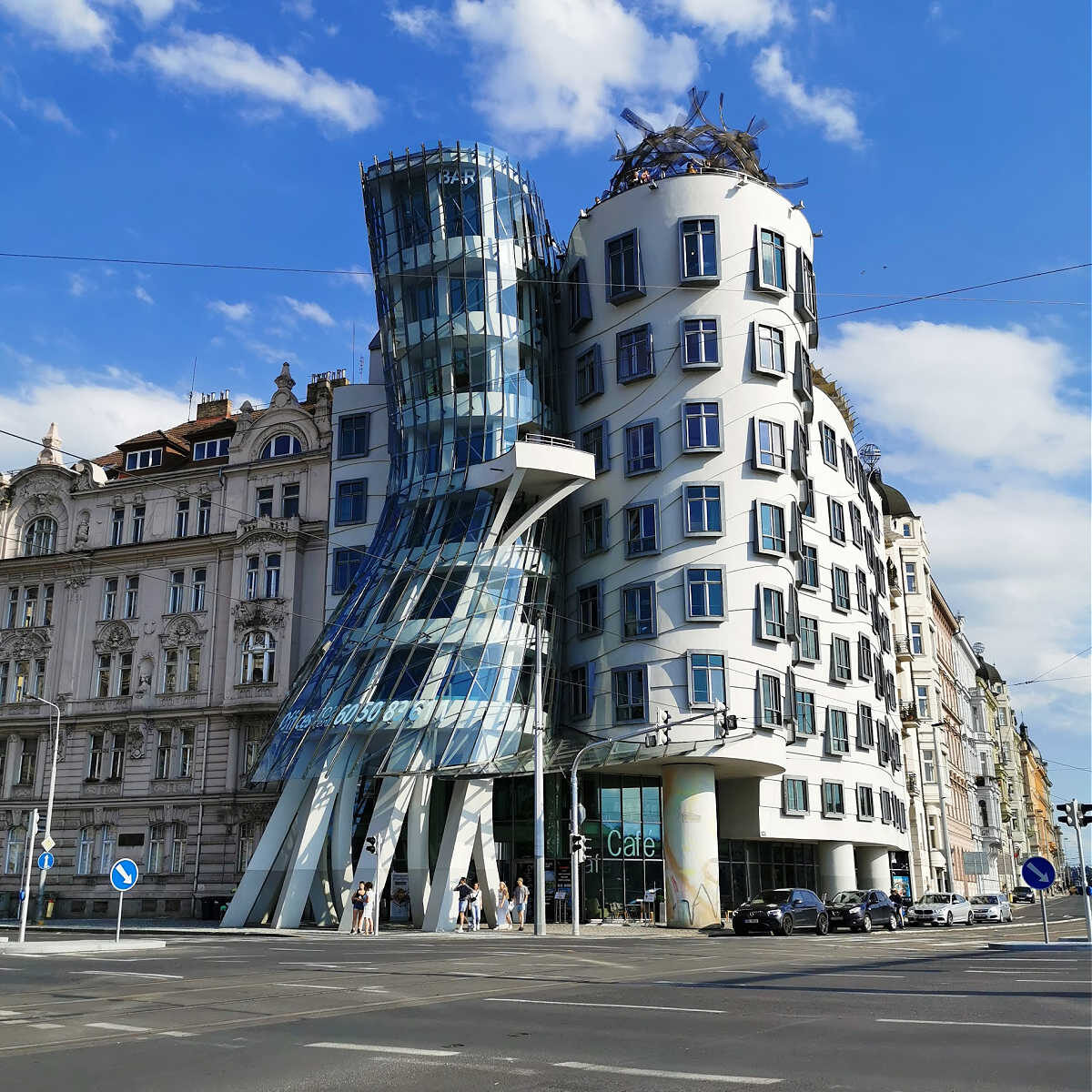
The Dancing House is a modern building from the end of 20 century which symbolises a dancing couple – Fred Astair & Ginger Rogers.
The building was won many prestigious architectural awards as well as have been a centre of controversy for being built in to a row of beautiful historic 19 century houses.
To this day, there are people who admire the building and people who don’t like the modern design standing against the traditional buildings.
If you are in Prague, why not include the Dancing House in your itinerary and you can make up your own mind!
PIN TO KEEP FOR LATER

My favourite reasons for visiting the Dancing House
- A modern building amongst the 19 century houses on the river bank (there is nothing quite like that anywhere else in Prague!)
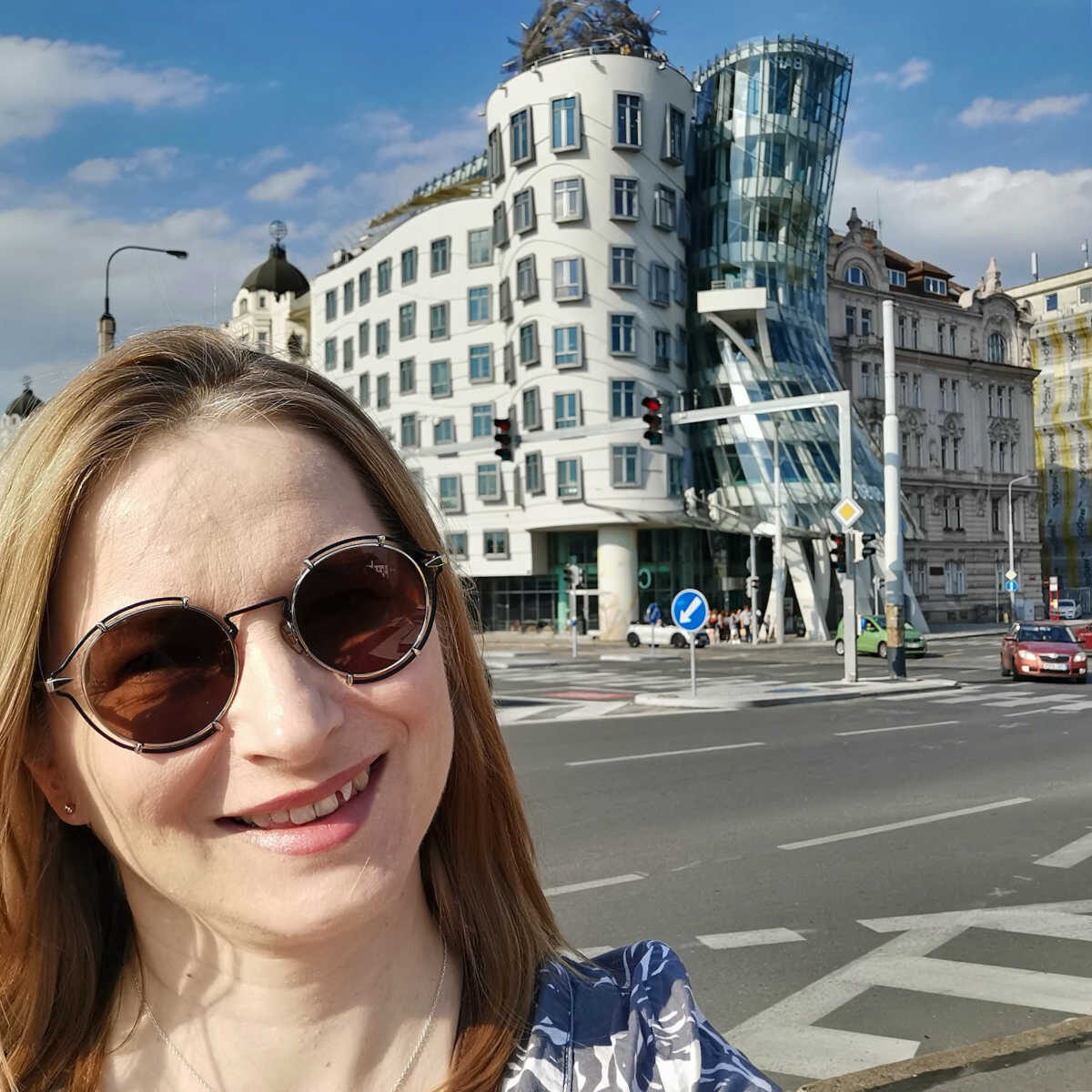
- Take a fun picture ‘kicking or pushing’ the building with your foot in the as you stand far away on the other side of the street
- Tick it off your list, but don’t worry about going in if you don’t have the time or don’t want to (you are not going to miss much…)
Entrance Fee to the top viewing gallery 2026
Things have recently changed and last time I visited in 2026, we had to pay separately for the viewing gallery (150 CZK) and for our drinks. It used to be the case of buying a drink, having a ticket to the art gallery exhibition or booking for the restaurant and you were allowed to access the viewing balcony. But unfortunately, that’s no longer possible.
Saying that we had a great time sitting on the top enjoying the views and our drinks. It’s quite a small area, but it didn’t feel to crowded, in fact it was a very pleasant experience!
The Dancing House History
This modern building was originally designed in 1992 and completed by 1996. It’s the work of a Czech-Croatian architect Vlado Milunic and Canadian-American architect Frank Gehry who designed the building and Czech-British architect Eva Jiricna has designed the interior of the building.
Sadly, the famous architect and legend of modern architecture Frank Gehry passed away in late 2025 at the age of 96.
The Dancing House building was originally named (officially or not…) Fred & Ginger, but later the name become the Dancing House, which is the one used now.
The inspiration for the name was the shape of the building, where the tall building with sort of head represents Fred Astaire and the part of the building next with wider lower part (skirt sort of tucked in the waist) represents Ginger Rogers – the dancer.
A Bit More History: From Bombs to Art
What many people don’t know is that the spot where the Dancing House stands has a very sad history. During the end of World War II in 1945, an American bomb accidentally hit the beautiful apartment building that used to stand here. For decades, the plot of land was just an empty, ugly hole in the row of houses.
It wasn’t until the late 1980s that the idea to build something new came up. Václav Havel, who was a famous dissident and later became the Czech President, actually lived in the building right next door! He wanted the empty space to become a place for culture and art, which is why he supported the project so much.
Why does the building look like that?
While we call it “Fred and Ginger,” the architects had a very specific vision for the design. The building is made of 99 concrete panels, and every single one is a different shape and size!
The “Ginger” part (the glass tower) is supported by curved pillars that make it look like she is leaning into Fred. If you look closely at the windows, you’ll notice they aren’t in a straight line.
They are slightly offset, which is supposed to give the building a sense of movement, like it’s swaying to music. This style is called Deconstructivism, which basically means it breaks the “rules” of traditional architecture.
Don’t miss the “Medusa”
When you are taking your photos from across the street, make sure to look at the very top of the “Fred” tower (the solid concrete one). You will see a strange, dome-like structure made of twisted metal mesh. This is nicknamed “The Medusa.” It adds to the height of the building and makes the rooftop look even more unique against the Prague skyline.
Fun Fact: The Dancing House on a Coin!
In 2005, the Czech National Bank issued a special gold 2,000 CZK coin featuring the Dancing House. It was part of a series called “Ten Centuries of Architecture.” Even though the building was controversial at first, the country is now very proud of it!

What to see & Do in the Dancing House
The Dancing House Art Gallery
The art gallery hosts regular exhibitions, which are usually very thought-provoking, slightly shocking or on a topic that’s often taboo. A bit different from the regular type of gallery, so if you see something you like, it’s worth a visit.
The same company that runs this art gallery is also behind the amazing Retro Museum, which was in Kotva Department Store, that’s currently being re-furbished (and the museums is looking for another space).
The gallery is open daily from 9 am – 7 pm
- Adults: 230 CZK
- Students (up to 26 years) & Seniors (over 65): 180 CZK
- Children: 150 CZK
- Prague Visitor Pass / CoolPass: If you have one of these city passes, the entry is usually free
The gallery is now run completely separately from the rest of the building, so sadly you won’t get any discount for the viewing platform or bar on the top of the building.
Restaurant
The restaurant is a fancy affair and the food on the menu does look very tempting. The prices for lunch menu start from 180 KCZ for starters and 300 – 500 KCZ for mains or you can try the 1500 KCZ tasting set menu – every day from 5 pm.
The restaurant can get quite busy, so I’d recommended to book in advance.
The Glass Bar
You don’t need any booking for the bar, which is slightly more casual dress code wise, so you can easily walk up from the street. The bar is quite small, but it does have a few tables and you do get some nice views too.
The drinks are quite pricey, expect to pay 95 KCZ for beer or speciality coffee and about 90 KCZ for soft drinks and regular coffee. Cocktails, wine and other alcohol start from 180 KCZ, which is much higher than the average prices for drinks in Prague.
Hotel
The building also has it’s own hotel rooms decorated in a modern style with views and prices to match. If you are booking your stay there, do check where your window is going to be (e.g. what views you’ll have) and bear in mind that you’ll be essentially staying above a very busy four way road and crossing.
The bar viewing balcony
The entrance to the bar viewing balcony is now completely separate and you need to buy extra ticket at the bar. I paid 150 CZK extra on top of my drinks when I visited in 2026 (and there is a person on the door checking that you have the right ticket to go through…)
The views are great, but I should mention that you’ll mainly see the Vltava River, Manes tower and Slavic Island, the Petrin Hill and the Petrin Lookout Tower and Kinsky park, Hunger Wall, the main historic Prague bridges over the river and Prague Castle in very far distance.
The centre and Charles Bridge is too far to see, so if you are after a view of the centre you’d be better off climbing up to the Old Town Square Hall Tower, Lesser Town Bridge Tower on Charles Bridge or the Gun Powder Tower closer to the historic centre.
What I think it’s great, that there are no glass partitions (just high enough railings) so you get unrestricted views – perfect for selfies and photos.
Location
Tancici Dum – The Dancing House, Rasinovo Nabrezi 80, 120 00, Praha 2
How to get to Dancing House
The closest Prague Metro Underground Station is Karlovo Namesti on line B.
There are trams 17, 3 that stop few metres away from the building. The Dancing House is closest to the ‘Jiraskovo Namesti’ stop, but you can also come back from ‘Palackeho Namesti’ stop.
Trams 22, 9 also stop at ‘Narodni Divadlo’ and you can take a slightly longer walk (about 7-8 minutes) along the river bank to see the building.
You can also cross the Jirasek Bridge from the Smichov Prague Area and take slightly different photos as you are approaching the Dancing House.

Opening Times
The restaurant and the Glass Bar is open daily until 10 pm. The viewing balcony is usually available to access during the same times, although if they have a private party booking, it might not be accessible at all.
The gallery is open daily from 9 am – 7 pm.
How long do you need for your visit
This very much depends if you want to just admire the building from outside, take a few photos or if you want to visit the bar or gallery and have a look from the top of the building.
10 minutes – to walk by and take few photos – best time for photos is probably late afternoon or evening if it’s very sunny (as the sun will be shining on the building).
1-2 hours – to visit the gallery or bar and check out the views from the top of the building
Facilities
There are no facilities unless you visit (and pay for a drink or ticket) the gallery, restaurant or the bar.

What else you can see near Dancing House
If you don’t want to visit the inside of the Dancing House or you are not that fond of modern architecture, there is still plenty to see and do around the Dancing House.
The Cyril and Methodius Cathedral
Just a 3-minute walk away (up the hill on Resslova street) you will find the The Cyril and Methodius Cathedral and the National Memorial to the heroes of Heydrich terror, which is free to enter. This church is where the Czech paratroopers hid after the assassination of the Nazi official Reinhard Heydrich during WWII. You can still see the bullet holes in the wall outside. It’s a very moving place to visit if you have 20 minutes to spare.
Walk by the river on the Naplavka
If you cross the street you’ll be able to see stairs leading down to the wide walkway by the river.
It’s a pleasant stroll with small coffee places, boats turned into a restaurants, art galleries and on Saturdays you’ll find the famous Naplavka Farmer’s Market there (you’d need to walk all the way towards the Vysehrad Railways bridge – about 10 minutes).
Have a drink in independent restaurants or coffee places along the river bank street
Visit the Slovansky (Slavic) Island opposite the National Theatre
This is a great little hideway from the hustle and bustle of busy Prague.
Once you cross the little bridge to the Slavic Island, you’ll find lovely shaded benches to sit on, take a small paddle boat for a ride or have a bite to eat at the few refreshment places.
There is also a children playground and of course the famous Manes art gallery and restaurant.
This blog post was originally written on 7 July 2022 and last updated on 7 January 2026


