
Visiting a Pilgrimage Complex and Church at Bila Hora – a true hidden gem!
The Pilgrimage Complex with the Church of Our Lady Victorious, which I think it’s another Prague’s hidden gem, was established between 1704 and 1730 through the gradual expansion of a chapel built originally in 1622.
I was really happy to find it, because I also find that the design of the church dome, cloisters and corner chapels is said to be the work of famous Baroque architect Jan Blažej Santini and I’ve recently travelled around the whole Czech Republic visiting his sites.
The monastery stands near the field where the important battle between the Imperial and Bohemian Estate armies took place on November 8, 1620 and only a short walk from the tram final stop at Brevnov.
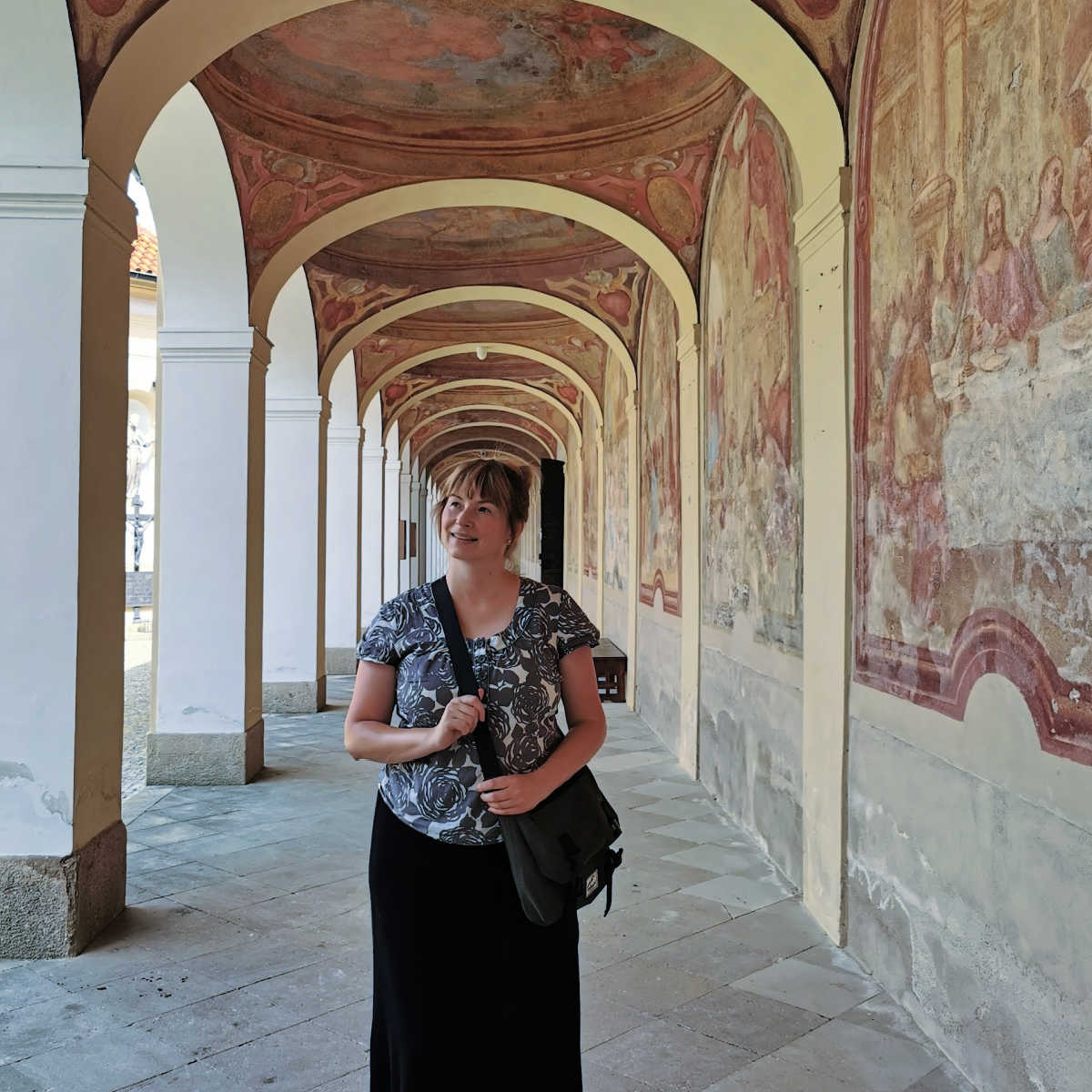
I’ve visited the monastery many times over the years and always enjoy the peaceful walk in the covered ambit corridors, discovering new exhibitions or sitting for a bit in a hidden garden.
I also like to walk on to see the pilgrimage chapel next to the monastery and then on to the Battle of White Mountain field behind and finally carry on to visit the Hvezda Obora (the Star Reserve Park), which only a bit further away.
It’s always a lovely walk, apart from the last time when I got caught in a storm, that was so strong it caused an electricity power cut for half of the tram system in Prague!
But as you can see it from the photos, the clouds make the most amazing background to the pictures.
PIN TO KEEP FOR LATER

Early beginnings of this religious site – A simple chapel
In 1622, Archbishop Jan Lohelius organized a collection for the construction of a shrine and in 1624, on the anniversary of the battle, the first procession from St. Vitus Cathedral headed to this site. People from the surrounding area began to make pilgrimages to the chapel built on White Mountain in honour of the Virgin Mary.
The original building before the current Church of Our Lady Victorious was built, was a simple chapel built between 1622 and 1624 after the Battle of White Mountain.
Nobody really knows who built the first chapel, but some of this chapel structure is still preserved in the western wall of the current church. The chapel was mainly used to store the remains of soldiers who were not properly buried and were left around White Mountain long after the battle.
VISIT OTHER CHURCHES & MONASTERIES IN PRAGUE

The first attempt to build a monastery at White Mountain
In 1628, at the request of the Bohemian King & Emperor Ferdinand II, the construction of a Servite monastery began a short walk from the existing chapel. The planned monastery church of Our Lady was to commemorate the famous victory of the Imperial troops and the Catholic Church at the Battle of White Mountain.
During the laying of the foundation stone on April 25, 1628, which was attended by Emperor Ferdinand II, his wife Eleonora and their son Ferdinand III, they even placed a commemorative medal showing how the monastery will look like.
Sadly, the monastery was never completed. I’ve not found out exactly why, but it looks like it suffered from the beginning from foreign army attacks and pillaging. The last attack in 1648 by the Swedish army was too much for the Servites community and they sold the unfinished monastery and moved out.
Over the centuries the buildings were used for other purposes, including pub, storage or farmstead. You can still see the buildings and can walk around most of them – if you walk from the tram terminus station in the opposite direction, there are the large white buildings ahead of you.
The main entrance to the church or the monastery was at one point used as a pub and you can still see signs there.
VISIT OTHER CHURCHES & MONASTERIES IN PRAGUE
The next building on the site of the original chapel
The original chapel was damaged during the Swedish invasion in 1634 (part of the Thirty Years’ War, 1618–1648) and later converted into an ossuary.
At the same time, the religious processions were moved to the Carmelite church in Malá Strana, which had the same name – Our Lady of Victory, which today is also known as the “Infant Jesus of Prague” church.
In 1704, the already dilapidated chapel was rebuilt by Bavarian builder Michael Hagen who bought the chapel and later got permission to hold masses there.
Soon after that Christian Luna and the White Mountain Brotherhood took over and continued to expand the plans for the chapel and surrounding area.
You can still see the date of the chapel’s consecration, December 8, 1704, carved into the lintel of the entrance.
The next part of the expansion was around 1705-6, when an octagonal presbytery with a low dome and lantern was added to the chapel. This newly created sanctuary, dedicated again to Our Lady Victorious, was consecrated by Prague Bishop Vít Seipel on August 8, 1706.
Sometimes during the building work, the builders come across problems they couldn’t solve and it’s said that at that time, they asked for help by the up-and-coming architect Jan Blažej Santini.
In 1714, the original church dome was demolished and a new, higher one was built. The Santini’s signature design can be easily seen in the corner chapels as well as the layout of the building complex.
VISIT OTHER CHURCHES & MONASTERIES IN PRAGUE
- Loreta Church, Chapel with melodic bell ringing >>
- Church of the Most Sacred Heart of Our Lord at Zizkov >>
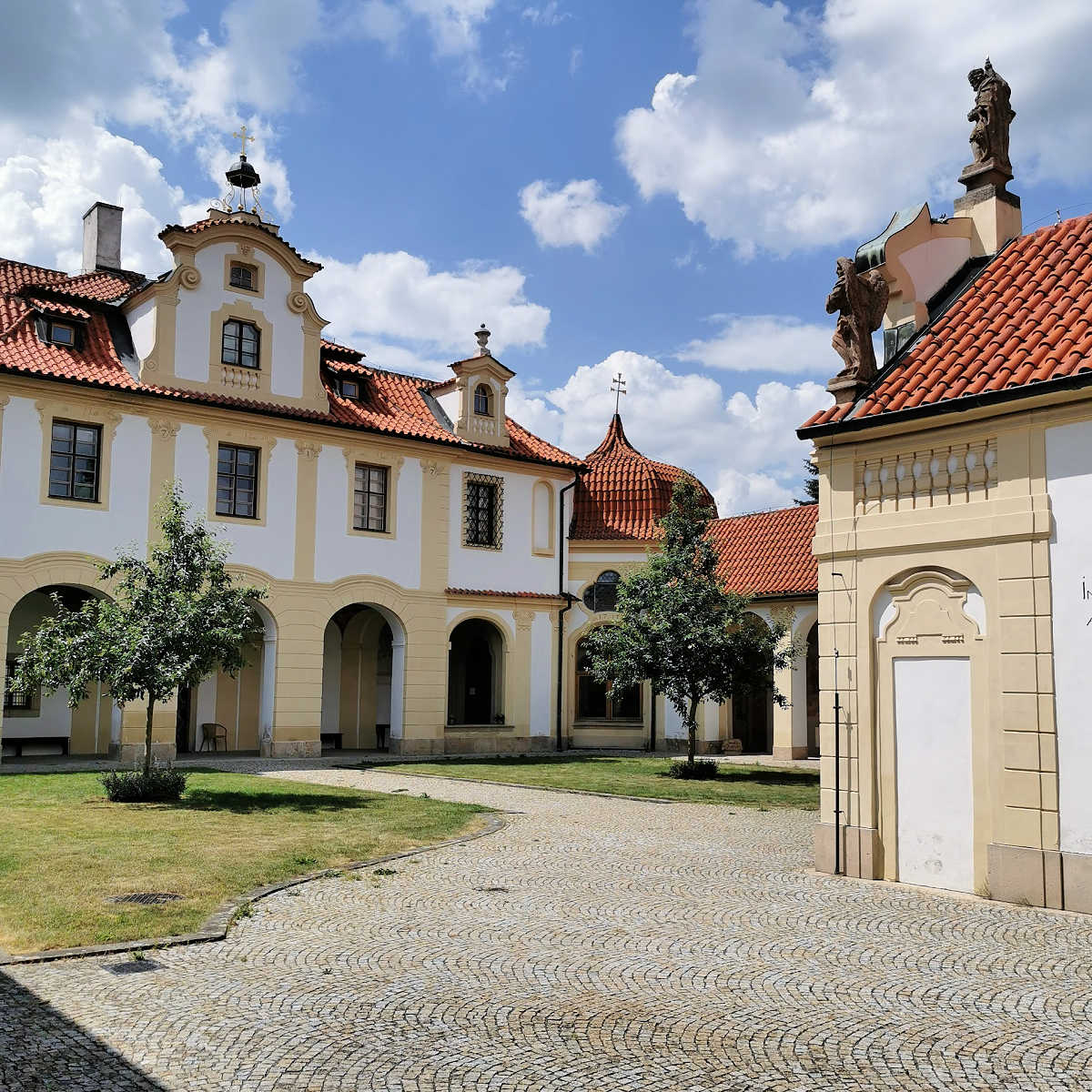
Expanding the monastery complex with more chapels added
The monastery started to expand and more chapels were added during the beginning of 18th century. In 1708, the construction of the sacristy began to the east of the octagonal presbytery.
In 1710, an octagonal chapel of St. Rosalia (dedicated to St. Felician from 1728) was added to the south of the presbytery. In the northeast corner of the future cloister, the chapel of St. Adalbert was founded in the same year.
In 1712, the presbytery was expanded again with the chapel of St. Hilary on the north side and the construction of the chapel of St. John of Nepomuk in the southeast corner of the future cloister began. The walls around the monastery were finally completed in 1713.
The third chapel, dedicated to the Holy Trinity, was built in 1713. The last southwest corner chapel of the cloister, the chapel of St. Wenceslav, was built in 1714.
That same year, the old dome of the church was demolished and a new, higher one was built, completed in 1715.
In 1720, the construction of the cloister arcades began together with the wings connecting the cloister with the church, were completed in 1729.
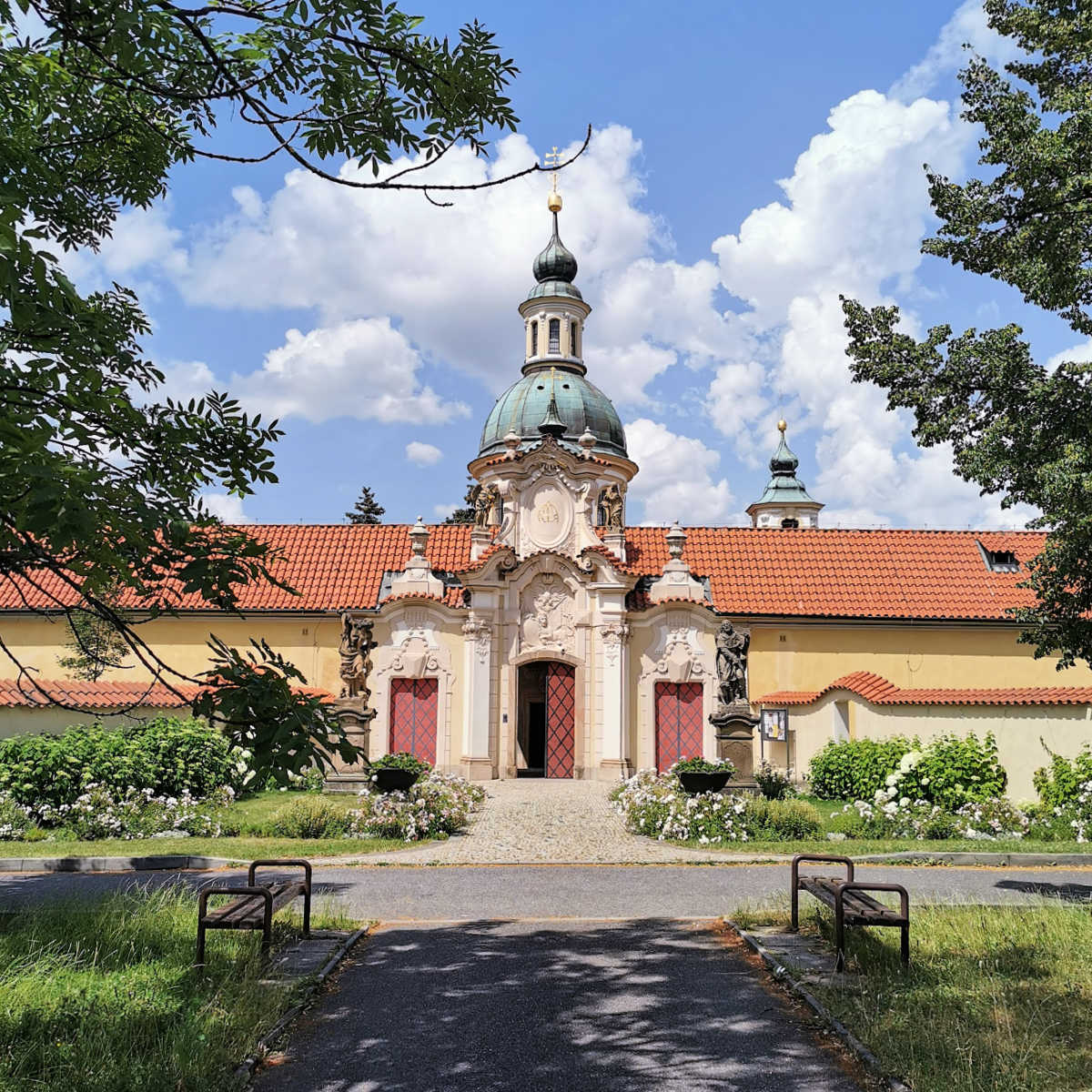
The White Mountain Monastery in Modern Times
Finally the building has slowed down and since the original construction of the Baroque complex between 1704 and 1735, there have been no further significant structural changes.
The pilgrimage site was thoroughly renovated before its reopening in 1811, but sadly inappropriate restoration at the turn of the 19th and 20th centuries damaged the original wall paintings.
After World War II, the building complex, especially the roofs, was in a state of disrepair, but gradually were repaired and a general repair of the entire courtyard was undertaken in the 1970s and 1980s.
Since 2007, the site is again run as a real monastery and it’s now a women’s Benedictine monastery called Venio. Interestingly, the sisters only wear habits and veils during services; otherwise, they wear civilian clothes and work in their original professions (architect, librarian, restorer, etc.) which they practised before joining the order.
Between 2006 and 2013, the former parish building and buildings next door went through a general renovation and were adapted for the life of the monastic community.
This included a new low-rise building, which was added to the monastery garden to accommodate the sisters. And from 2015 to 2020 the pilgrimage church, courtyard and the front gardens were completely repaired.
In 2018, the pilgrimage site was declared a National Cultural Monument.
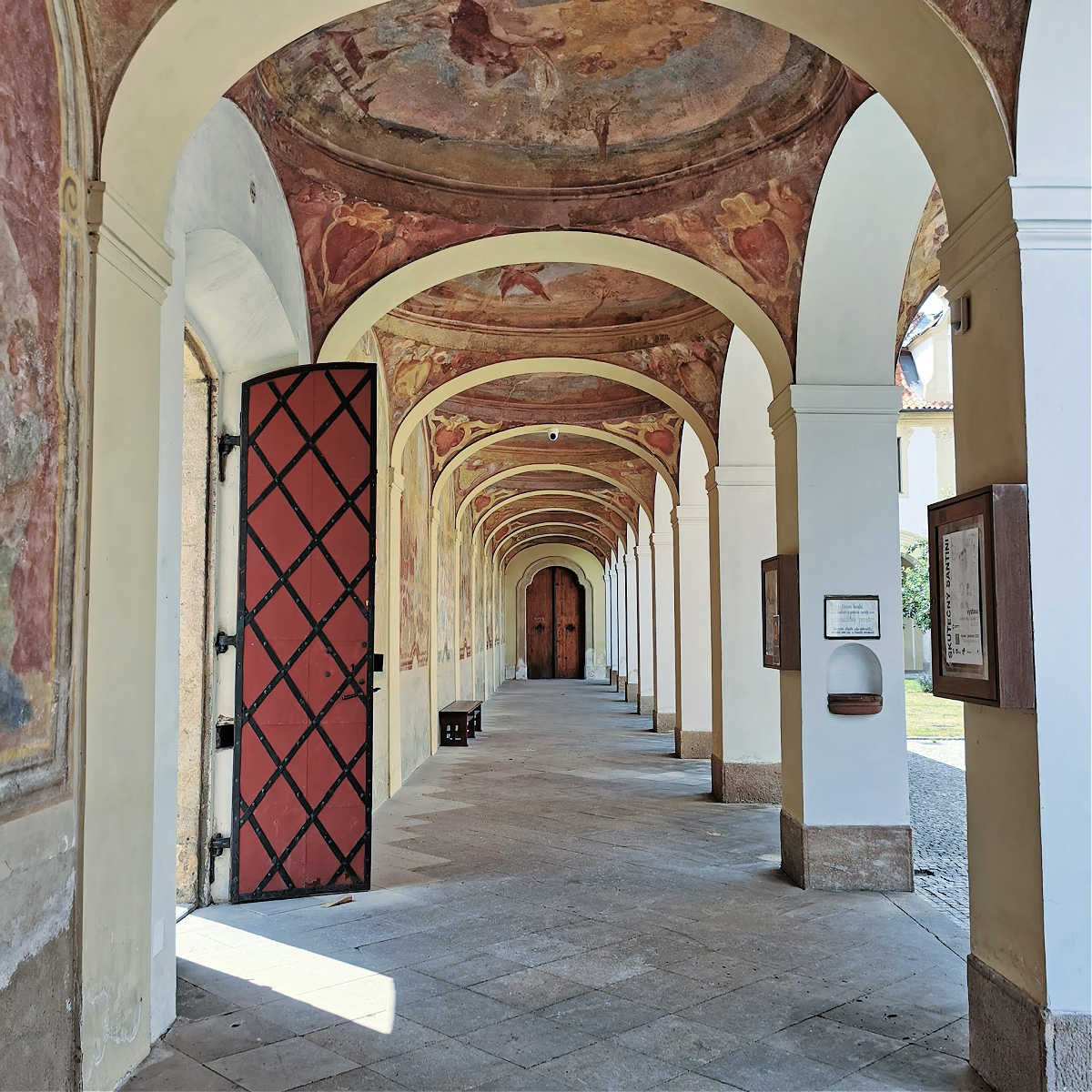
The beautiful Interior Paintings
In the central dome of the church, there is a fresco painting titled “The Glorification of the Church by Czech Patrons” from 1728 by the Bavarian painter Cosmas Damian Asam.
The side domes are decorated with frescoes of the Battle of White Mountain by Václav Vavřinec Reiner (1718) and Johann Adam Schöpf.
On the main altar, there is a copy of the so-called Strakonice painting (Adoration of the Newborn Christ), which was commissioned in Rome in 1708 by Pavel Hagen (brother of mason Michael Hagen) as a reminder of the miraculous intervention of the Virgin Mary in the Battle of White Mountain.
As the story goes, a monk named Dominik found it on the eve of the battle on the road to Prague. Someone had discarded the picture, desecrating it by gouging out the eyes of all painted figures except for Jesus.
The Battle of White Mountain Grave
In 1999, an ecumenical grave for soldiers who fell in the Battle of White Mountain was created at the pilgrimage site. The remains of the soldiers were transferred from the Military History Institute, where they were kept until then.
A total of the remains of 42 men and two women were found at various locations around the area and at different times as the history institute conducted their excavations over the years.
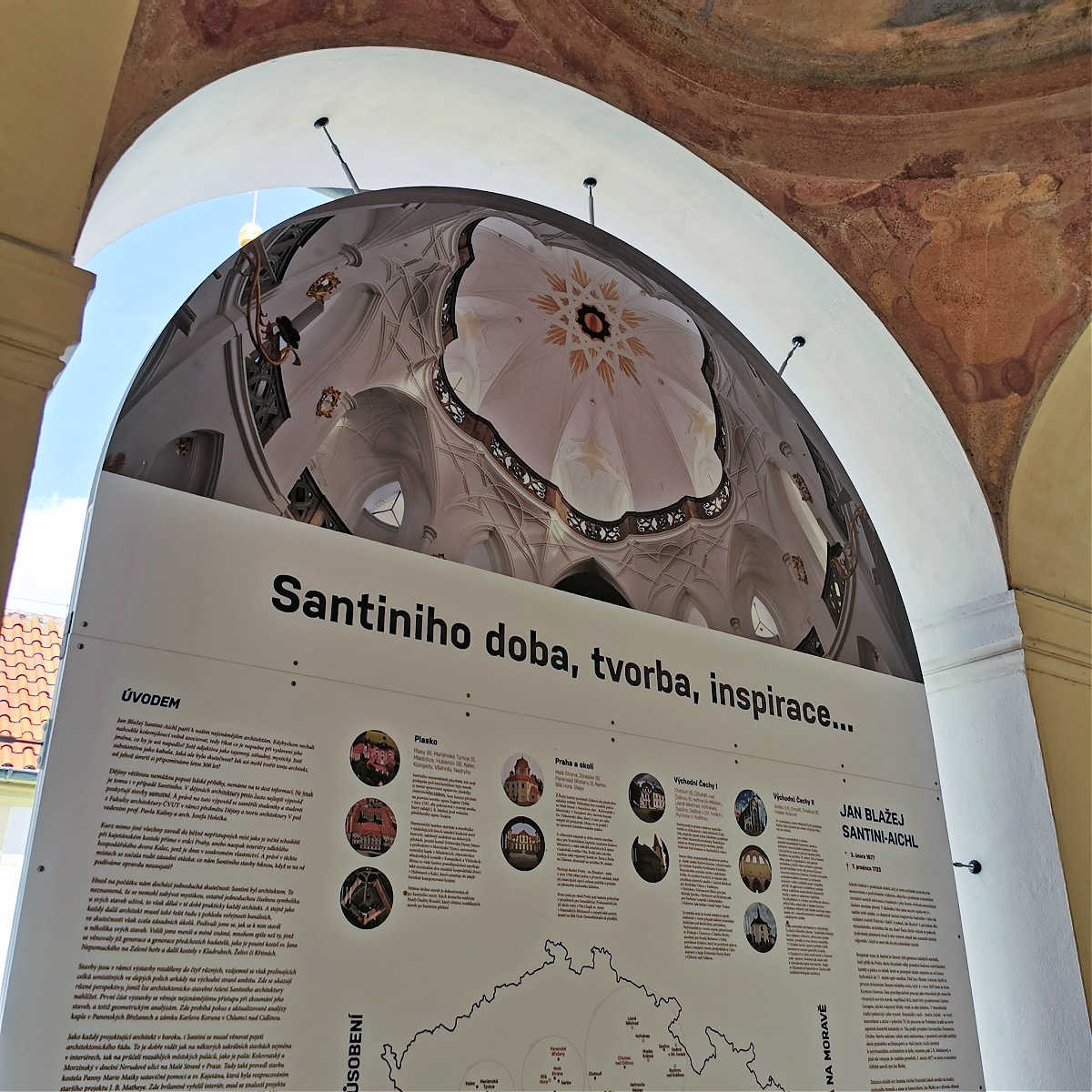
Exhibitions at the Monastery
I like that the open garden corridors are often used as outdoor exhibition spaces. I’ve been lucky enough to see the ‘Real Santini’ exhibition about the Baroque architect Jan Santini, who is also said to have designed Bila Hora pilgrimage complex.
Having been to Marianska Tynice (which was proven as a true Santini work) I have to say, that Bila Hora does look like a smaller version of the same building. Whether it was really Santini who build Bila Hora Pilgrimage or somebody who admired his style and was closely inspired, is still a bit of a mystery.
Pilgrim’s Garden
The Pilgrim’s Garden has informal flower beds of blooming perennials, trees, shrubs and herbs all chosen to complement the Baroque pilgrimage site.
You are welcome to sit on the lawn or on garden benches and chairs. The entrance to the garden is on the right side of the entrance gate to the pilgrimage complex and the entrance is free.
The nearby Pilgrimage chapel
The 37th chapel of the Holy Road from Prague to Stará Boleslav was founded by the Jesuits order in 1674 and was dedicated to Our Lady Victorious. You can find it next to the Bila Hora Monastery as you walk towards the Bila Hora Battle ground.
Practical Information for visiting the The Pilgrimage Complex with the Church of Our Lady Victorious at White Mountain in Prague
Location: Karlovarska 3/6, Prague 6
Opening Times
Daily except Monday from 9:00 AM to 6:30 PM
Entry Fee
Entry is free, but donations are always welcome. There is also a donation box for purchasing a guidebook (50 CZK) and postcards.
Church Masses (and Church Opening Times)
Sundays at 11:00 AM and Thursdays at 5:00 PM
Corner Chapel of the Holy Trinity
Evening Mass at 18 pm each weekday.
Guided Tours
Guided tours for groups and individuals are available in Czech and German (by prior arrangement) or you can explore the pilgrimage site with your own guide or a printed guide available in Czech, German, and English.
How to get there
Take the 22 or 25 tram from the Prague centre – about 20 minutes ride. From the terminus tram stop ‘Bila Hora’ walk straight on (following the busy road) and the pilgrimage complex is about 3 minutes walk. If you walk beyond the walls of the complex you can also see the pilgrimage chapel and then continue to walk to the Bila Hora battlefield (about 5-7 minutes walk).
This blog post was originally written on 3 July 2024 and last updated on 5 October 2026


