
Walk the Path of Kings: A Step-by-Step Guide to Prague’s Royal Coronation Route
If you want to have a good hike up Prague Castle and experience history first-hand, then the best way is to take the route that was taken by all kings on their coronation day.
I’ve done this walk many times and it’s definitely one of my most favourite walks in Prague, although I sometimes walk the other way round (more on that later).
This is quite amazing route that will take you through the historic centre of Prague, where practically every house has its own history and it’s interesting to look at and you can also stop at many of the coffee shops and restaurants along the way.

The Royal Coronation Route – What to know before you set out
This walk is about 3 km long, but most of it is up the hill, so it can easily take 45 minutes. If you want to walk slowly to admire the views or stop somewhere on the way, plan 1-2 hrs for your walk, so it doesn’t feel rushed.
There are plenty of attractions on the way, so you can easily turn this walk into a whole day tour of central Prague, where you’d see most of the major sights.
If you like the idea of this walk, but don’t fancy the steep climb to the castle, you can also do this walk in reverse. To do this travel by tram 22, tram no 23 or the historic tram no. 42 to the Prazsky Hrad stop (from Malostranska tram or underground stop) and then explore Prague Castle and St.Vitus Cathedral first before walking gradually down through Nerudova Street and on Charles Bridge to get to the Old Town Square.
Best time to walk the Royal Coronation Route
In my experience, the best time to walk this route is early morning (before 9:00 AM) to avoid the day tourists and big crowds, especially on Charles Bridge and in Nerudova Street.
If you don’t mind everything being closed (shops, attractions, cafes etc.), the perfect time is super early in the morning, like 6-7 am. Walking this route during evening is also lovely, especially as it’s light until 9-10 pm in the summer and the Prague Castle grounds are open until 10 pm ( from 6 am all year round) .
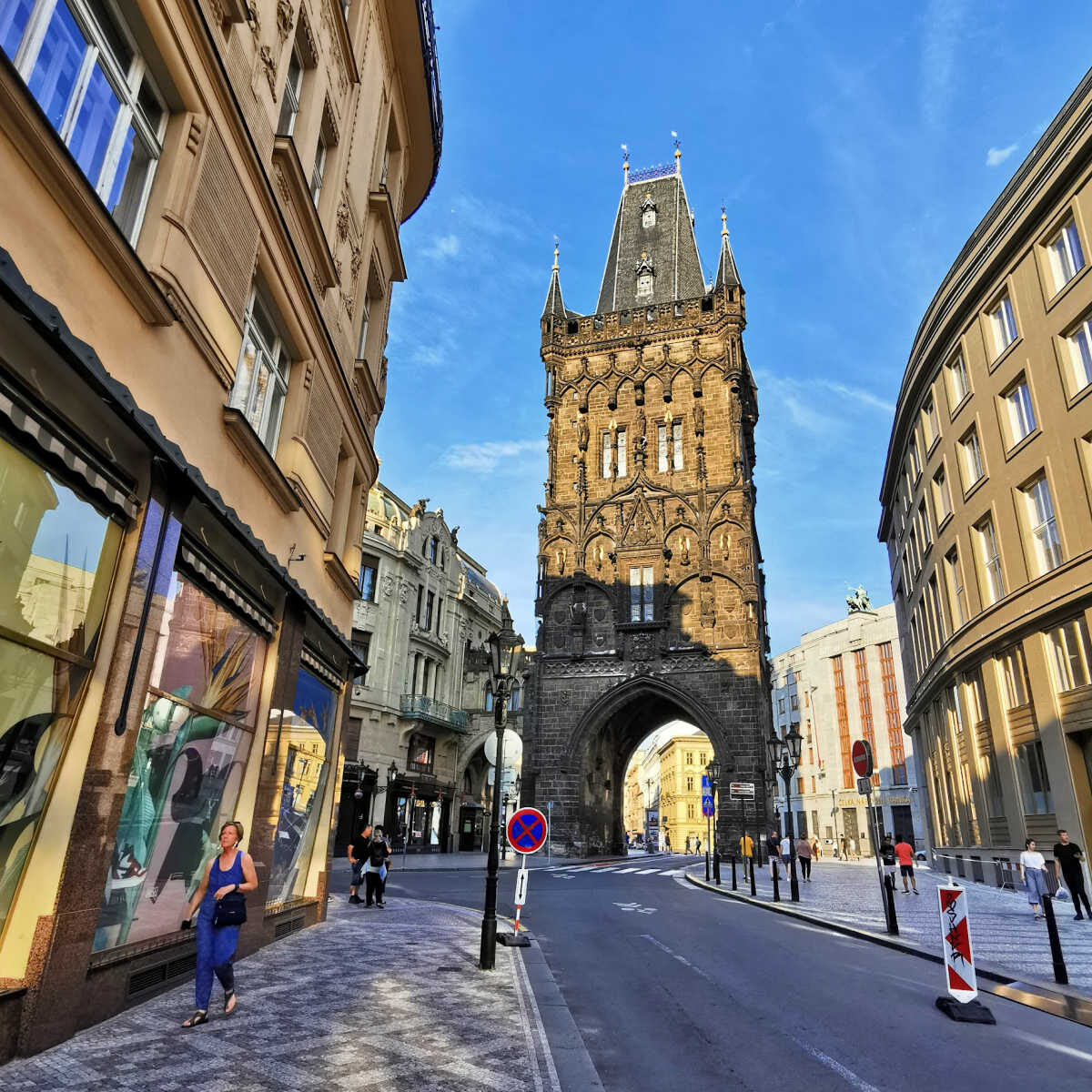
1. Section – The site of the original king’s castle at Powder Gate to Old Town Square
The Royal Coronation Route starts in front of the historic Powder Gate, which used to be right next to the original Prague castle where the king would start the procession.
This tower was built in the 1400s and was one of the original 13 gates protecting the Old Town. Even though it was named the “Powder Tower” because it was used to store gunpowder in the 17th century, its main purpose was much grander: it was the ceremonial starting point for all royal processions.
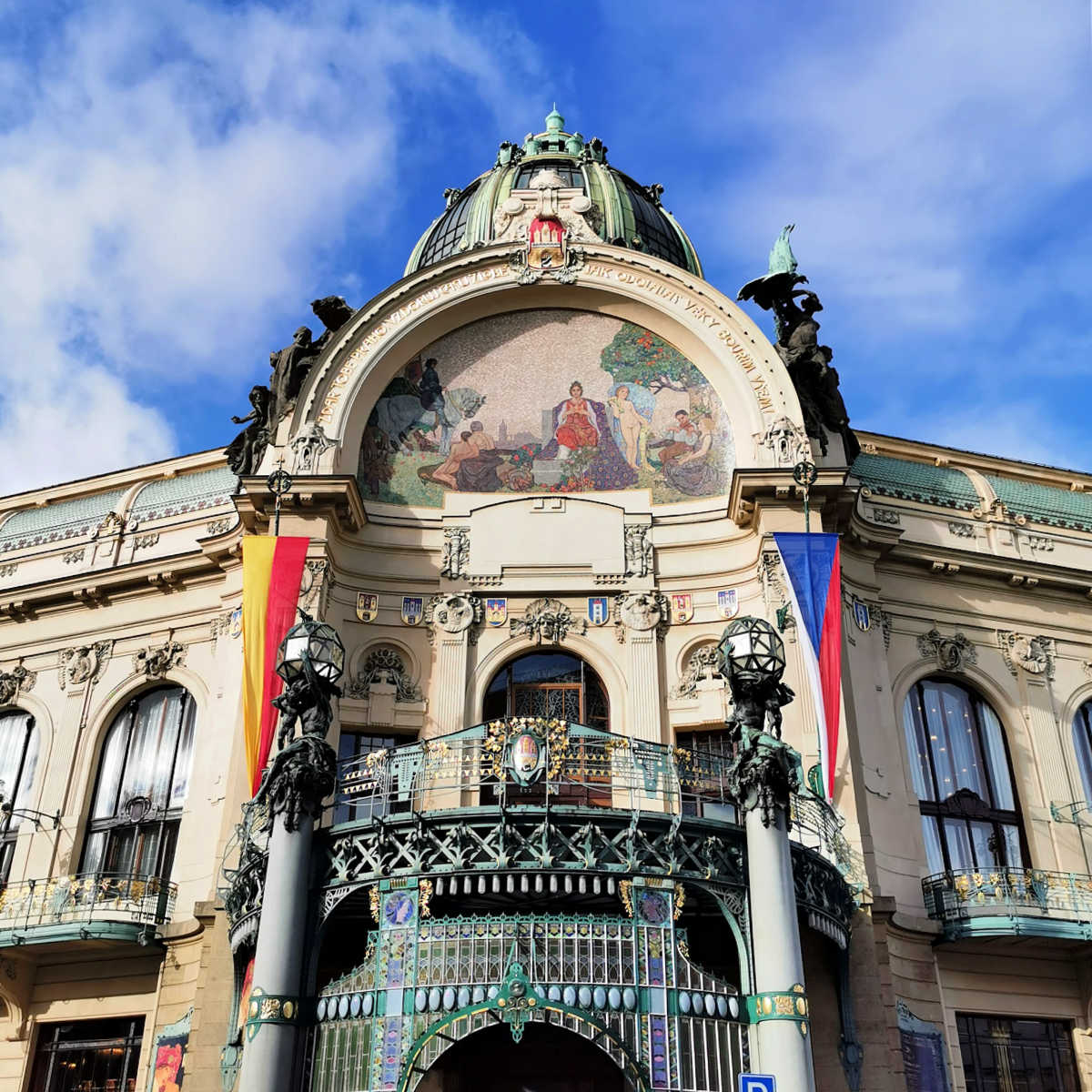
The Royal Court was the seat of Bohemian Kings from the 14th to the 15th centuries (approx. 1383 to 1484). Afterwards this palace was gradually abandoned, which led to a greater significance of Prague Castle once again.
The original castle area is exactly where the beautiful Municipal House is now with amazing deco by A Mucha and one of the most decorative cafes in Prague.
Once you pass under the tower, you are walking down the Celetná Street, a straight road that leads directly into the Old Town Square. This street is also special because it follows the path of a very old trading route.
The street is lined up with tourist shops, cafes and museums, such as the Madam Tussaud’s Wax Museum, Museums of Steel Figures.
Don’t miss this little hidden gem – One of my favourite shop is the little cafe called ‘Kolacerie‘ where you can buy traditional Czech Kolace – sweet pastry cakes with various fillings. I’ve had quite a few different kolace from here and their poppy seeds filling with almonds is one of the best ones I’ve ever tasted.

If you look closely at the buildings as you walk, you will notice that many have special painted or carved signs instead of numbers, like the House of the Black Madonna. This is a great example of Cubist architecture, a rare style where buildings look like they are made out of sharp, geometric shapes. You can find the only cubist cafe in the world here (make sure you have the square shaped ‘vetrnik’ pastry) and also a cubist architecture museum.

2. Section – The Old Town Square
After leaving Celetná Street, the Royal Route opens up into the impressive Old Town Square. Look to the east and you will see the tall, dramatic towers of the Church of Our Lady before Týn, one of the most famous Gothic buildings in the city.
Right near the Astronomical Clock on the square’s paving, there is a meridian line (a bronze plaque or marking). This mark indicates where the shadow of the Marian column used to fall at noon and was used for measuring time.
The square was the site of the execution of 27 Bohemian Protestant leaders in 1621, following the Battle of White Mountain. This event marked a major turning point in Czech history and you can see 27 white crosses embedded in the paving near the Old Town Hall to remind us today about this event.

But the main attraction is the Old Town Hall, which has the famous Astronomical Clock where you can see each hour (on the hour) moving figures of the Apostles.
The story of the Old Town Hall began in 1338 when the city’s wealthy citizens were given permission by the King to buy a beautiful corner house and turn it into their official meeting place. Over time, the city bought more houses next door and joined them all together, which is why the building looks like a collection of different styles.
The most famous part, the high Gothic tower, was finished in 1364 and this is where you can see the incredible Astronomical Clock which is the only one of it’s kind in the whole world.
Sadly, a large part of the hall was destroyed in fighting during World War II and was never rebuilt. This is why when you look at the building from a side, it looks like part is missing.
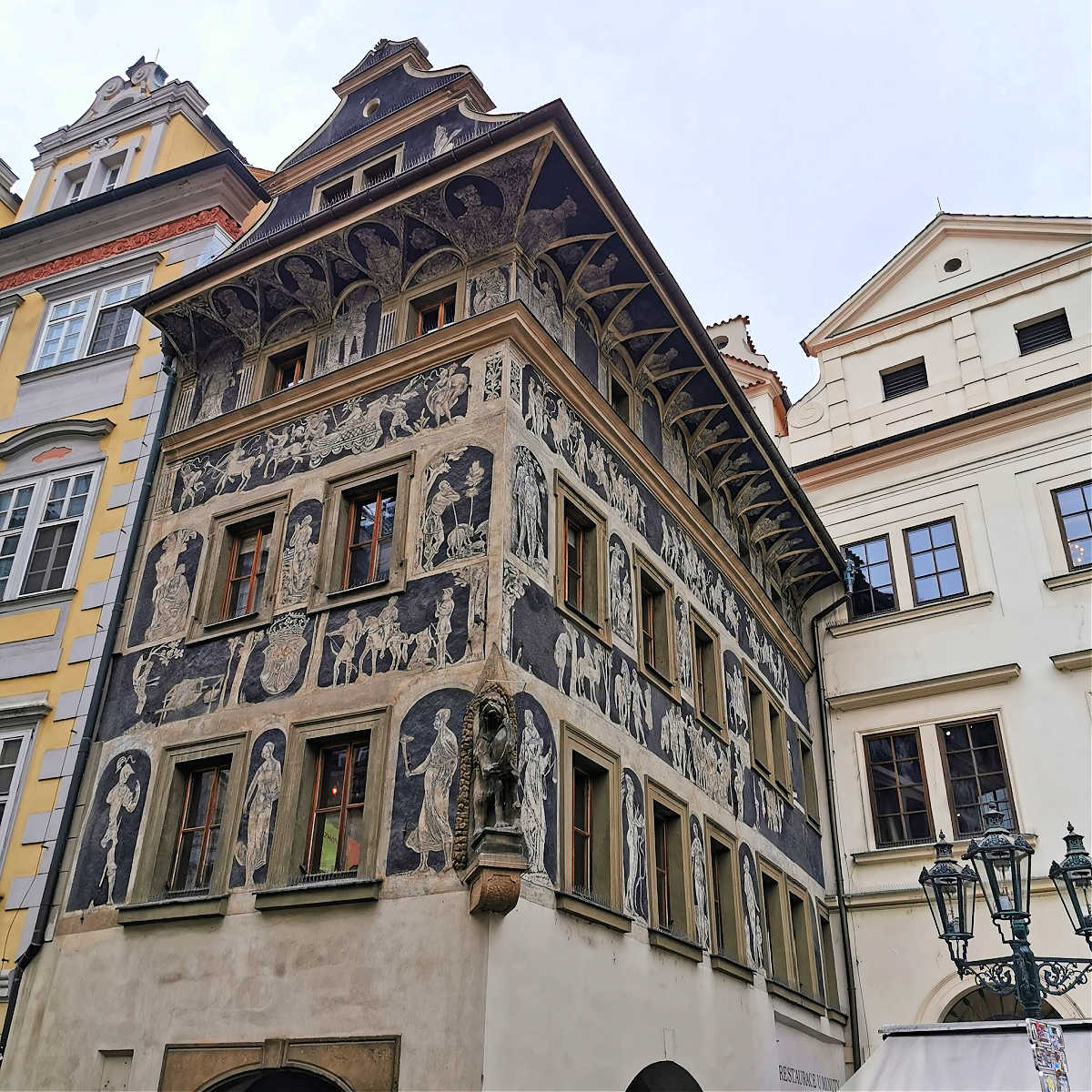
Don’t miss these hidden gems – There are several houses around the square, where the famous Franc Kafka writer lived and if you are interested in his story, I’ve already written self-guided walk of Kafka’s places in Prague, you can easily follow.
One of my favourite hidden cafes is at the Scout’s Institute building right next to the Minute House as you walk into the Small Square next to the Old Town Square.

3. Section – Winding streets of Old Town through Charles Street to Charles Bridge
The route will take you through the Old Town Square, Small Square and then through streets Jilska and Husova to Karlova Street taking you directly to the famous Charles Bridge.
In Husova Street, you will find the entrance to the Clam-Gallas Palace, practically the only palace open to tourists in the centre of Prague, which also hosts regular exhibitions.
As you walk down Karlova Street, notice how different it feels from the main square—it’s much more enclosed and mysterious. The street is lined with historic townhouses and small tourist souvenir shops.
Make sure you don’t miss the Klementinum on your right, a huge complex of Baroque buildings that was once a Jesuit college and library.
On the corner of Karlova and Liliova Street pause a little in front of the House at the Golden Serpent (U Zlateho Hada). Here the first ever cafe was established in 1714 by Georgius Deodatus Damascenus who was an Armenian merchant. He first moved to Prague in early 18th century and walked around the streets dressed in colourful Oriental clothing, selling freshly brewed coffee from a small portable stove.
Everyone loved this new type of drink and soon enough he was able to open his first coffee house, the Café U Zlatého Hada.

The St. Clement Cathedral regularly puts on classical concerts, as well as the Church of St. Salvator and St. Francis of Assisi Church further along this section.
You can also find quite a few museums, mostly private modern museums, including Beer Museum and Czech Garnet Museum. The Garnet Museum is run by one of the original Czech garnet jewellery companies, so if you are thinking of buying something truly special, this is the place.
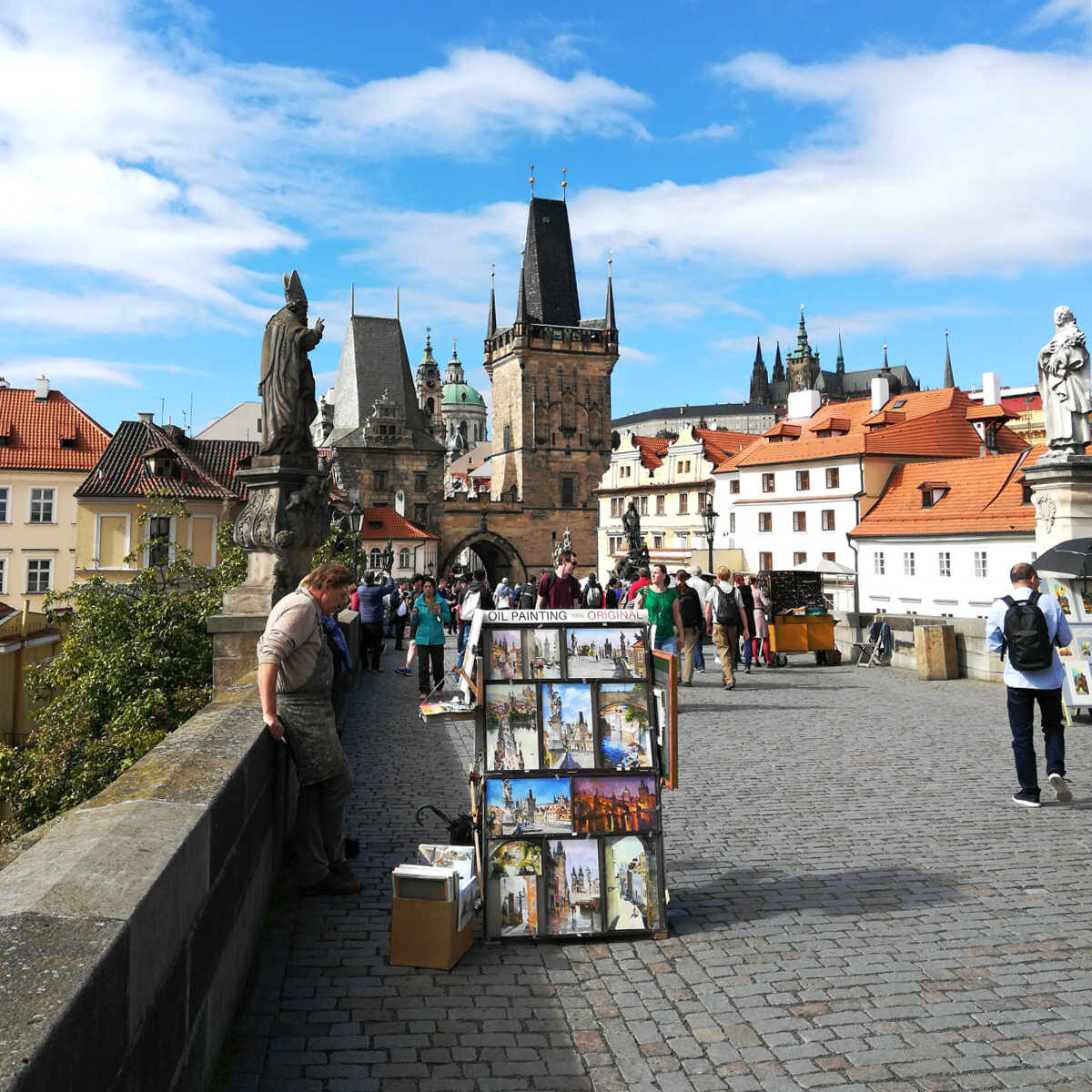
4. Section – Charles Bridge
Before you cross the bridge, you can visit the St. Francis of Assisi Church or the Museum of Charles Bridge next door. If you fancy seeing Charles Bridge from a different angle, the boat company linked to the museum will take you for a short boat trip across Vltava river and through Certovka stream on the opposite side of the river at Kampa Island.
The Old Town Tower at the beginning of the bridge is perfect for taking photos of the Prague Castle hill and you can find out more about the history of the bridge and the tower inside.

The Royal Route crosses the Charles Bridge, which until well into 19th century was the only connection between Old Town Town and Lesser Town and the only way the Royal procession could cross the river. The bridge is 516-meter-long and was originally build in 1357 under the patronage of Emperor Charles IV, replacing an older bridge destroyed by floods.
It was originally called the Stone Bridge or Prague Bridge until 1870, since it was the only bridge over the river Vltava in Prague.
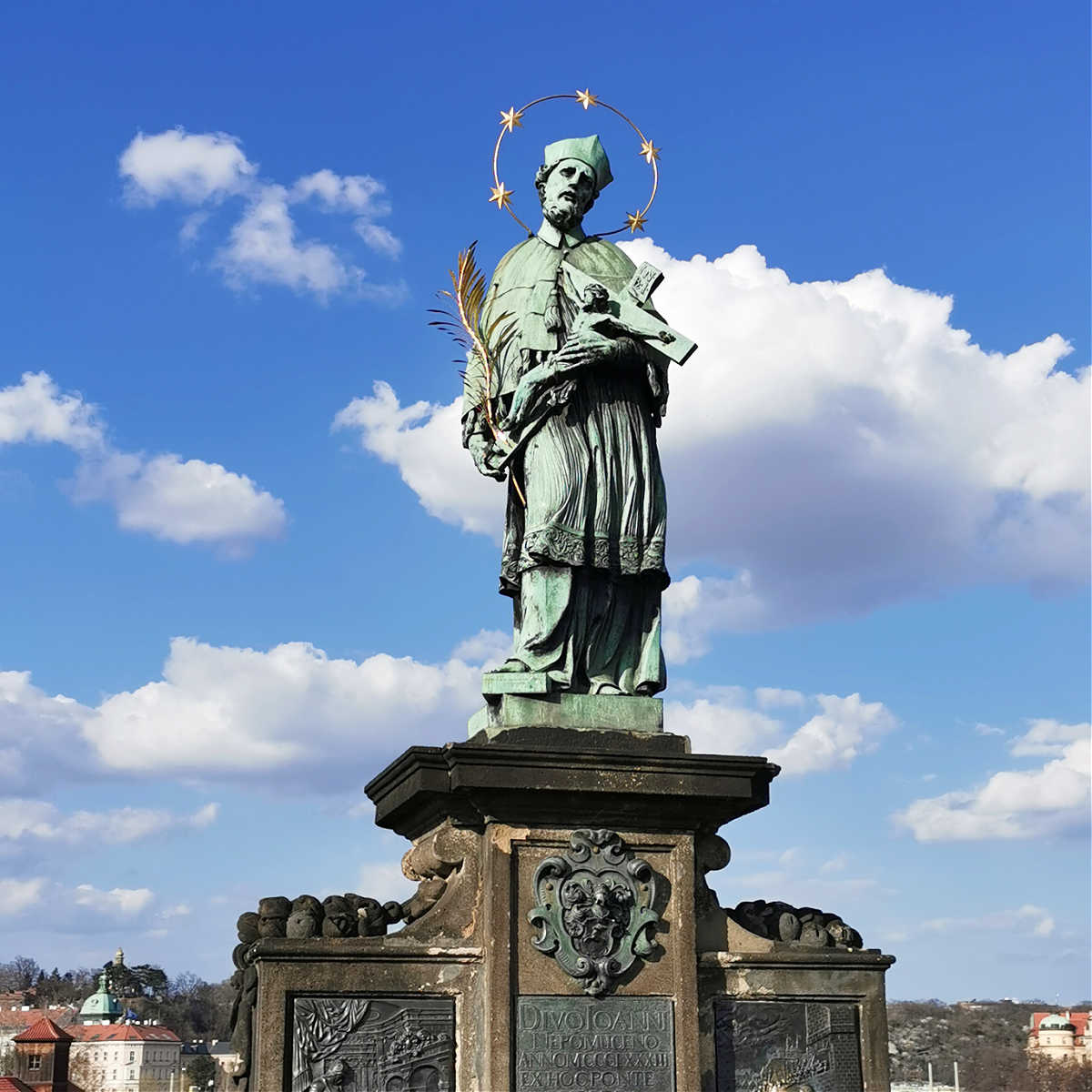
The bridge has the most amazing 30 Baroque statues of saints, added between 1683 and 1714, including the famous statue of St. John of Nepomuk, who’s decorative tomb you can see later in St.Vitus Cathedral.
Touching the bronze plaques at the base of the statue is said to bring good luck and your save return to Prague. Although I highly suspect this is a modern legend, that’s made up for tourist.
Bonus points for spotting the only statue that’s not directly on the bridge! It’s the Bruncvik statue which is on the left hands side nearly at the end as you walk towards the Lesser Town Tower.
Just before you leave the bridge, glance to your right, where you will see corner building called ‘Three Peacocks’. It’s now a hotel and a restaurant, but it was originally the second cafe in Prague also owned by Georgious Deodatus Damascenus. He worked at his cafe every day until his death in 1730.
5. Section – Lesser Town Square & Lesser Town
Once you are on the other side of the river, continue through Mostecka Street to Malostranske Namesti.
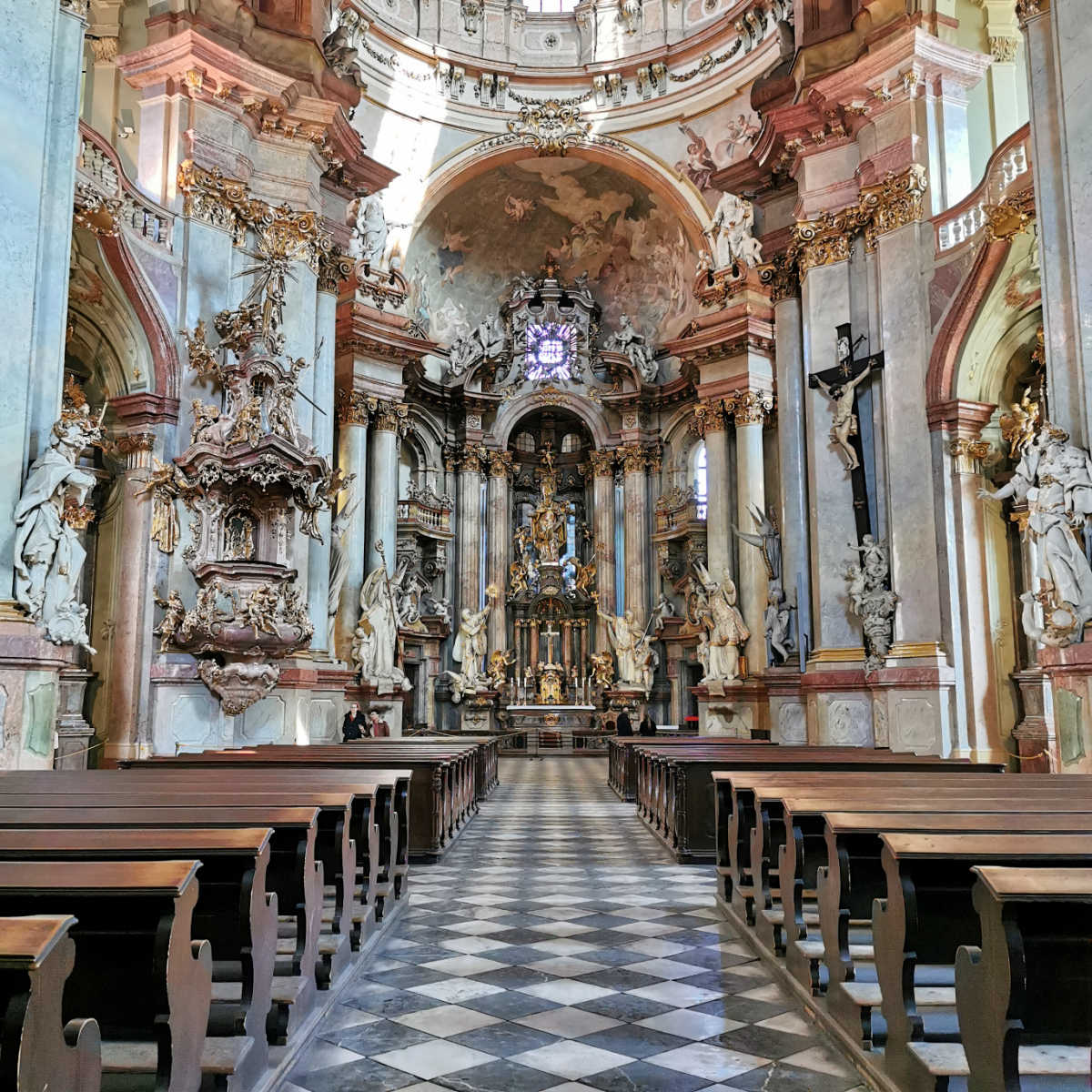
This large square is dominated by the St. Nicholas Church a spectacular example of High Baroque architecture built between 1704 and 1755 by the brilliant father-and-son architects, Christoph and Kilian Ignaz Dientzenhofer. If you want to see another great views of the area and learn about cold war spying, you should definitely visit the St. Nicholas Bell Tower.
The square itself is lined with significant Baroque palaces and the lower part next to the tram stop has often farmer’s markets and food stalls.

6. Section – Nerudova Street to Hradcany Square Hill
The final and most demanding part of the royal journey is the steep ascent up Nerudova Street. This street is named after the renowned 19th-century Czech writer and journalist, Jan Neruda, who lived at the House of the Two Suns near the top.
As you climb, you are surrounded by grand Baroque palaces, many of which still feature decorative House Signs which were once used instead of numbers.
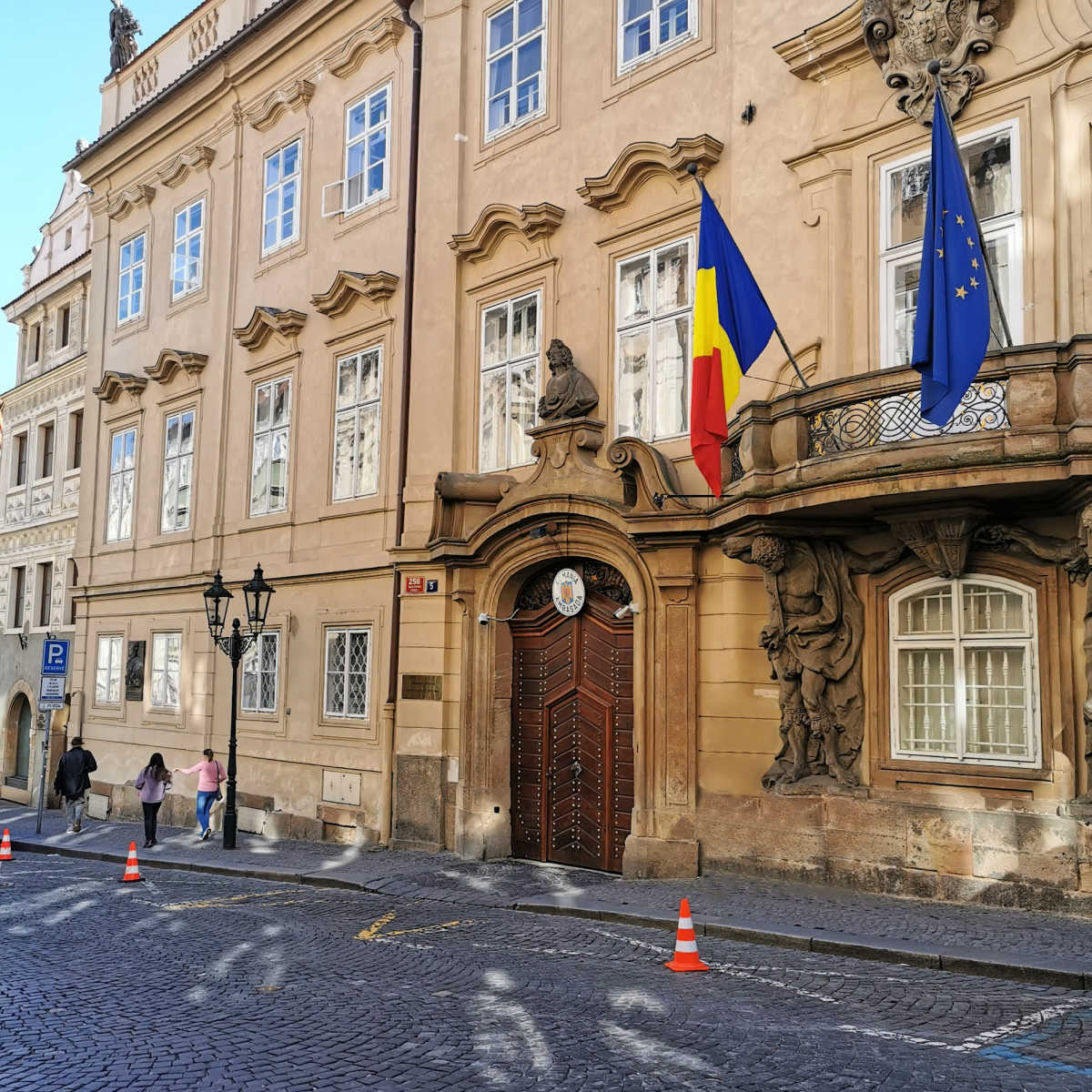
My favourite ones include no. 32 the House of the Golden Lion (U Zlatého lva) which is the Prague’s first ever pharmacy. Another interesting ones are also no. 16 House of the Golden Cup (U Zlaté číše), House of the Red Eagle (U Červeného orla) or no. 25 House of the Three Fiddles (U Tří housliček), where once the family of renowned violin maker lived.
The famous Czech Baroque architect Jan Blazej Santini (1677–1723) lived and worked in Nerudova Street. In 1714 he worked on redesigning of the Morzin Palace (No. 5), which has an entrance with two large sculptures representing day and night. Santini is also credited with adaptations to the Thun-Hohenstein Palace (No. 20) in 1721.

My favourite places to visit in Nerudova Street include Museum Montanelli (contemporary art gallery), Cafe U Kajetana (if you feel like you really need to try trdelnik, buy it here – at least this one is not completely overpriced and it’s actually pretty good – I’ve tried it!).
I also often pop in to Kafe & Hrnky cafe, which has a hidden courtyard that gives you an idea how most inner courtyards look like in Prague. The Kaferna has a cute seating window arrangements as you walk in. I also love visiting the Gingerbread Shop for inspiration (about half-way up the street) and buy chocolate at the Steiner & Kovarik chocolate shop at the top of Nerudova Street.

Just before you turn up to the final climb to the castle, turn back and have a look down the Nerudova Street. If you walk up a few steps to the Radnicke Schody, you get one of the most beautiful views of Prague.
7. Section – The St.Vitus Cathedral & Prague Castle
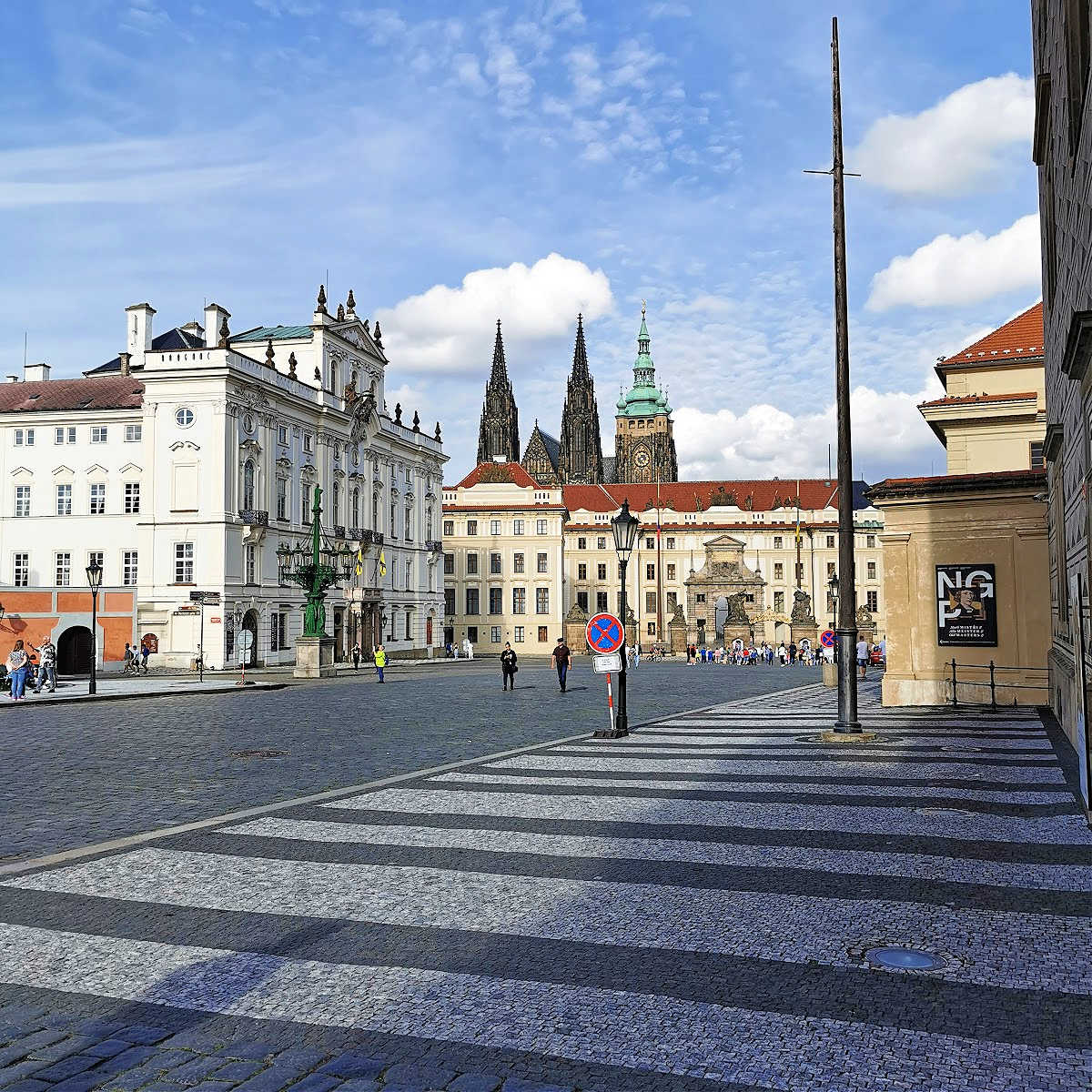
Just before you enter the castle grounds, you’ll walk through the lower part of Hradčany Square, which has some grand palaces, such as the Archbishop’s Palace and Schwarzenberg Palace, which is now used as one of the sites for National Art Gallery in Prague.
The Prague Castle, which has been the seat of Czech rulers since the 9th century is the largest castle complex in the world. The royal procession would have travelled through the courtyards to reach the ultimate destination: St. Vitus Cathedral.

This magnificent Gothic cathedral started to be built in 1344 by Matthias of Arras and Peter Parler, but wasn’t completely finished until nearly six centuries later. This is where the coronation ceremony would have taken place and now the cathedral has several tombs of Czech kings, including Charles IV. Once of the cathedral’s side chapels, the St. Wenceslaus Chapel is lavishly decorated with semi-precious stones, which protects the hidden chamber containing the Czech Crown Jewels.
The first king to be formally crowned in what was the predecessor of the current cathedral – the Romanesque Basilica of St. Vitus—was Wenceslaus I of Bohemia on February 6, 1228. While earlier Bohemian rulers were in fact ‘kings’ they were often referred to as ‘knights’, so Wenceslaus I was the first to receive the royal anointing and crowning ceremony at this special place.
The last king to be crowned here, was Ferdinand V of Bohemia (Ferdinand I of Austria). His grand coronation ceremony took place on September 7, 1836. Although he was the last person to have the Crown of St. Wenceslas placed on his head, he reigned for only a few years before abdicating due to the revolutions of 1848. The last monarch of Bohemia, Charles I of Austria (Karel III of Bohemia), who reigned from 1916 to 1918, was never crowned in Prague before the monarchy was abolished.
This blog post was originally written on 30 November 2025 and last updated on 30 November 2025


