
Discover Clam Gallas Palace – Prague’s most beautiful Baroque palace
Clam-Gallas Palace is the most important Baroque palace in Prague, originally belonging to a wealthy family of the same name. It’s been always closed to the public and only opened for the first time in 2022. Because of that, it’s still very much a new attraction and I think, it’s a complete hidden gem right in the centre of Prague.
I spent a lovely late afternoon visiting the palace and as there were only a few people in each room I had the chance to see the palace without any crowds. I bought a combined ticket for both the palace and the art exhibition, but you can visit just the palace if you wish.
PIN TO KEEP FOR LATER
Is Clam-Gallas Palace worth visiting?
I’ve really enjoyed visiting the Clam-Gallas Palace, because it’s been closed to public until a couple of years ago, so I could have never visited it before.
I was also keen on visiting this palace because I’ve been to the other Clam-Gallas castles and palaces around Liberec, which is where the family originally had most of their properties. I was also inspired by a beautiful exhibition about the Clam-Gallas family history in Liberec Museum and really wanted to see their Prague ‘crash pad’!
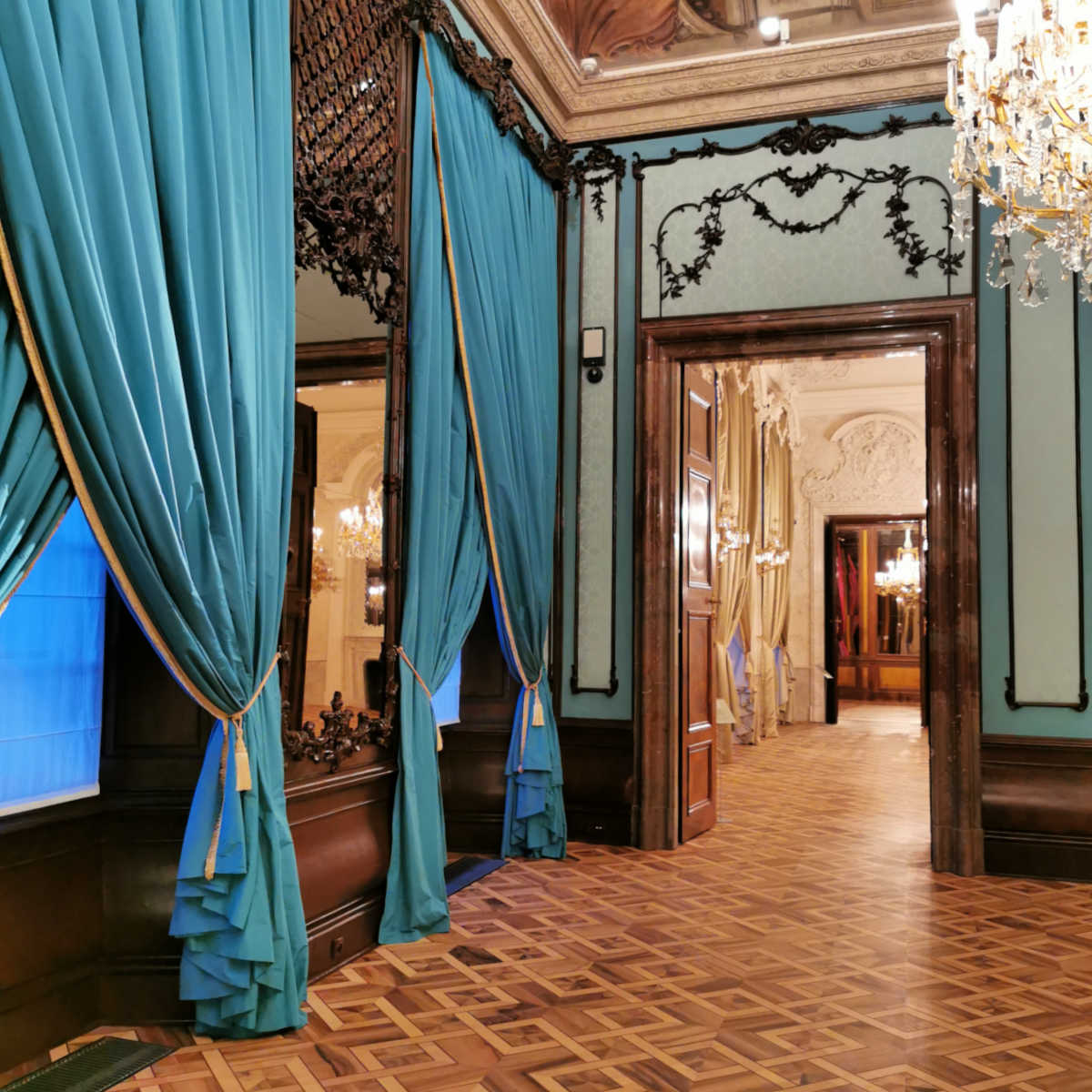
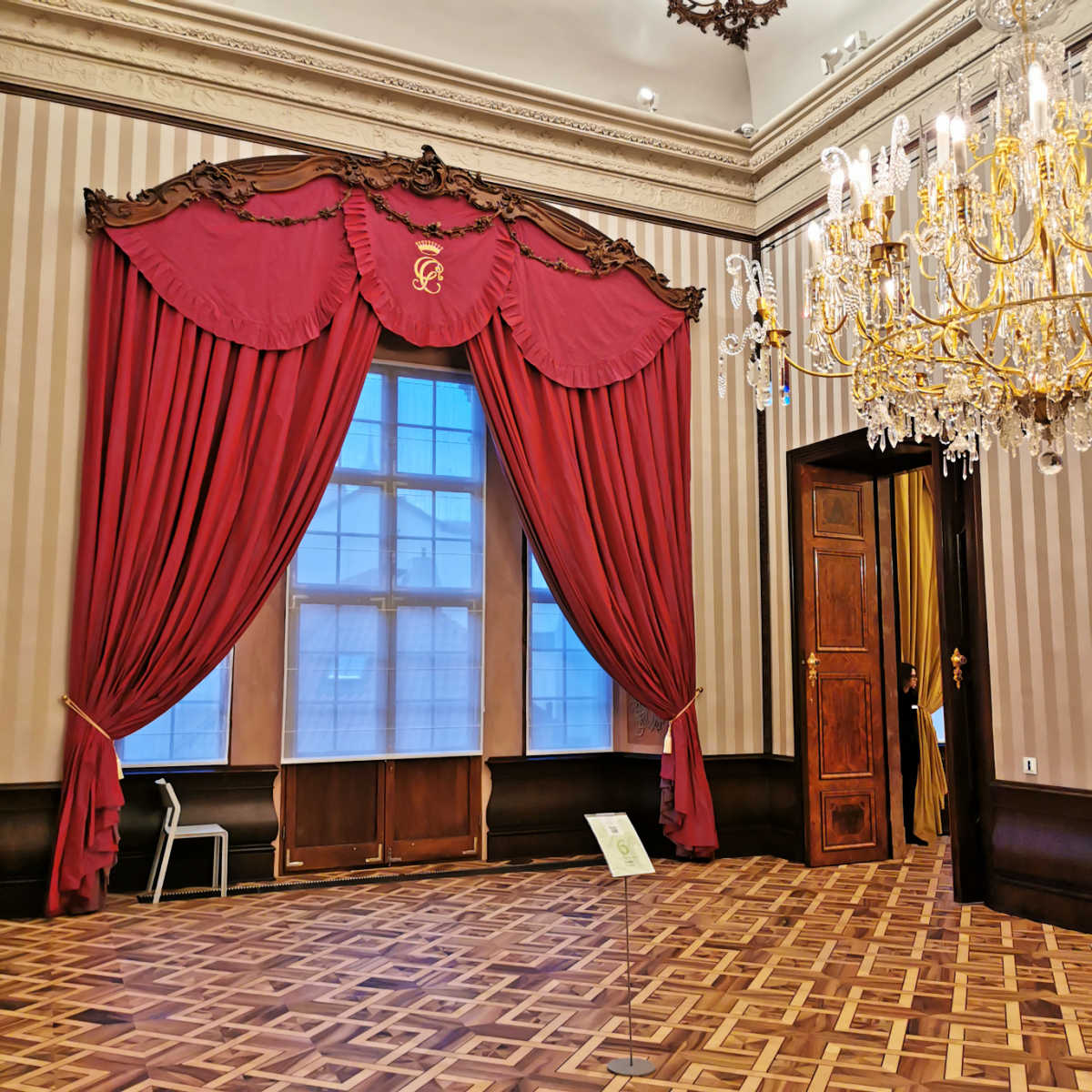
But, even if you don’t know anything about the family, I think, the palace is still worth visiting. It’s one of the best examples of a beautiful baroque building, each room wall is decorated with paintings, gold and fabric.
You can also see a great example of a private – home theatre room, which is quite rare (there are only a few in the whole Czech Republic, like the one in Cesky Krumlov or Litomysl).
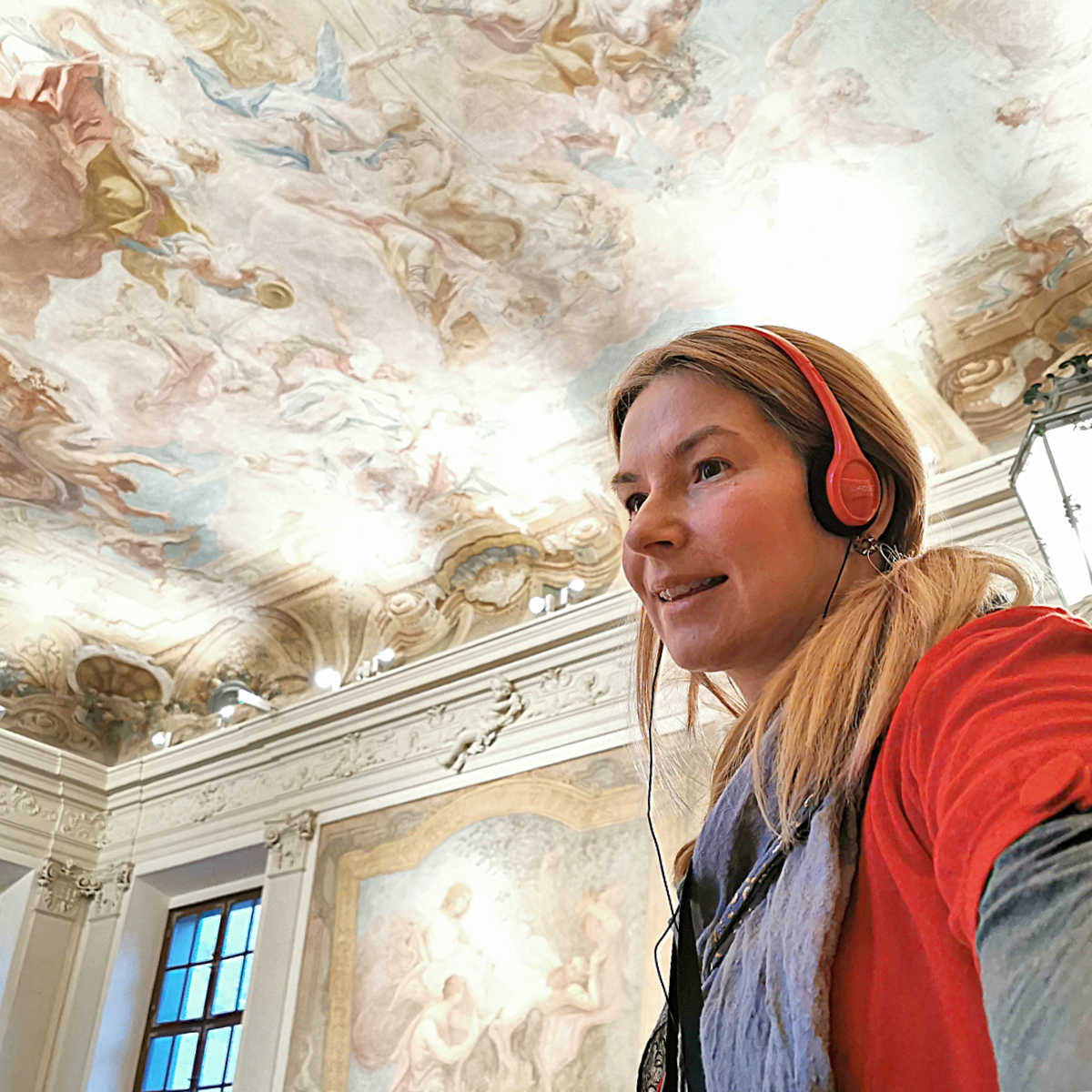
You can choose to go around with a guide, but I chose the pre-recorded audio guide, that you listen to as you go around. It’s quite nicely done and told from the point of view of the statues from the entrance to the Palace.
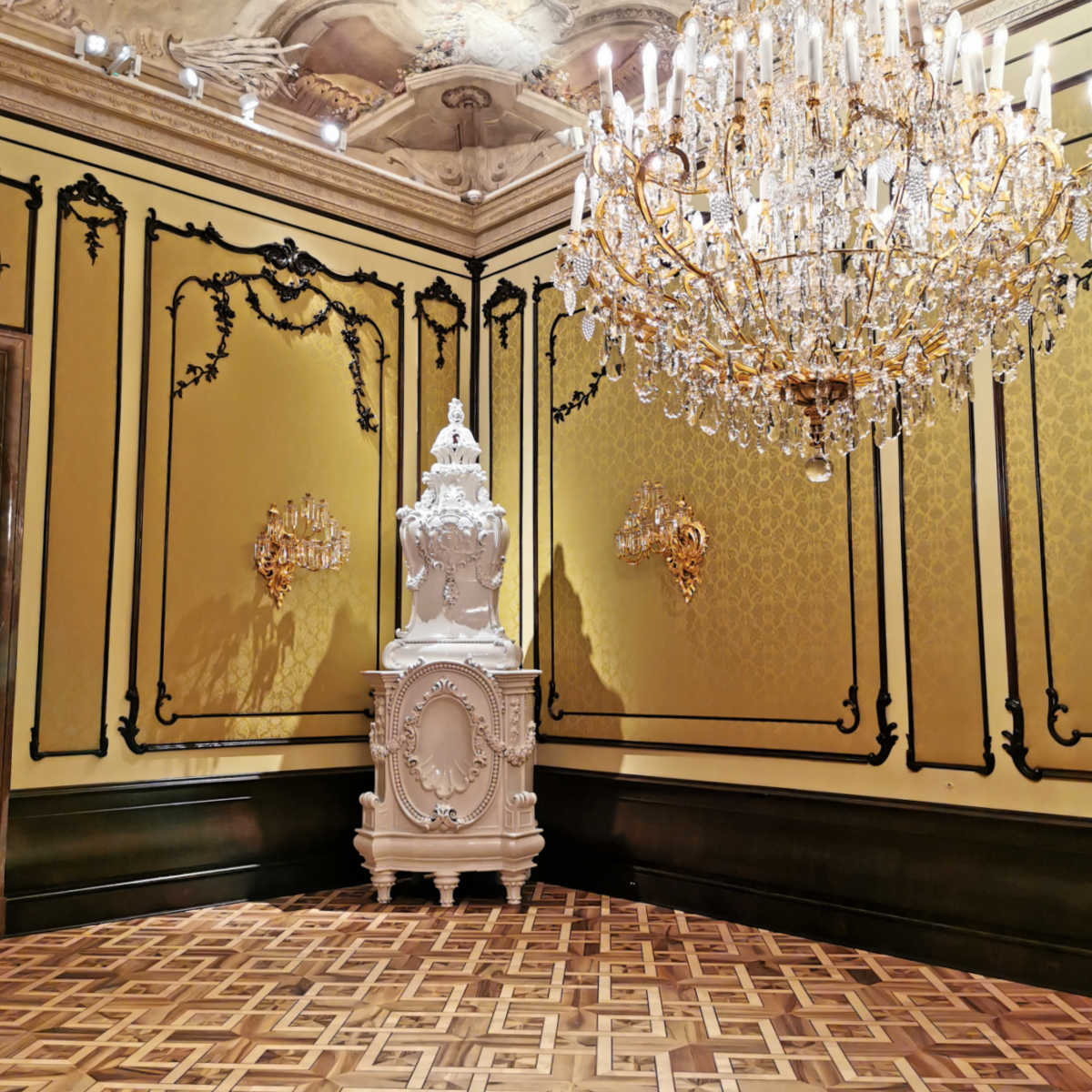
What was slightly disappointing is that all the rooms are empty. Apart from large ceramic heating stoves and gorgeous chandeliers, you won’t find any furniture in the whole palace.
I get, that there is no original furniture left since the place was used as an archive for more than 70 years, but if you like your palaces and castles to look like somebody is actually living in them, you might find visiting the palace a bit underwhelming.
I also have to say, that I’m not impressed with the grey facade colour, which I found it’s not even based on the original colour and has been criticised by Czech historians as a completely inappropriate choice for a facade colour.

Practical Information for visiting Clam-Gallas Palace
Location: Husova 158/20, Old Town, 110 00 Prague 1
Opening Times
- Tuesday to Sunday: 10:00 AM – 6:00 PM (last entry at 5:30 PM)
- Monday: Closed
How to get to Clam-Gallas Palace
- Metro: The closest metro station is Staroměstská on Line A (the green line), which is about a 3-minute walk from the palace.
- Tram: The nearest tram stop is Staroměstská, served by tram numbers 2, 17, and 18.
Ticket prices
- Adults: 180 CZK
- Students: 80 CZK
- Children: 80 CZK
English friendly
Self-guided audio guide is part of the admission fee and it’s in Czech, English, Spanish, French, Italian and German.
The guided tour seems to be only given in Czech language and runs only on two days a week (cost is 250 CZK)
How much time do you need for your visit
If you want to just quickly walk around, you can easily see everything in about 30 minutes. But if you want to listen to the audio guide, you will need about 45-50 minutes.
The Prague Art Gallery, one of the top art galleries in Prague, is also using part of the palace as an exhibition space. I visited when the modern art and pottery exhibition was on and there is normally a new exhibition every few months.
The exhibition rooms are on a different floor than the palace rooms open for the public and there is a separate entrance fee of 100 CZK. Tickets and the entrance to the exhibition are the same as for the palace.
If you want to visit the exhibition, you will need about another 45 minutes or more. The exhibition areas are surprisingly large and one room interlinks with a few more, so it’s a bit of a maze trying to find your way around and not to miss anything.
What can you see in Clam-Gallas Palace
The southern part of the façade of the Clam-Gallas Palace, one of the most significant Baroque palace buildings in Prague, extends to the intersection of Karlova and Husova streets. It is a magnificent example of a monumental aristocratic residence situated within the small-scale medieval urban development.
The palace was constructed in the high Baroque style on the site of older buildings between 1714 and 1718, according to a design by J. B. Fischer von Erlach for Jan Václav Count Gallas.
The decoration of the building involved contributions from M. B. Braun and his workshop (portals with atlantes, statues of ancient gods in the roof section, inside cherubs as light-bearers, and vases on the staircase), painter C. Carlone, stonemason D. A. Rappa, and stucco artists R. Bolla, S. Bussi, and G. Fiumberti.
In one of the three courtyards, there is a fountain with a statue of Triton by M. B. Braun, protected by a Baroque grille.
I particularly liked the large staircase, where you can admire not only how the builder Fischer von Erlach dealt with the cramped Old Town development but also the sculptural, stucco and painting works of outstanding artists from the first third of the 18th century.
The Gallas and Clam-Gallas families, the owners of the palace, were lovers and patrons of the arts. The palace became a well-known cultural centre in Prague and they would host concerts, including W. A. Mozart (1787) and L. van Beethoven (1796) among others as well as put on plays and art exhibitions.
In the niche of the palace’s wall on Mariánské Square, there is a fountain with an allegorical statue of the Vltava River by V. Prachner called Terezka.
For the anticipated construction of a theatre hall, the northern wing of the palace was raised by one floor. However, this interesting plan was eventually abandoned and the resulting attic space was later used as a hayloft and the theatre room was placed in the a different part of the palace.
Brief history of the Clam-Gallas Palace
The houses where the palace is now, originally belonged to several different owners. The last one before the Gallas family was Vilem Kinsky, who was unfortunately assassinated in Cheb in 1634 and all his properties confiscated. The Bohemian King Ferdinand II. gifted the confiscated palace to General Matthias Count Gallas (1588–1647).
Although the palace was not in good condition, it only underwent the most necessary repairs at the time. At the beginning of the 18th century, Matthias’s grandson Jan Václav Gallas (1671–1719) purchased several neighbouring houses and plots and had a three-wing Baroque palace built on their site.
When the Gallas family line died out in 1757 with Philip Joseph, the palace was inherited by Christian Philip of Clam, the son of Gallas’s sister Elizabeth.
He combined the surnames of his parents into the name Clam-Gallas and that’s how the palace got its final name.
After the demolition of the buildings north of the palace, including the Church of Our Lady on the Brook with its rectory, school and cemetery, the land of the former cemetery was purchased in 1800.
The palace complex was expanded to include a corner garden, an enclosing wall towards Mariánské Square (designed by František Heger), and in 1812, a public fountain with a statue of a girl, known as Terezka, by the sculptor Václav Prachner.
During the 19th century, the family started to rent out most of the palace as they mainly lived in Vienna and kept only a few rooms as an apartment, when they visited Prague.
At the end of 1918, the Czechoslovak Ministry of Finance moved in and in 1945, the palace was nationalized. After that the Archive of the City of Prague was moved here from the burned-down Old Town Hall. The archive remained there until 2017.
The palace, which had already begun to deteriorate between the wars, eventually fell into such disrepair that a complete reconstruction became necessary.
Extensive reconstruction work on the palace took place from 1978 to 1994 and from 2017 to 2022.
This blog post was originally written on 16 September 2024 and last updated on 20 August 2026


