
House of the Black Madonna – Prague’s Cubist Gem (2026 Guide)
The House of the Black Madonna is a great example of Cubist architecture. It was built in 1911–1912 based on the design of Czech architect Josef Gočár.
It is the best place to start my self- guided tour of cubist architecture in Prague, because if you don’t have time to visit the other buildings, you can spend time here, admiring the cafe interiors whilst having a lunch or a morning coffee and a square ‘venecek’ cake (a cafe speciality), visit the cubism museum and the cubism-inspired shop.
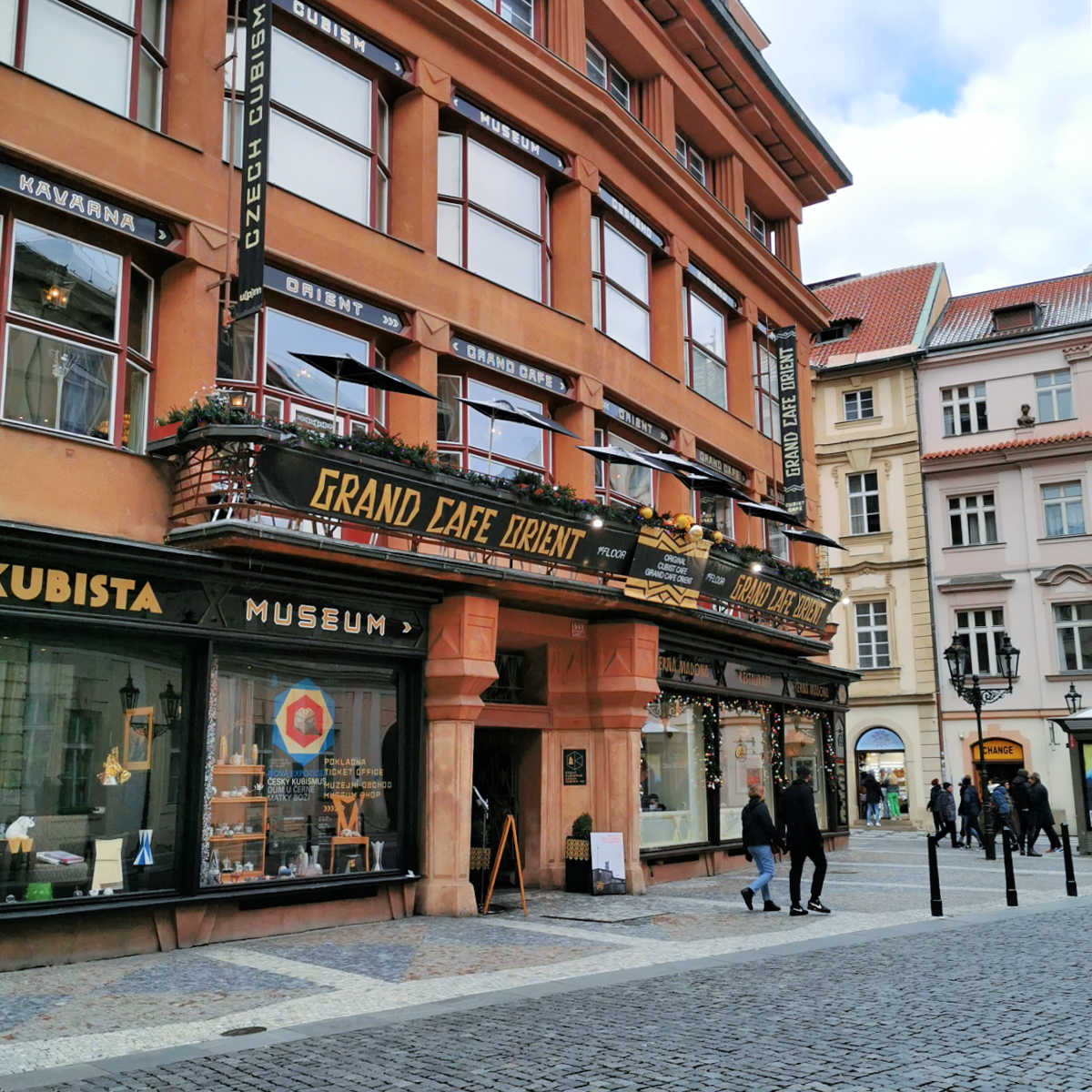
The House at the Black Madonna, was originally designed as a department store by Josef Gocar in 1911-1912. On the first floor, you can visit the world’s only Cubist café – Grand Café Orient, for which Josef Gočár designed the interior furnishings, including chandeliers and lanterns.
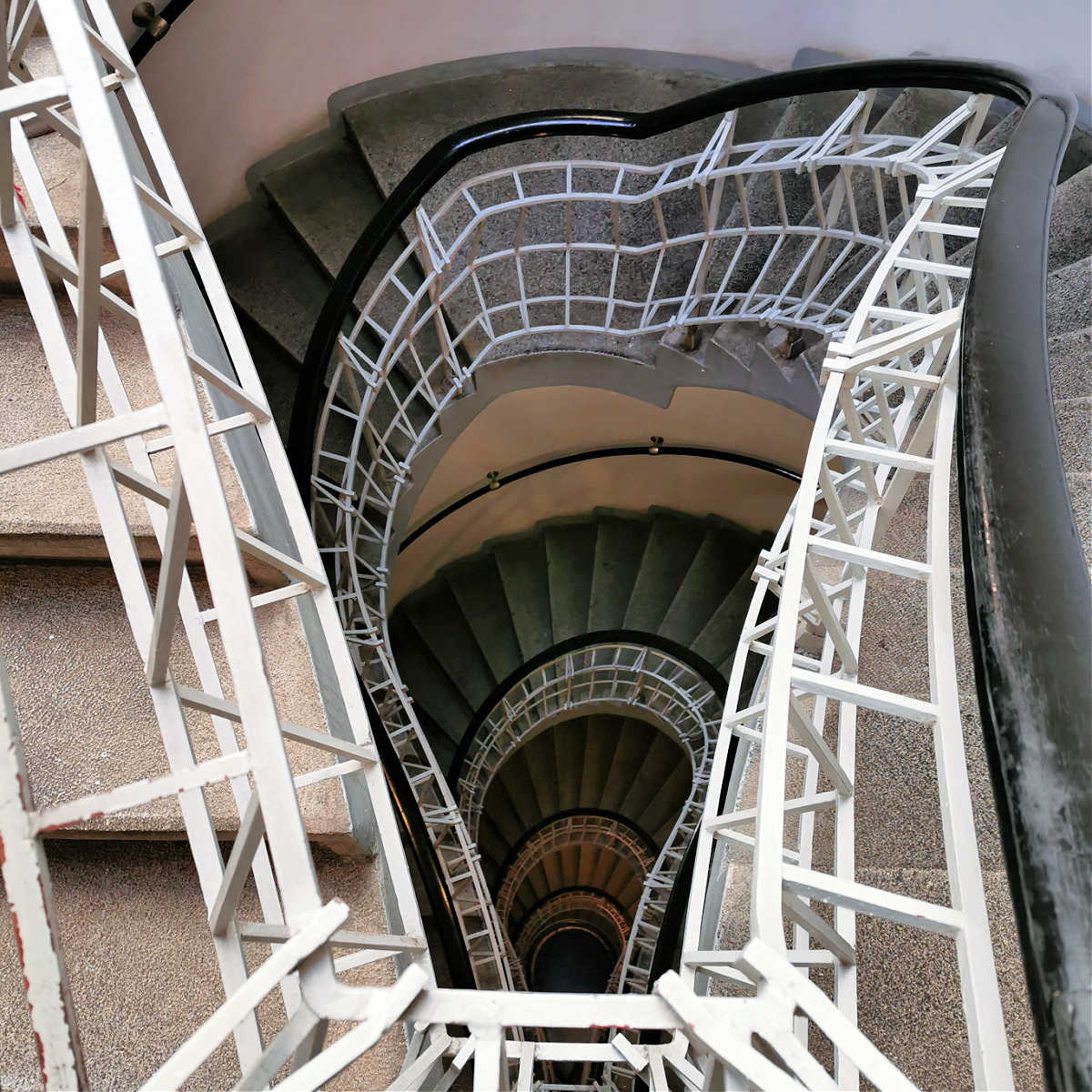
I’ve also enjoyed visiting the museum, which has examples of furniture, short films about other cubism houses in Prague. I love that you can also see how the building could have looked like when it was a department store with spacious rooms, light from the large windows and beautiful staircase.
PIN TO KEEP FOR LATER

The history of the House of the Black Madonna
The House of the Black Madonna was built on the site of a demolished Gothic house, which had a street number 569 and the streets around were called U zlaté mříže (At the golden iron gate) or At the Black Madonna.
The oldest parts of the original house were late Gothic, but the rest of the house was mostly dated from the seventeenth century. The sculpture of the Black Madonna (also from around 1700), which gave the house its name, was transferred from the original buildings and incorporated into the design of the new building. You can see the statue on the corner of the house, on the level of the first floor, from the Celetna Street.
The decision to demolish the old Gothic house was made at the turn of the 19th and 20th centuries, but when it came to the demolition in 1911, there were huge protests and people tried to save the house. Despite the protests, the old house was torn down and in its place, a department store for the wholesaler František Josef Herbst was built based on Josef Gočár’s design.

The interior of the house, including furniture and other details, was also designed in the Cubist style. You can also see characteristic cubist deco on the entrance portal, roof dormers, wrought iron grilles at the entrance, and stair railings, and the painting with a geometric pattern. Gočár also designed the interior of the Grand Café Orient, built-in furniture and a bar counter made of dark-stained oak wood.
The original set up had a vine bar on the ground floor, cafe on the first floor and shop with textiles on the third floor. The third floor was used as offices for the business and last – fourth floor as flats for the owner and family.
The cafe become less popular at the beginning of the 1920s, apparently because of the cubist style going out of fashion and the floor was converted to offices.
Sadly, the building was used as a department store only until 1922, because the original owner passed away. After this time, more and more of the house space was converted to offices until it was confiscated in 1948 and by the 50s the whole house was used as offices for a building company.
At the beginning of the 1990s the house was owned by the Ministry of Culture, who used the house as a collateral against a 300 million Czech crowns loan to fund a new lottery business. The department nearly lost the house, because the lottery went belly up and they had to quickly get a loan from another bank to cover it.
After the devastation of the interiors during gradual modifications for office use, a complete reconstruction of the house took place in 1993–1994 based on designs by Karel Prager. It’s nice to see that the building was put back to how Josef Gocar originally designed and they also finished building a part of an attic that originally had a glass roof. The reconstructed café on the first floor was opened in 2005.
In 2010, the house becomed listed as a Czech national cultural monument.

The Cubism Museum Visiting Guide
The Cubism Museum has been in the building in some shape or form (and with a few gaps) since the house was completely reconstructed in 1993. The museum is quite large and takes up three floors of the building.
You can see here furniture collection, interior accessories, photos, short films about works by the most significant Cubism designers.
And of course, you can learn more about the cubist architects and designers such as Pavel Janák, Josef Gočár, Josef Chochol, Vlastislav Hofman, Otakar Novotný and František Kysela. Their works are complemented by a selection of Cubist paintings by artists Emil Filla, Bohumil Kubišta, Josef Čapek and Václav Špála, as well as sculptures by Otto Gutfreund.
If you don’t get the chance to visit all the main cubist buildings, you can see their period photographs and building plans here.
In 2022, the museum acquired the most significant private collection of Cubist pieces in terms of quality and scope. This collection has 14 sets of furniture and another 65 items, sets of ceramic, metal and glass art works. It includes works by Vlastislav Hofman, Josef Gočár, Pavel Janák and other authors.
- Opening Times: Tuesday 10 am – 8 pm, Wednesday – Sunday 10 am – 6 pm (Mondays closed)
- Museum Tickets: 150 CZK adult tickets, students & seniors 80 CZK
MORE MUSEUMS & ART GALLERIES
- House at the Golden Ring Museum – Prague during Charles IV reign >>
- Dvorak’s Museum in in a Baroque Villa by Kilian Ignaz Dientzenhofer >>

Grand Cafe Orient
The Grand Cafe Orient is on the first floor of the building and it’s the only Cubism cafe in the whole world!
The cafe opens at 8 am in the morning, so you can come in for breakfast or morning coffee. The cafe also offers light lunches, salads, homemade burgers, vegetarian dishes, desserts and coffees of all kinds, as well as alcoholic and non-alcoholic drinks. The speciality here is the traditional Czech Venecek pastry cake made into a square to symbolise Cubism.
I’ve visited the cafe on a mid week day during January and it felt nice and cosy with only few people. It’s a different story during high tourist season, when this place becomes a little too busy for my liking. The prices are also quite high, but I guess you pay for the location.
When we visited there was no option to use a card, so make sure that you have enough cash. I understand that this has now changed, but I always take some extra cash, just in case.
The Cerna Madona Cafe
The Černá Madona café is on the ground floor and there are plenty of tables both inside and outside for you to enjoy breakfast, light lunch or afternoon pastry. The cakes are displayed at the ground floor window and you can even admire them from the outside!
Kubista Shop
If you want to buy cubism inspired gifts, original art or authentic furniture and accessories, you should definitelly visit the Kubista Shop, which is in the same building on the ground floor with the entrance from the back of the building.
You can find some amazing gifts there, which will make the perfect souvenir from Prague. My tip is also to look at the Cubism Museum ticket office, as they have more cubism inspired gifts there and some with much more affordable price tag.
MORE MUSEUMS & ART GALLERIES
Josef Gocar’s background, life & work
Josef Gočár (13 March 1880 – 10 September 1945) was educated at the Prague School of Applied Arts under Professor Jan Kotěra, the founder of modern Czech architecture.
Gočár’s early work was influenced by the Cubist and Rondocubism movement and he became one of the pioneers of this architecture style in the Czech Republic.
Apart from the House of the Black Madonna, he designed several other interesting buildings in this style, including the Legiobanka Building in Prague, completed in 1923.
If you visit the Prague ZOO, you can also see two wooden houses, which Gocar designed for Prague – Kbely airport to be used as the original departure halls. They are in the top part of the ZOO and one is now a traditional Czech restaurant and the other one has a temporary exhibitions in.
You can also see the St.Wenceslas Church in Vrsovice (Prague 10), but this building Gocar designed in a functionalist style in 1930.
Gocar also worked on projects outside of Prague, mainly in Hradec Králové (Town Hall, School, stairs) and Pardubice town (Winternitz Automatic Mills).
I’ve also seen his department store Wenke in Jaromer, which is so light and beautiful building, it must have been a really lovely to shop there!
Location & How to get to the House of the Black Madona
Ovocny Trh 19, Prague 1, Old Town
The house is standing on the corner of the Ovocny Trh and Celetna Street in Prague 1, Old Town, only a few minutes walk from the Old Town Square. The nearest underground station is ‘Namesti Republiky’ on the B line (also a tram stop for numbers 6, 15, 34) and then about 5 minutes walk. There is no direct tram or bus stop nearby.
This blog post was originally written on 28 May 2024 and last updated on 25 May 2026


