
Cubist Architecture in Prague – self guided tour of the best buildings
Join me on a self-guided tour of my favourite cubist and rondo cubist style buildings in Prague, where you’ll see this very special architectural style of early 20th century. You’ll see the only cubist lamp post, cafe and a cemetary in the whole world and discover why Cubism can be mainly found in Prague and the Czech Republic.
This year, I volunteered for Open House Praha and I was one of the English speaking guides running tours in Adria Palace. This inspired me to look up more cubist style buildings and learn more about them. I have to say, that cubism wasn’t a style that I particularly liked, but it’s definitelly growing on me! After visiting the Cubism Museum at the Black Madona and working on this self-guided tour for my blog, I’m finding cubism style everywhere and it’s nice to be able to recognise the style from other historic styles.

A short introduction to Cubism – an architecture style unique to Prague and Czech Republic
The original Cubist architecture is very rare, but Prague is one of the few places where you can see quite a few examples of this unusual style. Cubism was applied to architecture mainly in Prague, Czech Republic and central Europe as Czech architects were the first and only ones to ever design original Cubist buildings. Cubist architecture was mainly built between 1910 and 1914, but the Cubist or Cubism-influenced buildings were also built after World War I. After the war, another architectural style called Rondo-Cubism was developed in Prague fusing the Cubist architecture with round shapes.

How to use my self-guided tour itinerary
I’ve included all the major cubist and rondocubist buildings in my self-guided tour and I’ve listed them in order of how far they are from the Prague centre and also in order of being able to visit them and see the interiors as well as exteriors.
You can see most of the buildings close to the centre of Prague within 1/2 day, but if you want to see all of these (and visit the museum and the coffee houses in some buildings) the tour can easily stretch to a whole day and more.
What you should know before setting off
Most of the cubist and rondocubist buildings are privately owned and not open to the general public. But you can see all of these by walking around and often you can also see the interiors when they are open during special open days during the year (such as the Open House weekend in the middle of May).

Black Madona House, Cafe, Cubism Museum & Shop
The best place to start our tour is right in the centre of Prague at the Black Madonna House, which is just a few minutes walk from the Old Town Square. If you don’t have time to visit other buildings, you can spend time here, admiring the cafe interiors whilst having a lunch or a morning coffee and a square ‘venecek’ cake (a cafe speciality), visit the cubism museum and the cubism inspired shop.
The House at the Black Madonna was originally designed as a department store by Josef Gocar in 1911-1912. On the first floor, you can visit the world’s only Cubist café – Grand Café Orient, for which Josef Gočár designed the interior furnishings, including chandeliers and lanterns.
I’ve also enjoyed visiting the museum, which has examples of furniture, short films about other cubism houses in Prague and beyond that you can see how the building could have looked like when it was a department store (large spaces, light from windows and beautiful staircase).
Location: Ovocný trh 19, Prague 1, Lesser Town

Diamant House
The house was originally built for a local pharmacist František Schnöbling who purchased a piece of land on the corner of Lazarska street at the beginning of the 20th century. The house was built in 1912 by Matěj Blecha’s company with facades in the style of Art Nouveau based on the plans of F. Ohmann. The facades were pretty much straightaway redone in Cubist style, possibly following Emil Králíček’s design and the house was finished the next year (1913).
Interestingly, the house is connected to the Holy Trinity church next door by a Cubist arcade dating also to the 1913. This arcade was designed by architect Pfeiffer (or possibly Emil Kralicek) and to protect the statue of St. Jan Nepomucký by Jan Brokoff from 1717.
The Diamant house is still privately owned, but you can walk around and see it from the outside. The ground floor has a discounted English Book Shop, which is great for holiday novel reading, but they also sell guidebooks and books about Prague in the English language.
Location: Lazarská 82, Prague 1, New Town (nearest tram stop ‘Vodickova’ on trams 9, 42, 22 etc.)

U Mysaka
The historic House at Myšák was originally a Neo-Renaissance building from 1883 by architect Otto Ehlen, but was reconstructed in 1922 in the Rondocubist style based on design of the builder Josef Čapek, who was inspired by Josef Gocar. ‘U Mysaka’ house makes a great stop on our cubism architecture tour, because it’s also a well known patisserie and a coffee house.
The interiors have been re-done in 2007, but they are in keeping with the 1920s style. It’s always fairly busy, so I usually visit during the week, when you can get a table either upstairs in the modern part of the building or if you are lucky, you can sit in the original entrance to the cafe downstairs.
Location: 710/31, Vodičkova, New Town, Prague 1 (nearest stop ‘Vaclavske Namesti’ on tram line 9, 42 etc)

Newspaper Stand at Vrchlicky Park
The next example of cubist architecture is a wooden tobacco and newspaper stand from the 1920s, which was probably designed by architect Pavel Janák. I say, probably, because, in the most recent biography book about Janák from 2011, the Austrian art historian Norbert Kiesling does not mention this building because he did not find it in any of Janák’s own project paperwork. It’s also possible that because this would have been temporary building at the time, it was not significant enough to mention.
In 1980, the kiosk was scheduled for demolition, but it was saved by the Prague Heritage Society. A year later, in 1981, the newspaper stand was declared a cultural monument and was restored to its original colours.
Location: Vrchlickeho Sady, Prague 1 (directly as you get off tram at ‘Hlavni Nadrazi’ Main Train Station stop, trams no. 9, 5, 15)

The only cubist Street Lamp in the world
A true rarity and the only one in the world is the cubist lamppost by architect Emil Králíček hiding in the corner of Jungmanovo Square in the centre of Prague. The lamp column is made of artificial stone in the shape of pyramids stacked on top of each other. The lamp was recently repaired and since spring 2024 is switched on again at the sunset.
Location: Jungmannovo Square, Prague 1 (nearest underground ‘Mustek’ & then walk towards the music department store)

Legiobank Rondocubist architecture
I think that the Legiobank is one of the best examples of rondo cubist architecture in Prague. This building was designed by Josef Gočár and built between the 1921 and 1923. The facade was designed by the well-known Czech Cubist sculptor Otto Gutfreund,who was the world’s first Cubist sculptor. As you look up the facade, you can see sculptures of Czech legionnaires and scenes from their warfighting in Serbia during World War I.
You can have a look inside the lobby to see the beautiful wooden doors, intricate iron railings with decorative spirals, parquet flooring, wall paintings and marble decor. The main part of the building is still being used as bank and the front of the building has an upmarket cafe where you can have great coffee and desserts. The cafe is run by the same company that runs the Black Madona Cafe, but it’s a lot less busy, so it’s worth visiting if you’d like to sit somewhere less crowded for a while.
Location: Na Poříčí 24, Prague 1, New Town (opposite the department store ‘Labut’ – nearest underground ‘Namesti Republiky or Florenc’)

Adria Palace
The Adria Palace is another rondocubism style building which was built between 1923 and 1924 and was designed by architect Josef Zasche in collaboration with Pavel Janák. You can walk inside the passage, which still has a few shops, a theatre and cafe – restaurant.
I often pop into the Adria Cafe upstairs, because despite being directly in the centre, it’s never that busy and the prices are still reasonable. There is a great view from the cafe terrace, where you can enjoy your coffee and cake watching people walking by.
Location: Jungmannovo Square, Prague 1, New Town (just outside ‘Mustek’ underground station)

Radio Palace Rondocubist architecture
The Radio Palace was built in the rondocubist style between 1922–1924 and was designed by the Czech architect Alois Dryák as a cultural and social centre for the Vinohrady district of Prague.
The building is constructed on a U-shaped floor plan with an internal built-in courtyard wing. The building was used as cinema and ballroom. There are several small halls, which all have separate bar area, backstage area, and are all soundproofed. The Great Hall is impressive 1550 m2 and has a wooden parquet floor, ornamental columns, a variable stage with a luxurious curtain, and a spacious gallery with a beautiful marble entrance.
Location: Vinohradská 1789/40, Prague 2, Vinohrady (walk up from Namesti Miru – tram stop or underground or nearest tram stop is Italska on tram line 5, 11, 13).

Houses below Vysehrad – Kovarovicov House, Neklanova Street House
I was always fascinated by the Cubist-style houses under the Vysehrad Hill fortress, which are so different to the rest of the houses in the area.
A true gem of Cubist architecture is the apartment building at 98-VI on the corner of Neklanova and Přemyslova streets. The house was built by the contractor František Hodek between 1913 and 1914.
In the years 1912-1913, the prominent architect Josef Chochol built the Kovařovic villa in the Cubist style on Rašínovo nábřeží (Libušina street no. 49/3). The most distinctive Cubist element is the facade, windows in deep alcoves, or the striking sculptural cornice. It is the house in my photo and the one you can easily see from the tram as you go by.
As you walk towards the Vysehrad fortress, you can also see more cubist houses, which are directly at the Rasinovo Nabrezi just before the tram goes through a little tunnel.
Location: Rasinovo Nabrezi, Prague 2 (nearest tram stop ‘Vyton’ on tram line 17, 6, 2, 3)

Bethlehem Chapel in Zizkov
This cubist-style chapel is hidden in the inner block of houses on Prokopova Street in the Žižkov district of Prague. It’s used by the Czech Brethren Evangelical congregation and was originally designed by Emil Králíček.
The reason why the chapel is standing between the other houses is because, at the time, there were no free building plots available, so the congregation purchased a house on Prokopova Street, known as “At General Zach’s,” which was built in 1870 by the entrepreneur František Horn.
The newly purchased building plot was also previously used as a sand mining pit, which was later filled with debris from the demolition of the Old Town. This was definitely not an ideal surface for building a new chapel, so the builders had to first put a concrete slab over it before building the new foundations.
When the church was being built the neighbours were not too happy about it and tried to stop it. They were unsuccessful, and on the day of the Sarajevo assassination, June 28, 1914, the chapel was solemnly opened.
Location: Prokopova 216/4, Prague 3, Zizkov
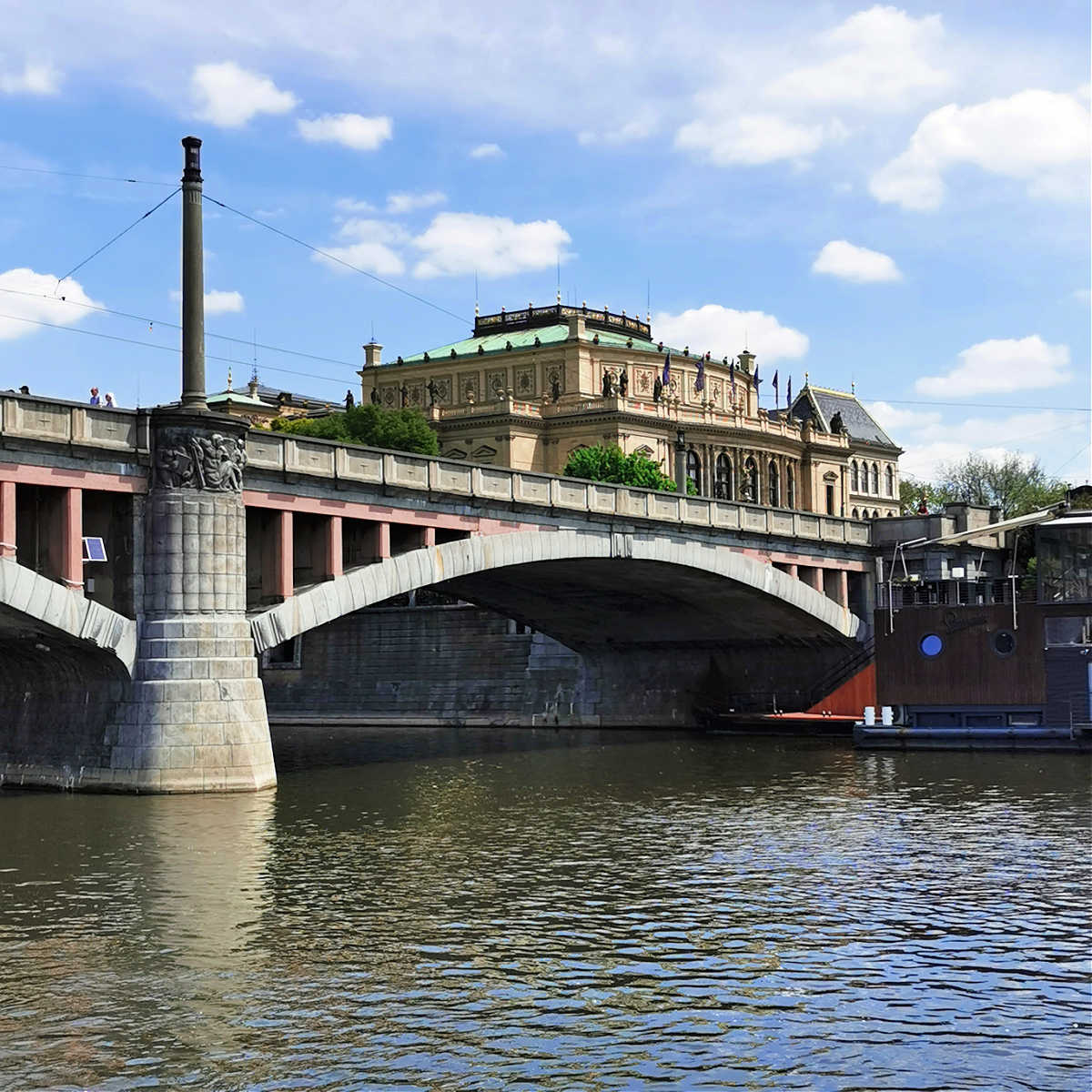
Bridges – Manes, Liben, Hlavka Bridge – Cubist Architecture
Probably not as super exciting as other cubist buildings, but I think it’s worth mentioning that the Manes, Liben and Hlavka bridges in Prague, were designed in cubism style. The Manes and Hlavka bridges are close to the centre of Prague, so you can walk across Manes Bridge when you cross the Vltava river going from the Old Town Square to the Malostranska Underground (and then walk up to the Prague Castle).

Dablice Cemetery Building
Prague seems to be winning with cubist architecture, so it’s probably no surprise when I tell you that Dablice Cemetery is the only cubist-style cemetery in the whole world.
The design of the Ďáblice municipal cemetery was put together by Vlastislav Hofmann, an employee of the city’s building authority, in 1912. This was a completely new cemetery, which included cubism elements in every aspect, including a cubist-shaped torso of the cemetery wall and two polygonal kiosks with impressive tiered roofs and a three-part gate built between them.
There should have also been a large mortuary building in the similar design as the entrance kiosks, but in the end, Hofmann’s original design was greatly simplified.
When you look at the cemetery plan, you can see that even the shape, paths and everything inside the cemetery were designed with a style – from the top, the cemetery looks like inside a steampunk watch. That’s not an official description, by the way, that’s how it looks to me…
The Ďáblice cemetery has 29 hectares, which makes it the second-largest cemetery in Prague after the Olšany cemetery.
Location: Ďáblická 564/2a, Prague 8, Dablice (few minutes walk from the last stop ‘Sidliste Dablice’ on tram line 10, 34 – about 25 minutes from the centre of Prague)
This blog post was originally written on 3 May 2024 and last updated on 3 May 2024
PIN TO KEEP FOR LATER


