
Stargazing in Prague: Visiting the Štefánik Observatory on Petřín Hill
Štefánik Observatory on top of Petrin Hill has been welcoming visitors since 1928, offering everything from daytime solar observations to nighttime stargazing sessions. I’ve recently visited the fascinating meteorite exhibition and enjoyed learning more about Milan Rastislav Štefánik – the astronomer after whom the observatory is named.
The best thing is that the observatory has recently extended opening hours, so that you can come up and watch the day and night sky later in the afternoon or evening.
Here’s everything you need to know about visiting this hidden gem, including what to see inside and my local tips.
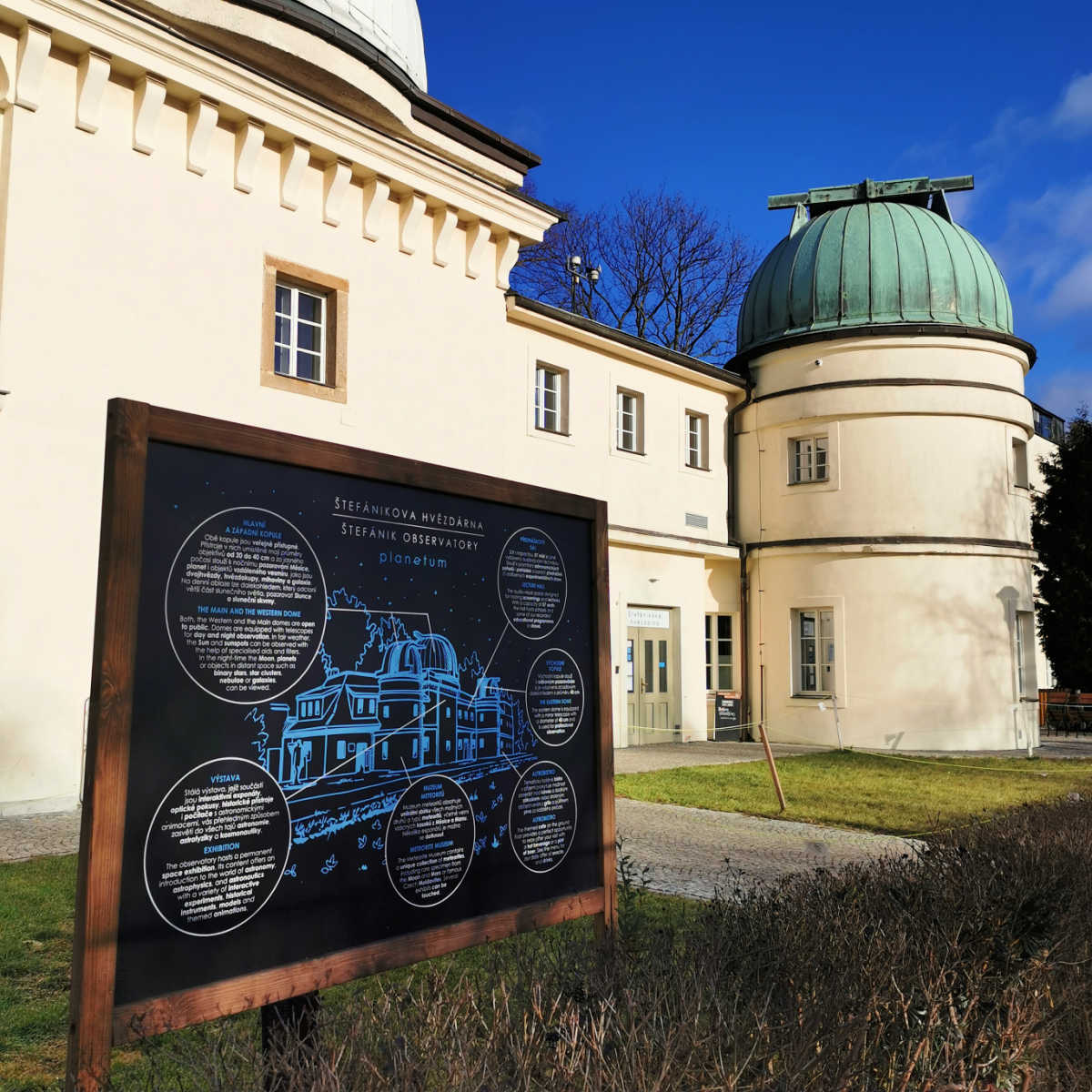
The Štefánik Observatory History
The Czech Astronomical Society was founded in 1917 and straight from the beginning they had a plan to establish a public observatory in Prague or near the city, accessible to members and guests.
Unfortunately, the society’s financial situation and the lack of official permits didn’t make this possible for some time. I found out that as a temporary observation site, the society used between 1920 and 1922, an artificial cave in what is now Havlíček Park – Grebovka in Prague 2.
It took another few years, before the Astronomical Society managed to find the right place and finally in 1928 the first observatory was built on top of the Petřín Hill. It was named in honour of Slovak astronomer and national hero Milan Rastislav Štefánik.
The observatory’s main building was designed specifically for public astronomical education and observation, and it has undergone several renovations since then — mainly in the 1970s and again in the early 2000s to modernize its equipment and exhibition spaces.
What to know before you visit & my local tip
The two large telescopes can be only used during dry weather (they can not get wet) and the stars or moon is only visible when it’s clear sky (even during day).
This means that if it’s cloudy, misty or raining, it’s probably not worth visiting the observatory, unless you are just happy to see the exhibitions. The staff won’t be able to show you the telescopes in action.
In fact, when we visited, it started to pour down quite suddenly and the staff had to quickly close the roof. They even told us that if there is a chance of a storm lighting, they have to evacuate the building just in case, as the telescopes are so large (and made of metal of course), that they could easily attract the lighting through the wooden roof.
What can you see inside the observatory
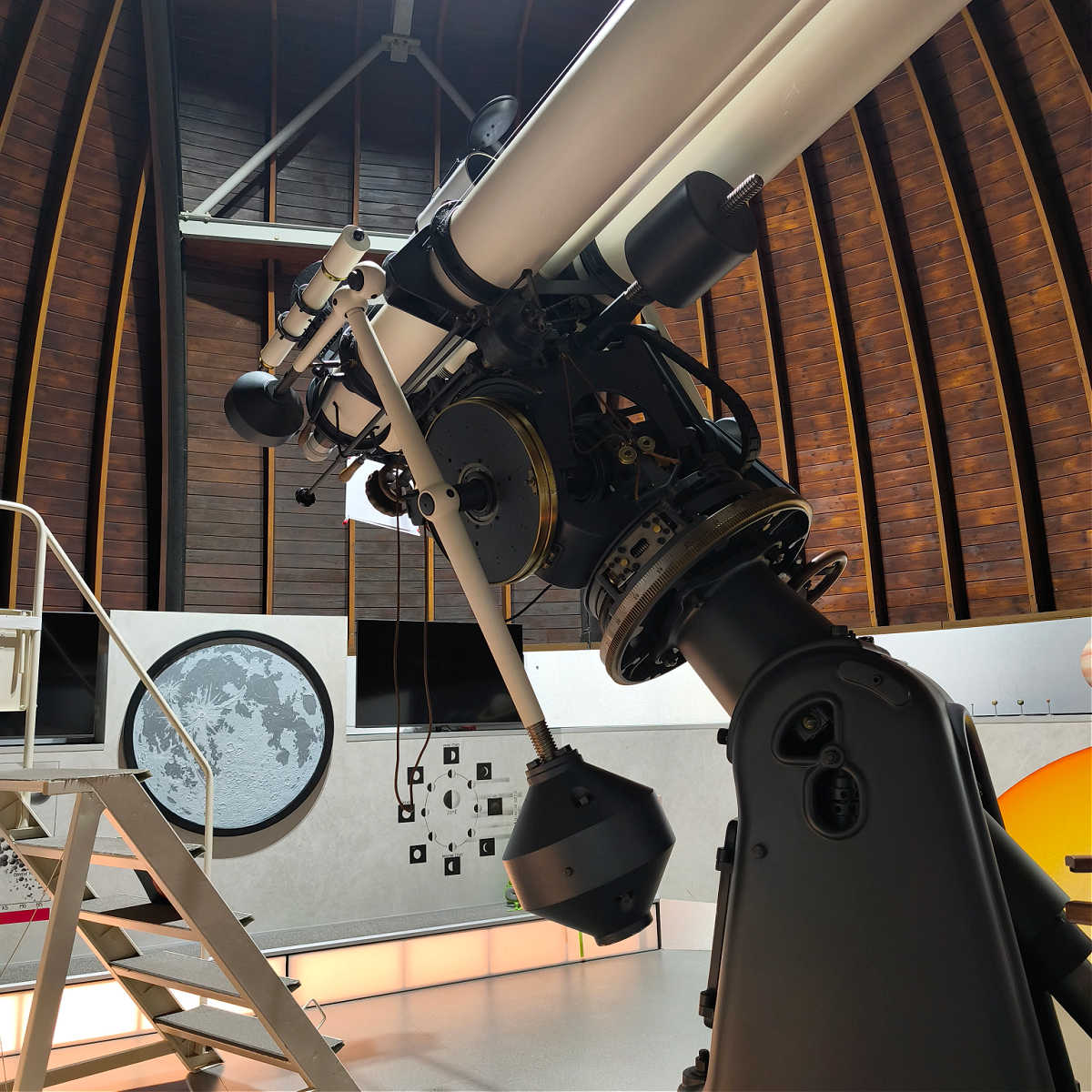
The observatory building has several telescopes available for both daytime and night time observations. The most popular is the largest telescope with three refractors in the main dome. It is used for exploring the night sky but also allows observation of the Sun’s surface, prominences, and solar flares.
On the upper floor, there is a permanent exhibition focused on astronomy and history of the observatory.
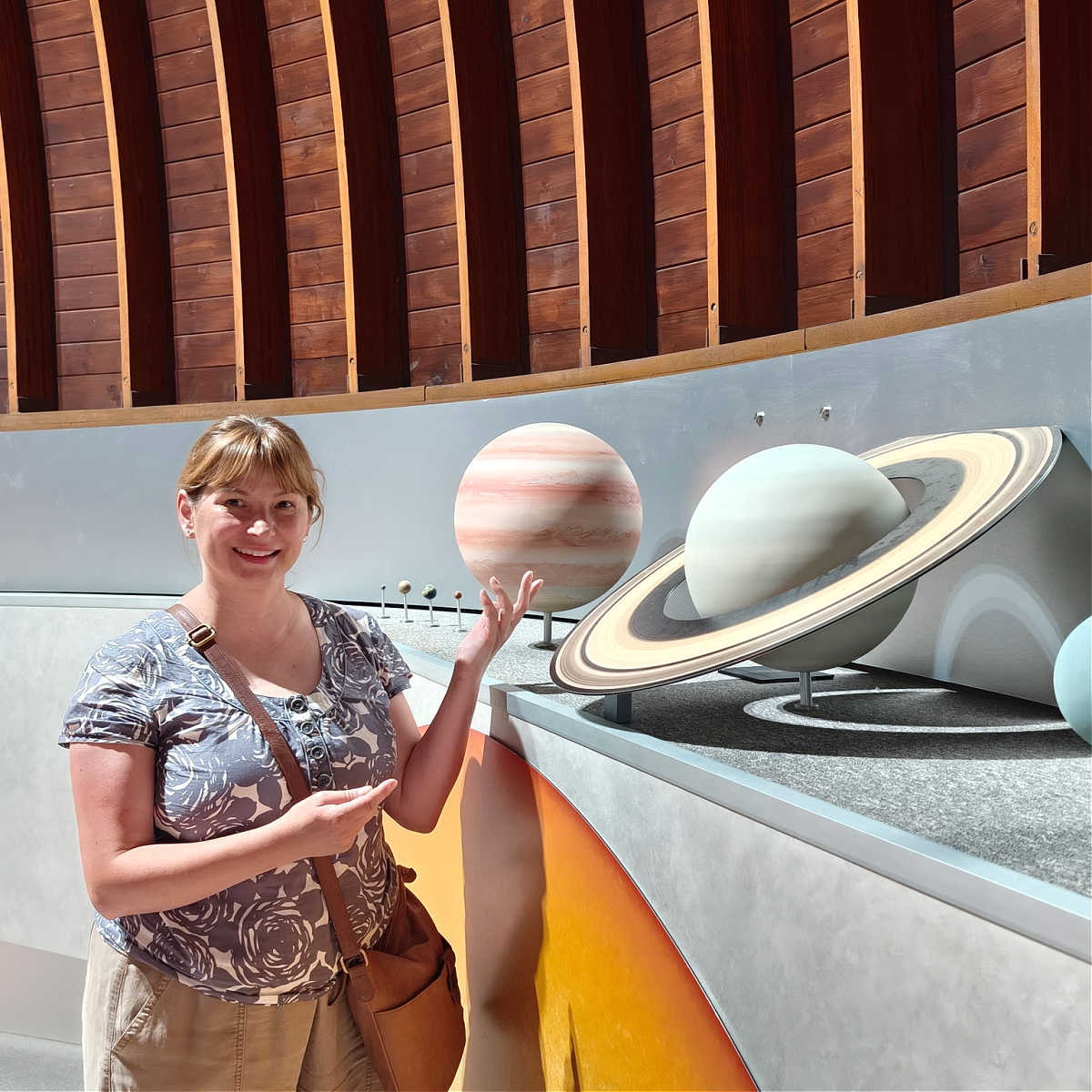
There is also a new exhibition called the Meteorite Museum, where you can see an extensive collection of meteorites, including rare meteorites originating from the Moon, Mars, and the asteroid Vesta. What’s super cool is that some of the meteorites can even be touched.
A special part of the exhibition is also dedicated to the Slovak astronomer, aviator, and politician Milan Rastislav Štefánik, where you can learn more about his life.
The Zeiss Astrograph Telescope
The main telescope of the Štefánik Observatory is a double Zeiss astrograph, which was made in 1905 and used as the observatory’s main telescope since 1930.
This impressive telescope weighs 5.5 tons, was purchased for the observatory in 1928 from the estate of Viennese selenographer König.
The telescope was completely renovated between 2022 and 2024 and since then it’s being used again for observing the planets and the Moon. If you spot a few dents and scratches on the telescope, these were preserved deliberately (the telescope was damaged during the second war war).
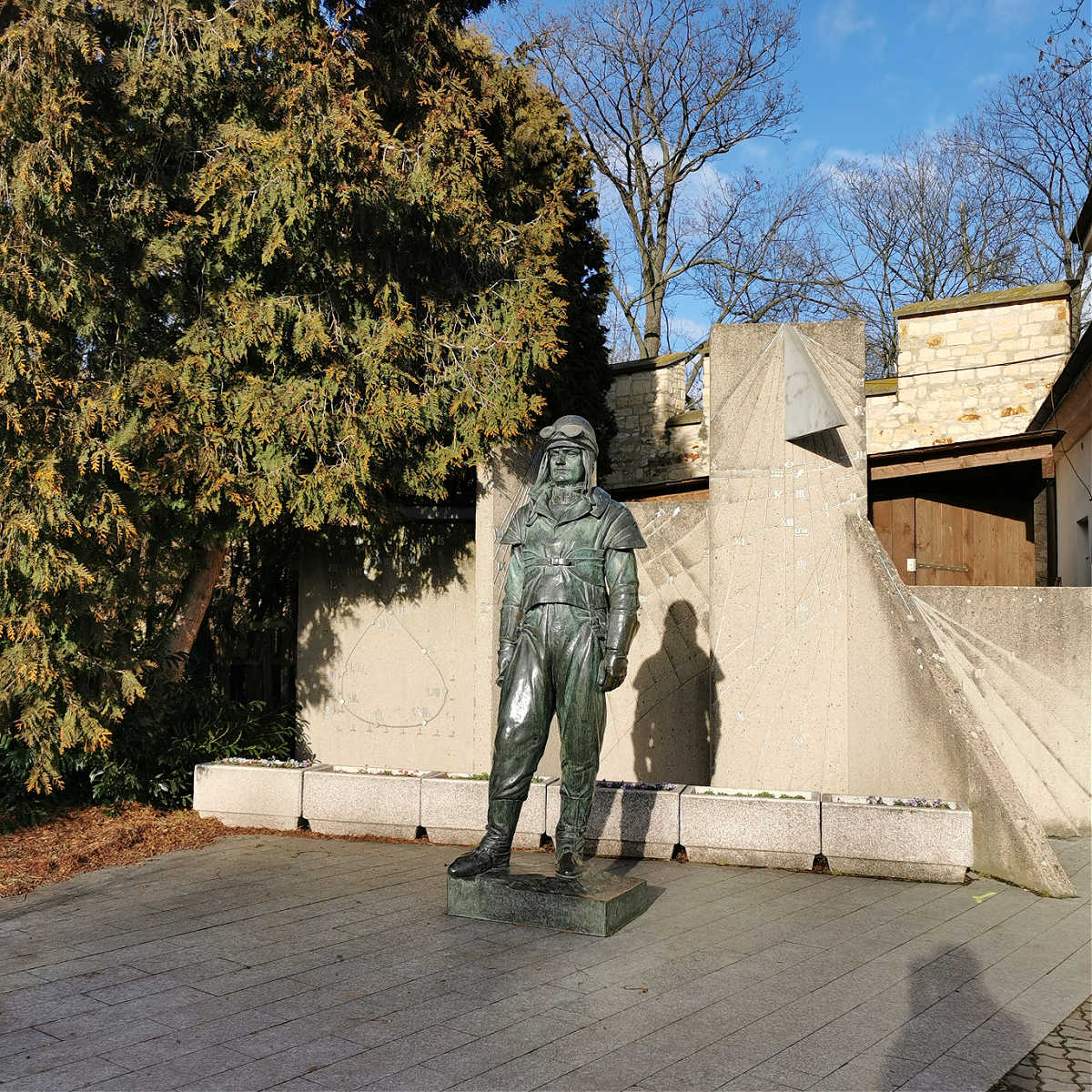
Who was Milan Rastislav Štefánik
Milan Rastislav Štefánik (1880–1919) was a Slovak astronomer, aviator, diplomat, and politician who played a key role in the founding of Czechoslovakia.
Born on July 21, 1880, in Košariská, Slovakia, he studied astronomy and philosophy at Charles University in Prague, earning his doctorate in 1904. He later worked in France at the Meudon Observatory, where he conducted significant astronomical research, including observations of solar eclipses and atmospheric phenomena.
Štefánik was also a skilled pilot and used his aviation expertise during World War I, serving as a general in the French army. Alongside Tomáš Garrigue Masaryk and Edvard Beneš, he helped establish the Czechoslovak National Council, which laid the groundwork for the creation of Czechoslovakia in 1918.
Tragically, Štefánik died in a plane crash near Bratislava on May 4, 1919, while returning to his newly founded homeland.
Practical Information for visiting the observatory
Location: Strahovska 205, Prague 1 (top of Petrin Hill, right next to the entrance (or exit) of the Petrin Funicular)
Ticket Prices:
Adults 110 CZK, Students, Seniors 90 CZK, Children free
Opening Times:
The opening times vary, based on the time of the year and daylight and the observatory is often open until 8 or 11 pm. This also means that it also opens later – often at 2 or 3 pm during weekdays. Weekends are generally open from 10 am – 4 or 5 pm. The observatory is also open on special occasions depending on what’s likely to be visible in the sky.
The observatory is always closed on Mondays.
Facilities & Shop
In the renovated ground floor, you’ll find the a small cafe called Astrobistro and also souvenir shop. The cafe is open to anyone and you don’t need a ticket to use it. They have a few tables outside overlooking the rose garden and also indoor seating.
How to get to Stefanik Observatory from the centre of Prague by public transport
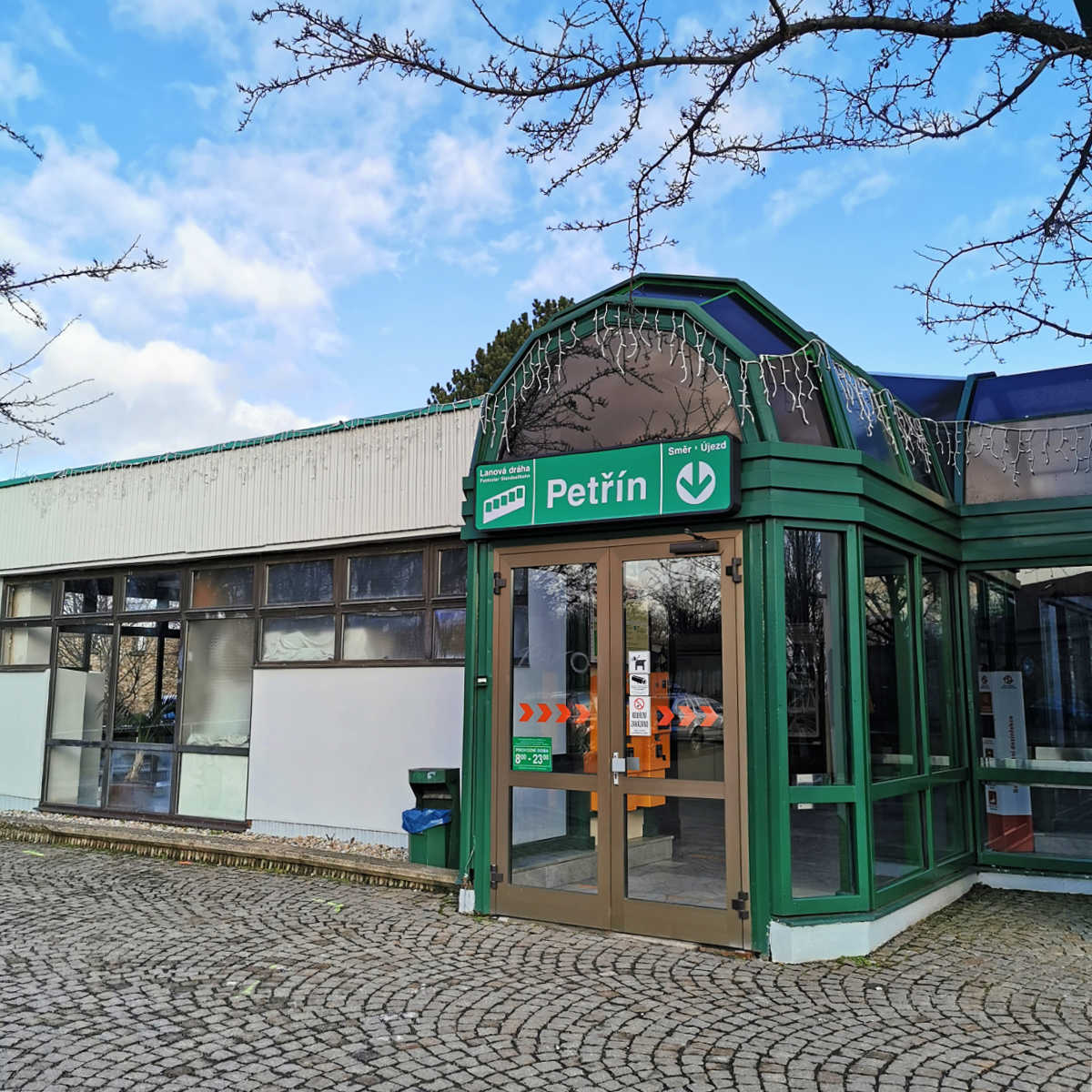
The most popular route is to take a tram to Újezd and then continue by the Petrin Funicular. You can catch tram number 9, 12, 15, or 20 to the Újezd stop. From there, it’s a short walk to the lower station of the Petřín Funicular Railway (Lanová dráha Petřín). Take the funicular up to the Petřín stop, and after getting off, follow the signs to the Štefánik Observatory, it’s literary round the corner.
If you prefer walking, you can also reach the observatory on foot through Petřín Park. From Malostranská metro station (Line A), it takes about 30 to 40 minutes uphill through the narrow historic streets and gardens, while from Újezd, the walk is shorter, around 20 to 25 minutes uphill.
If you happen to be at the Prague Castle, stay on top of the hill by walking towards Strahov Monastery and then continue walking towards Petrin Lookout Tower. Keep going and walk towards the upper entrance to the Petrin Funicular, pass that and you will see the observatory on your left, opposite the beautiful rose garden.
You can use the same ticket for the tram, metro, and funicular, as the funicular is part of Prague’s integrated public transport system. A 30-minute ticket costs 30 CZK, and a 90-minute ticket costs 40 CZK.
How to get to the observatory when the Petrin Funicular is out of order
When the Petřín Funicular is not operating, you can still easily get to the top of Petrin Hill and the Štefánik Observatory from Old Town Square using public transport.
From the stop Staroměstská, take the underground line A to Dejvicka and then bus number 143 or 149 in the direction of Strahov and get off at the Stadion Strahov or Koleje Strahov stop. The whole journey takes about 35 minutes.
I also sometimes get the bus 191 from Andel (Line B underground), which is about 20 minutes and get of at the Stadion Strahov stop. If you happen to be around Karlovo Namesti (closer to the centre), there is another direct bus 176, which takes about 25 minutes and will take you to Stadion Strahov bus stop too.
From there, it’s roughly a 5-10 minute walk to the observatory and the good news is that it’s mostly level (and definitely no climbing!). Follow the signs toward Petřín Hill – you’ll first walk by the student accommodation buildings and then walk through the Rose Garden to get to the Štefánik Observatory.
This blog post was originally written on 26 October 2025 and last updated on 26 October 2025


