17 Most Beautiful Churches in Prague: A Complete Guide
Prague was once called the city of a hundred spires and it’s no wonder why. Everywhere you look, you can see a church or a house tower. I usually just walk around churches, since they are so beautiful to look at from the outside, but recently I started to also visit them inside.
I admire the beautiful decorations, colours and the light that comes from the stained glass windows. It’s lovely to see that each church has it’s own identity and they are all very different from each other.
So, today, come with me on a walk through Prague and visit some of these amazing churches as you explore the town. Most of the churches are free to enter and where you need to pay an entrance fee is fairly moderate (perhaps apart from the St.Vitus Cathedral).
It’s difficult to order the most beautiful church list, because each church is beautiful in a different kind of way. But recently, the ones I’ve been most surprised by were the St.Nicholas Church at Old Town Square ( with an unusual light chandelier), St. Paul & Peter Cathedral at Vysehrad (because of the colourful paintings, that cover the whole church inside) and St. Nicholas Church at Lesser Square (because of the sheer size, statues decor and separate chapel with second floor).
1. Loretta
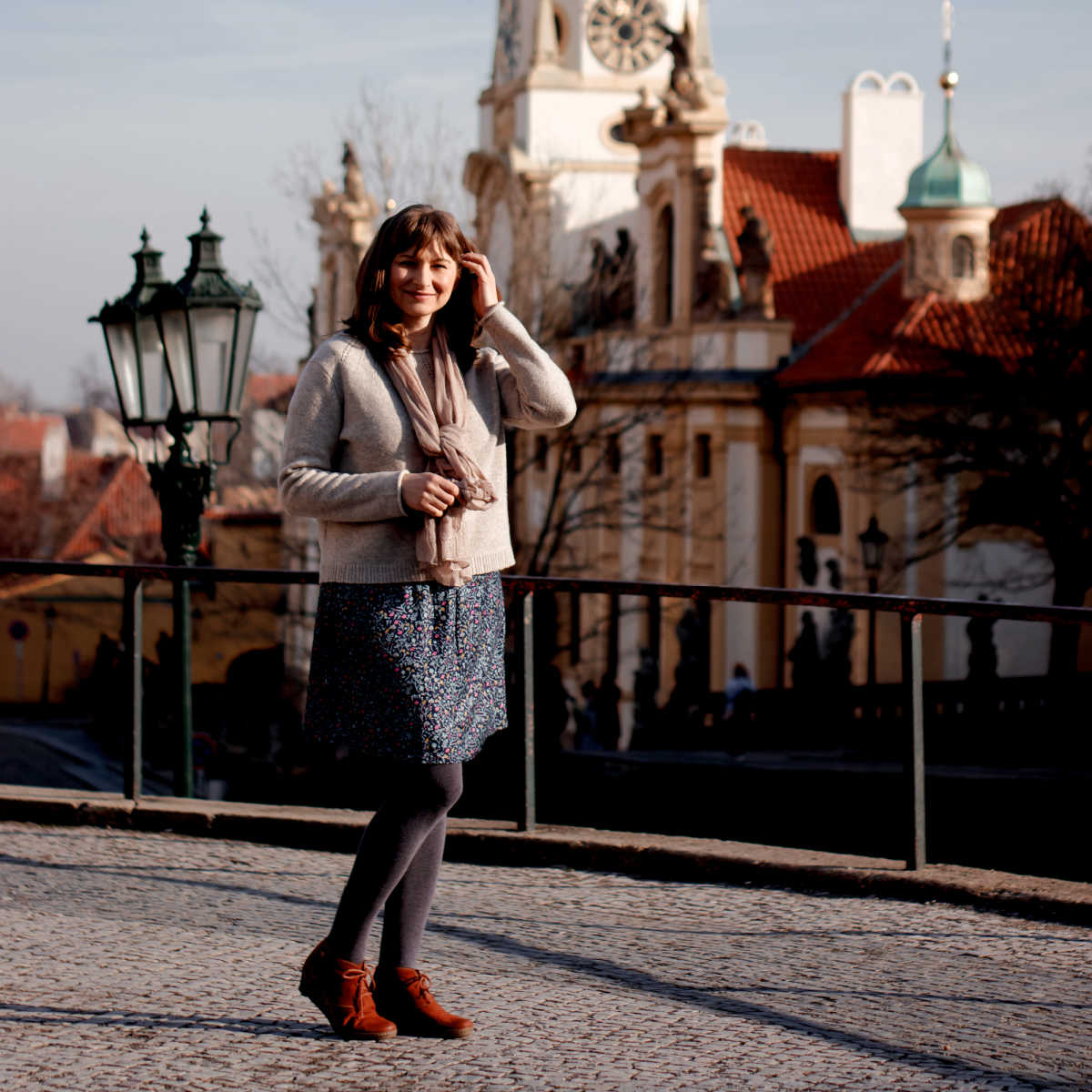
I always make a diversion to see this church when I’m walking down Hradcany to see Prague Castle complex or visit the Czernin Palace Garden opposite the Loreta Church.
The Prague Loreta Church and Chapel is a Baroque complex that has been a place of pilgrimage since 1626, when it was founded by a Bohemian noblewoman, Kateřina of Lobkowicz.
The Loreta church has a tower with a clock that plays a pretty tune every hour. The tune is actually played by 27 differently-tuned bells. When these were installed at the end of the 17th century, they were deemed a true wonder!
The Loreta Bells were donated by the wealthy merchant Eberhard from Glauchova. The author of all thirty signed bells is the Amsterdam city bell founder and clockmaker Claudy Fremy, who made them between 1683-91.
The bells were installed at Loreta in 1695 and big celebrations were held to mark the occasion. Each bell had its godfather from the ranks of the high nobility, and even the Bohemian Emperor Leopold I took patronage over the first bell.
- Location: Loretánské náměstí 7/100, 118 00 Praha 1 – Hradčany
- Opening Times: Daily from 10:00 am to 5:00 pm
- Tickets:
- Adults: 250 CZK
- Students (with valid student ID): 200 CZK
- Family (2 adults + 2 children): 600 CZK
- These prices cover the entrance to the entire Loreta complex, including the Treasury and seasonal exhibitions.

2. St. Nicholas Church (Old Town Square)
I was quite surprised when I visited this church because it’s so very different from the others. It looks absolutely huge from the outside, but the inside feels quite compact and cosy.
The beautiful chandelier is definitely what makes this church very special. Most of evenings, there are classical concerts here, but during the day, you can visit the church for free using the small entry from the side of the church.
The Church of Saint Nicholas was built during the Baroque period between the years 1732–1737 by the architect Kilián Ignác Dientzenhofer on the site of a burnt-down Romanesque church.
In 1871, the church was given for use to the Russian Orthodox Church. At that time, Russian Tsar Nicholas II donated to the church a huge chandelier in the shape of an imperial crown, which was made in the Harrachov glassworks. The chandelier makes the church as it’s quite unusual and decorates the whole space beautifully.
- Location: Old Town Square 27, Old Town, Prague 1
- Opening Times: Mon – Sat: 9:00 – 17:00, Sun 10:00 – 17:00
- Tickets: Free during day or buy a ticket for an evening concert, which start from 300 – 800 CZK

3. Church of our Lady of Snow
The Church of Our Lady of the Snow was founded in 1347 by Emperor Charles IV and opened the day after his coronation as King of Bohemia. The church was originally going to be a large triple-aisled basilica to show the world that Prague is the second Rome (as Charles IV was also a Roman Emperor).
The church vaults are reaching an impressive 34 meters, which makes the church on one of the tallest in Prague. Despite this, the church is somewhat hidden behind the houses from nearby Wenceslass and Jungmannovo Square.
Originally the church was part of a Carmelite monastery until the 15th century. During this period, it was also the preaching site of Jan Želivský, a prominent Hussite leader.
The Carmelite order was replaced by the Franciscans in the early 17th century and they continue to look after the church and serve the local community to this day.
My local tip: There are regular exhibitions within the church complex (I always visit the Christmas Bethlehem one in December) and you can take a walk through the Franciscan Garden that connects Jungmannovo Square with Svetozor Shopping Passage on Wenceslas Square.
- Location: Jungmannovo náměstí 753/18, NewTown, Prague 1
- Opening Times: Mon – Sat: 10:00 – 18:00, Sun 10:00 – 20:00
- Tickets: Free

4. St. Giles’ Church
St. Giles’ Church, located in the Old Town of Prague, is a monastery and church complex dating back to the 14th century. Over the years, the church has undergone many reconstructions, resulting in its present appearance as a four-wing monastery managed by the Dominican Order.
The church is famous for being one of the filming locations for Miloš Forman’s acclaimed movie Amadeus. The church is very opulently decorated with gold paint and it has a very traditional feel.
- Location: Husova 234/8, Old Town, Prague 1
- Opening Times: Mon – Sun 10:00 – 16:00
- Tickets: Free
5. Church of the Virgin Mary – At the Theatines
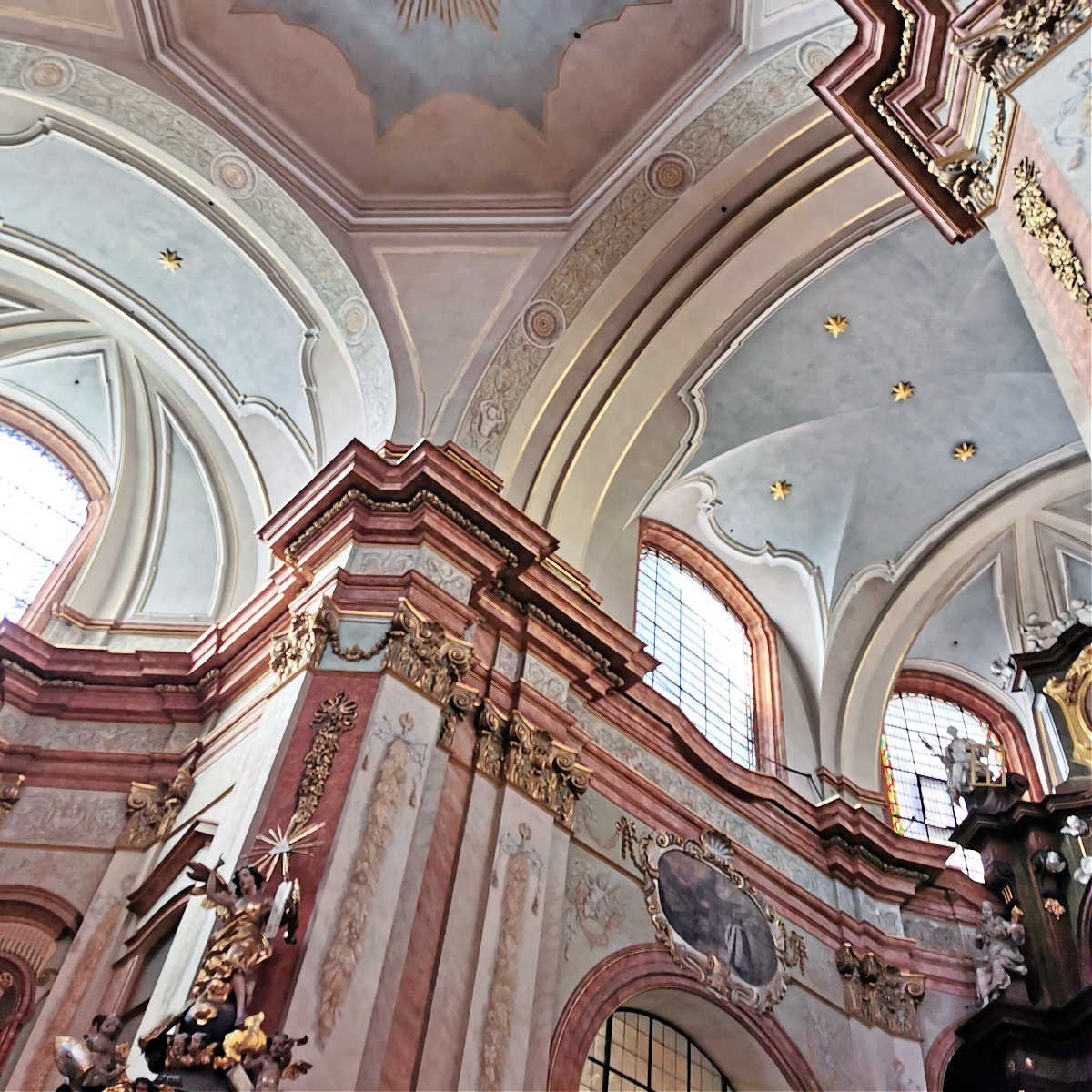
I really like this church – it’s almost playfully decorated like a beautiful fairy tale church and definitely worth stopping by.
At the site of two original houses near the former Strahov Gate on Nerudova Street, the Church of the Virgin Mary, also known as the Church of Our Lady “U Kajetánů”, was built between 1691 and 1717.
The foundation stone of the church was laid in 1691, and the construction was likely completed at the beginning of the 18th century, with the consecration taking place on September 29, 1717. The monastery and its school took in mainly noble sons from well-to-do families.
The first design was submitted in 1679 by the Italian architect Guarino Guarini, but it’s sometimes also attributed to Jean Baptiste Mathey, who was Santini’s mentor.
The final appearance of the building was probably not heavily influenced by the famous architect Santini as he took over the completion of the church construction in 1706. But as you walk around the church, you can start noticing the little stars on the ceiling, slightly edgier collums and the simple style of the decor in the upper part of the church walls, so you know Santini was here!
- Location: Nerudova Street 22, Lesser Town, Prague 1
- Opening Times: Mon – Wed: 13:00 – 17:00, Thu – Sun 10:00 – 17:00
- Tickets: Free

6. St. Salvator Church
You can find St. Salvator Church, near the Charles Bridge, as a part of the Clementinum complex. It was previously the headquarters of the Jesuits in Bohemia and was frequented by composer Jakub Jan Ryba (who is the author of the famous Czech Christmas Mass), who played the church organ in the 1780s.
The exterior of the church is decorated with 14 sandstone statues of saints by Jan Jiří Bendl, while the interior marble pavement was created by Kristina Kortesiová’s workshop in 1660. The whole church interior has a very elegant feel as it’s quite white and subtly decorated.
- Location: Křižovnické náměstí 1040/4, Old Town, Prague 1
- Opening Times: Monday to Sunday: 9:00 AM to 6:00 PM
- Tickets: Free during the day, evenings are usually reserved for classical concerts and tickets star from 300 CZK.

7. St. George’s Basilica
St. George’s Basilica is part of Prague Castle complex and was originally founded in 920 and rebuilt several times due to fires and wars. The basilica is easily recognizable because it has a pretty red colour, which was added during the Baroque.
The basilica kept some Romanesque interior decor as well as Gothic style from the 14th century, but most recently the basilica was reconstructed at the turn of the 19th and 20th centuries.
The basilica has tombs of several members of the Přemyslid dynasty, including the tomb of St. Ludmila, the grandmother of St. Wenceslas, who is the patron saint of the Czech Republic.
- Location: Prague Castle 119 08, Hradcany, Prague 1
- Opening Times: April to October: Daily from 9 am – 5 pm, November to March, daily 9 am – 4 pm.
- Tickets: Admission to St. George’s Basilica is included in the main Prague Castle circuit tickets (there is no free entry).
- Adults: 450 CZK
- Students/Seniors: 280 CZK
- Family (2 adults + up to 5 children): 900 CZK
8. St. Vitus Cathedral
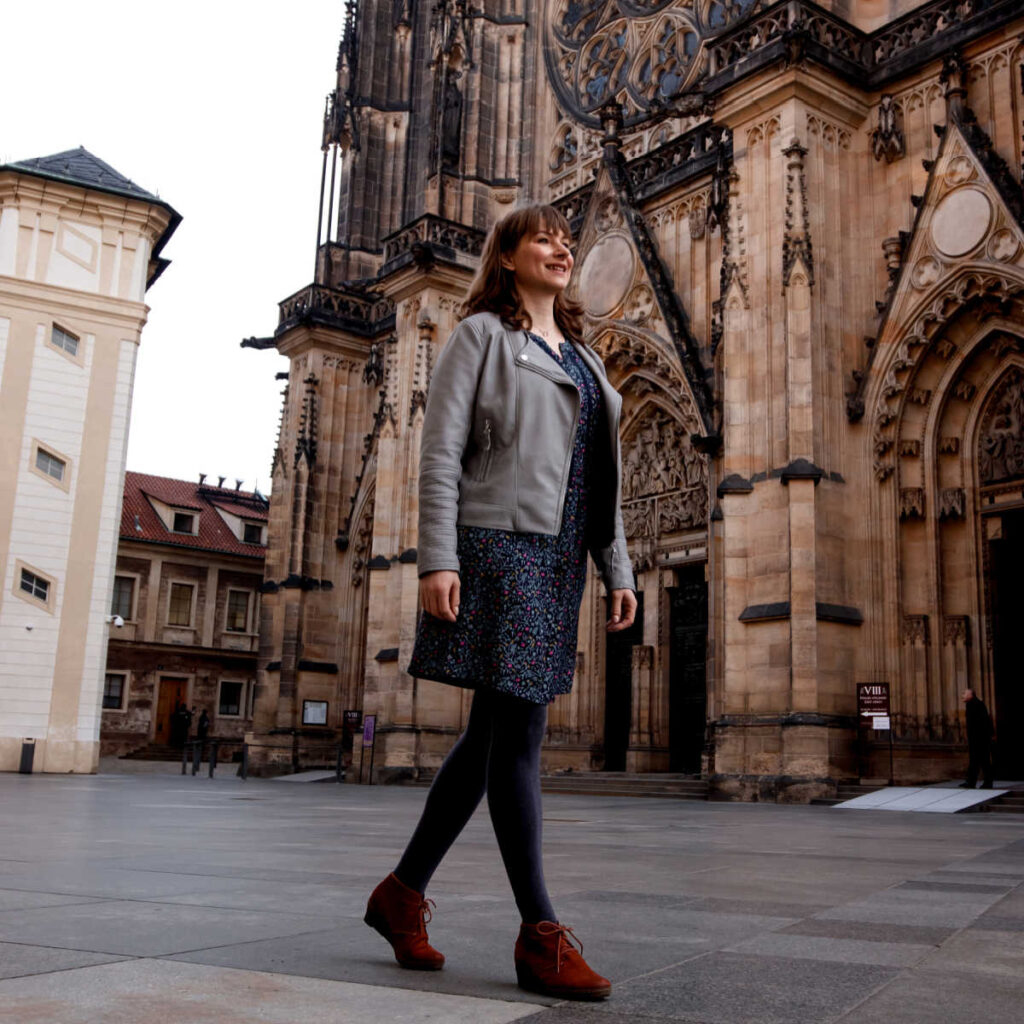
St.Vitus Cathedral is the most visited church in Prague and as such it can be a little bit difficult to appreciate all the beautiful interior and the surrounding grounds.
St. Vitus Cathedral was originally a church built in 930, which was rebuilt and changed many times. The final version was built in Gothic style. The construction began in 1344 and took nearly 600 years to complete, with the final touches added in 1929.
This was because the construction of the three-nave Gothic part of the cathedral was interrupted by the Hussite wars and was resumed and completed years later in late 19th and 20th century.
The southern tower of the cathedral is the third tallest church tower in the Czech Republic, standing at 96.6 meters. One of the beautiful stained glass windows was designed by the Czech Art Nouveau artist Alfons Mucha in 1931.
My local tip: If you want to enjoy discovering the cathedral just for yourself, come to the Prague Castle grounds just after 6 am, walk around and then join the morning mass at 7 am. It will be very different from a regular tourist visit, but it’s how I think this place should be experienced.
- Location: Prague Castle 119 08, Hradčany, Prague 1
- Opening Times: April to October: Monday to Saturday: 9:00 AM to 5:00 PM, Sunday: 12:00 PM to 5:00 PM, November to March: Monday to Saturday: 9:00 AM to 4:00 PM, Sunday: 12:00 PM to 4:00 PM
- Tickets: Free only during the official mass (or special open days organised by the castle)
- Admission to St. Vitus Cathedral is included in Prague Castle tickets.
- Adults: 450 CZK
- Students/Seniors: 280 CZK
- Family (2 adults + up to 5 children): 900 CZ

9. Church of Our Lady Victorious
The Church of Our Lady Victorious is also known as the Shrine of the Infant Jesus of Prague, which is a 16th-century statue of Spanish origin believed to have a miraculous powers, that’s displayed in the church.
The church was originally built in 1613 for German Lutherans and later acquired by the Carmelites in 1624 and it’s one of the first Baroque buildings in Prague.
The church is still an important pilgrimage site and it’s always busy with people coming to see the Infant Jesus statue and seek blessings.
My local tip: The entrance to the church is free and so is the small museum of the infant Jesus outfits at the back of the church (this is one of only a few completely free museums in Prague). You can contribute by donating money at the entrance, buying a souvenir in the church shop or stopping for a lovely coffee from the coffee cart outside the church.
- Location: Karmelitská 9 118 00, Lesser Town, Prague 1
- Opening Times: Monday to Saturday: 8:30 AM to 6:00 PM, Sunday: 8:30 AM to 7:00 PM
- Tickets: Free
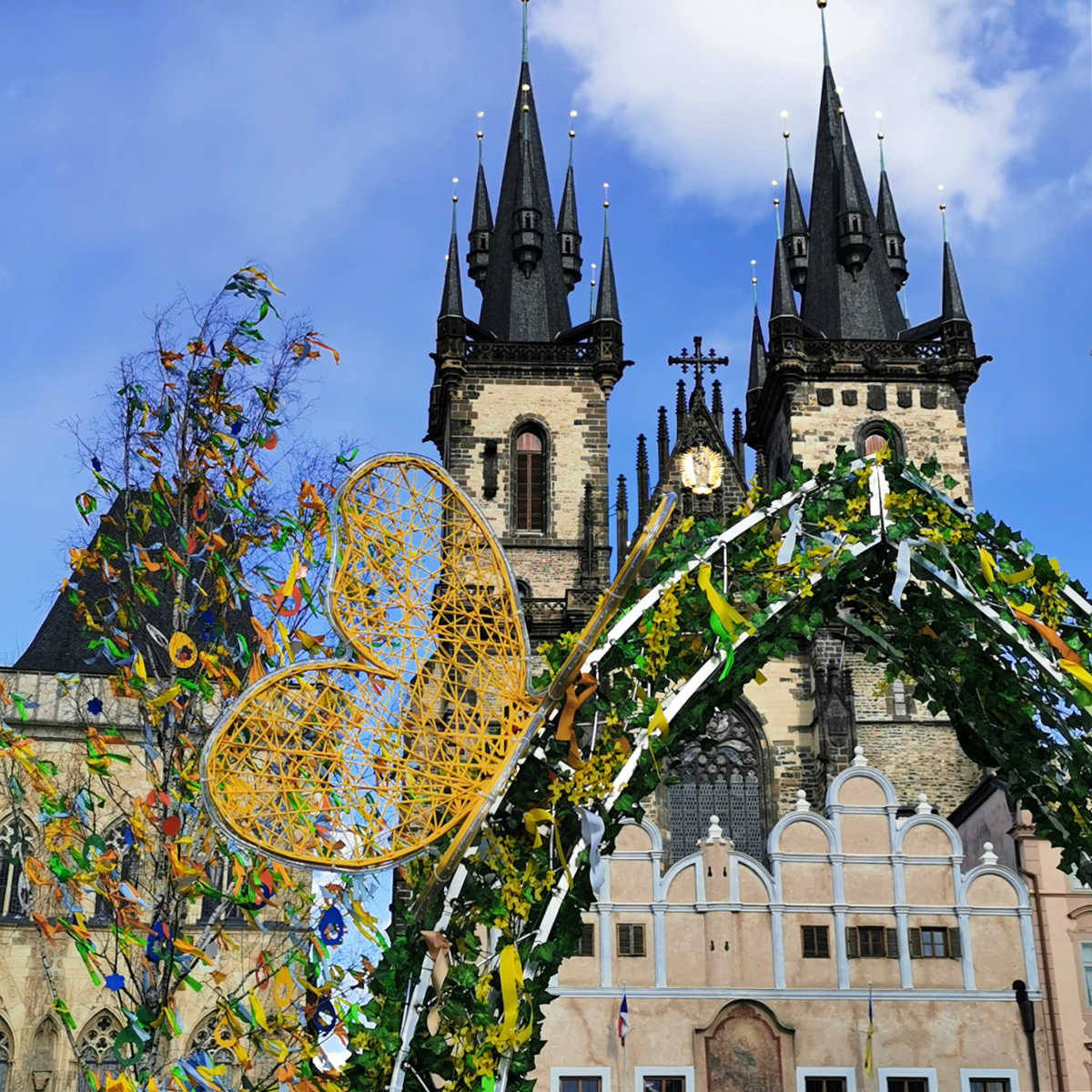
10. Church of Our Lady Before Týn
I’m sure you’ll recognise the tall towers of the Church of Our Lady Before Týn, also known as Chrám Matky Boží před Týnem from many Prague photos. It’s located in Prague’s Old Town, near the Old Town Square.
The church is originally from the 14th century. The church towers are just over 80-meter-high and each has two layers of four spires.
The legend associated with the church tells the story of a small bell in the church’s bell tower. According to the legend, a lady strangled her maid because she prayed to the sound of the church bells instead of helping her lady get dressed.
Although the court cleared her of all charges due to her social status, the lady’s conscience was reminded of her terrible deed every time the bells rang. To atone for her sin, she had a small bell cast in memory of her maid, gave all her belongings to the poor, and became a nun.
The church’s interior is quite dark and has a Baroque altar, a Gothic pulpit, and a Renaissance organ. Inside, you can also find the tomb of the astronomer Tycho Brahe, who died in Prague in 1601.
- Location: Old Town Square, Old Town, Prague 1
- Opening Times: Monday – Closed, Tuesday – Saturday: 10 am – 13:00 and 3 pm – 5 pm, Sun 10:30 am – 12 noon
- Tickets: Free (but 50 CZK donation is suggested)

11. Cathedral of Saints Cyril and Methodius/Chrám svatých Cyrila a Metoděje
The Cathedral of Saints Cyril and Methodius, also known as Chrám svatých Cyrila a Metoděje, is a relatively new church in Prague, built in the 1830s as a Baroque Roman-Catholic church and later converted to an Orthodox church.
It was this church (or rather the crypt underneath the church) that was the last hiding place of the secret war agents who assassinated SS-Obergruppenführer Reinhard Heydrich during Operation Anthropoid.
My local tip: The museum in the crypt is very moving and the visit to the church just completes the picture of what it must have been like hiding there. When I visited the crypt (with the national memorial museum), I thought that the most haunting thing was to hear the distant (but surprisingly clear) sounds of the street, knowing that the people hiding there would have heard the same.
- Location: Resslova 9a, New Town, Prague 2
- Opening Times: Tuesday to Saturday: 9:00 AM to 5:00 PM, Sunday: 9:00 AM to 12:00 PM
- Tickets: Free

12. Church of St. Martin in the Wall
The Church of St. Martin in the Wall (Kostel svatého Martina ve zdi) is a stunning church located in the Old Town of Prague. Dating back to the second half of the 12th century and it’s now used by the Evangelical Church of Czech Brethren.
It’s amazing, that despite the so many historical events and changes in Prague, the Church has been preserved as an almost intact medieval structure, including Romanesque and Gothic architectural elements.
The name “in the Wall” comes from its location near the old city walls of Prague. The southern wall of the church was actually part of the city fortifications. During the Hussite Wars in the early 15th century, the church became a significant center for the Hussite movement. In 1433, the St. Martin Council was held here, which played a pivotal role in the Hussite reformation.
- Location: Martinská 8, Old Town, Prague 1
- Opening Times: Open only during services
- Tickets: Free

13. Basilica of St. Peter and Paul
The Basilica of St. Peter and Paul on Vyšehrad dates back to the 14th century, with several previous church buildings existing on the site. The basilica underwent significant reconstruction in the Gothic style at the turn of the 19th and 20th centuries and has two imposing towers that can be seen from anywhere, when you look up the Vysehrad hill.
The cemetery next to the basilica is the final resting place of many notable Czech presidents, composers, actors and novelists.
My local tip: I was amazed at the beautiful painted ceilings and walls and the whole interior felt quite modern in comparison to the other churches. Because Vysehrad is a little bit out of the way, the church was not that busy at one point I was there on my own, which was great.
- Location: Štulcova 128/1 128 00, Vyšehrad, Prague 2
- Opening Times: daily 10 am – 6 pm
- Tickets: 110 CZK, Students, Seniors 70 CZK, Children under 6: Free

14. St. Nicolas Church
The St. Nicolas Church in Lesser Town, is a truly remarkable Baroque building built in the 18th century on the site of a former Gothic church.
The church is considered one of the most important Baroque buildings in Prague and I was definitely surprised at how spacious and decorative it felt when I walked inside. You can walk up to the middle floor, where you can see the paintings and statues even better and get a different view of the whole church.
During the 20th century, the bell tower of the St. Nicolas Church was used as an observation post for the communist police known as the Státní bezpečnost (StB). It was a strategic location for observing the embassies of the USA and former Yugoslavia, as well as the access way to the embassy of Western Germany.
My local tip: There is a separate entrance to the tower on the side of the church (with a separate entry fee), but you get a great view of the Lesser Town Square, the Prague Castle and the centre of Prague in distance from the top, so it’s definitely worth the climb.
- Location: Lesser Town Square, Lesser Town, Prague 1 (entrance from the little square behind the church)
- Opening Times: Mon – Sat: 9 am – 5 pm, Sun 12 – 5 pm
- Tickets: Adults 170 CZK, Students, Seniors 120 CZK, Children under 10: Free

15. Church of the Most Sacred Heart of Our Lord
The Church of the Most Sacred Heart of Our Lord was built between 1928-1932 and is the best example of Czech architecture between WW1 and WWW2 designed by a well-known Slovenian architect Josip Plečnik.
The church was built as the capacity of the St. Ludmila Church on Míru (Peace) Square wasn’t sufficient enough. The building has a striking design and it’s said that the architect Josip Plečnik was inspired by Noah’s Ark during the design process.
The church has a 42-meter bell tower with a flat copper roof, which is the largest clock in Prague and the Czech Republic. The clock was recently repaired in 2014 and is again showing the correct time.
Inside the church is decorated in a modern style, with the main altar made of white marble. Above the altar, you’ll find a three-meter tall gold gilded figure of Christ, along with statues of six Czech patrons: St. John of Nepomuk, St. Agnes, St. Adalbert, St. Wenceslas, St. Ludmila, and St. Procopius. They are made of lime wood (Czech national symbol is a lime tree) and were created by sculptor Damián Pešan.
- Location: Jiřího z Poděbrad Square, Zizkov, Prague 3
- Opening Times: Monday to Friday: 8:30 AM to 6:00 PM, Saturday: 8:30 AM to 12:00 PM, Sunday: 9:30 AM to 12:00 PM
- Tickets: Free

16. St. Ludmila Cathedral (Basilica)
The cathedral (from 2023 an official basilica) of St. Ludmila is built in a neo-Gothic style by architect Josef Mocker and constructed between 1888 and 1892.
The basilica is named after St. Ludmila of Bohemia, a wife of the first historically evidenced Premyslovec king, a Czech saint and martyr who was also the grandmother of St. Wenceslas, the patron saint of the Czech Republic.
The Basilica of St. Ludmila has a striking twin-spired facade and has beautiful stained glass windows and detailed interior decorations.
The little square in front of the church always has the best Christmas and Easter markets and the church stairs become a hub for people meeting and enjoying the season.
- Location: Náměstí Míru, The Peace Square, Prague 2, Vinohrady
- Opening Times: daily 10:00 – 17:00, unless there is a mass or an event
- Tickets: Free

17. Church of Saint Henry & Saint Cunigunde
I thought I’d also mention the Church of Saint Henry and Saint Cunigunde, because it has super interesting history and the square around the church is like a set from an old film.
The church was founded in 1348 by Emperor Charles IV as part of the New Town of Prague, which he established to expand the original town of Prague.
The church was dedicated to Saint Henry II, Holy Roman Emperor, and his wife, Saint Cunigunde of Luxembourg. Originally, the church served as a parish church and there was also a school nearby, a separate bell tower and a cemetery around the church, which was the biggest cemetery in the Prague town at the time.
The bell tower was built separately and later built where you see today’s Jindriska Vez – apparently because the church was given bigger bells that needed a large tower. They couldn’t build it right next to the church as there was a cemetery at the time.
This is why today, you have the bell tower so far away from the church. The bell tower is the highest – free standing bell tower (65,7 m) in Prague.
But nobody could guess what happened at the end of the 19 century, when the town was designing it’s first tram lines and simply told the church, they wanted to run the new tram directly through the cemetery. The church and the tower were re-designed in 1880s and most of the cemetery tombstones were removed and placed around the church. By 1883 the first tram has run through the street dividing the church from it’s bell tower.
- Location: Jindřišská 30, New Town, Prague 1
- Opening Times: Mon – Friday: 8.30 – 6 pm, Sat – Sun 8.30 – 12 noon
- Tickets: Free
This blog post was originally written on 17 July 2024 and last updated on 8 April 2026
PIN TO KEEP FOR LATER