
10 Historic Cemeteries in Prague – Visitor’s Guide & Local Tips
The complete visitors guide to 10 historic cemeteries in Prague, including Jewish Cemeteries, plus local tips, locations, opening times, history, famous people and interesting facts.
Prague is a city full of history and I think that cemeteries complete that wider picture of what happened before us. A walk through Olšany Cemetery, the city’s largest, takes you past beautiful old trees and the resting places of many people who helped to shape Czech history.
The Lesser Town Cemetery is also very green, quiet and filled with impressive amount of statues and large tombstones, while the Old Jewish Cemetery has narrow paths between gravestones that feel like they are on top of each other. I like to think, that visiting these peaceful spots is a special way to experience another side of Prague and connect with its past.
There are around 30 cemeteries maintained by the city, but I’ve picked my ten favourite and the most historic cemeteries for us to explore today.
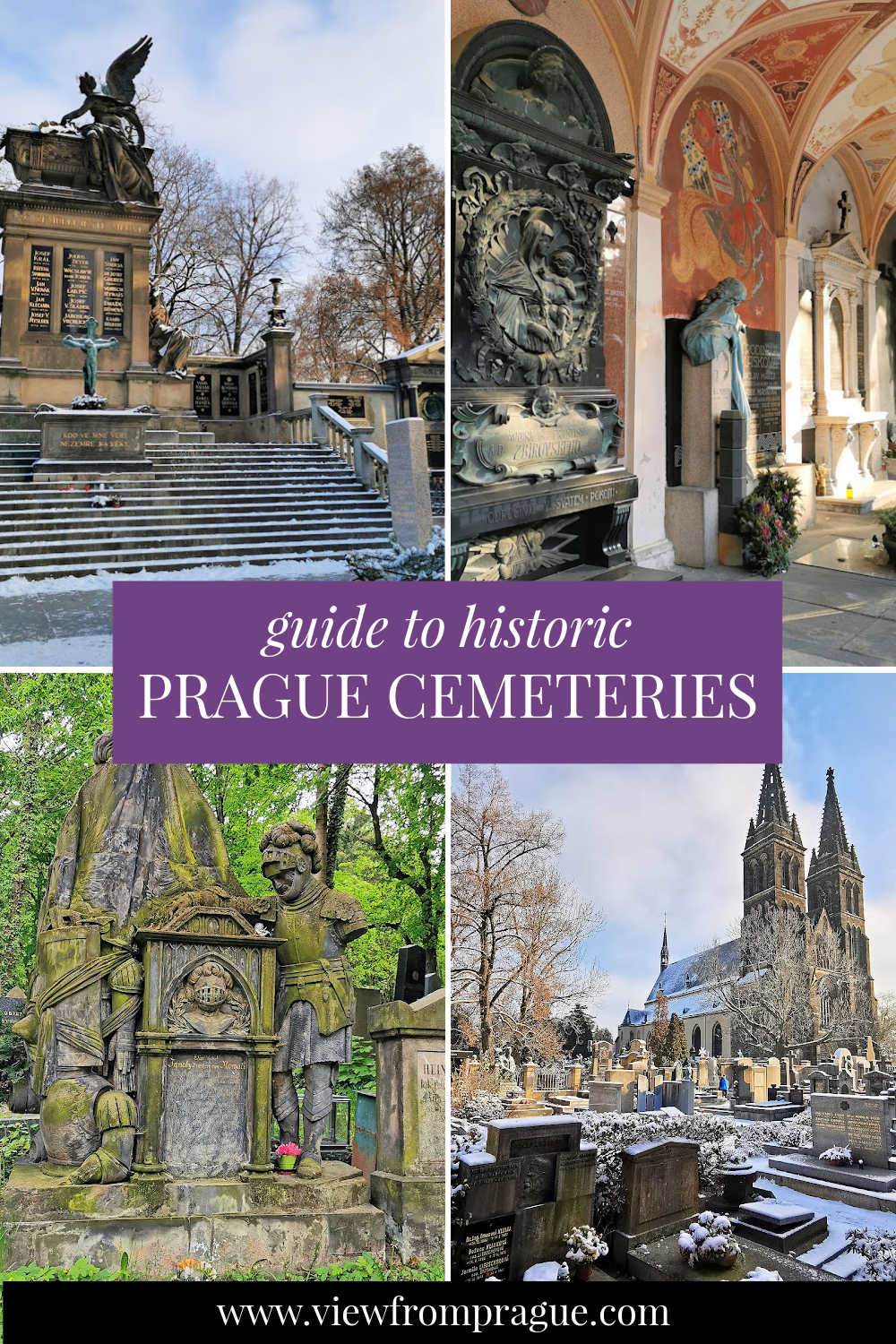
PIN TO KEEP FOR LATER
Why visit Prague cemeteries – My personal experience
I know that visiting cemeteries might not be on everyone’s list when they are planning a trip to Prague, but I think they are a great way to learn about history, link all the people you’ve learned about in the books and also find a bit of piece and quiet in a busy town.
When I visited the Vysehrad cemetery, it was during a very cold, but sunny day and somehow it felt like a privilege to walk around. I visited Olsany Cemetery during a Prague summer heatwave and it was lovely to walk for two to three hours under a cover of large trees, whilst trying to find the most significant tombstones.
What is the most beautiful cemetery in Prague?
I think that the old part of the Olsany Cemetery, Lesser Town Cemetery (at Smichov) and the Vysehrad are the best examples of old historic cemeteries which are worth visiting. Olsany and the Lesser Town Cemetery have trees shading the tombs and all the cemeteries have historic graves, and beautiful tombstones.
What is the largest cemetery in Prague?
The largest cemetery in Prague is Olsany Cemetery, which spreads over 50 acres and it’s even divided by a road with a tram running through it. The cemetery has several parts – old, new, orthodox and also dedicated soldiers’ cemetery.
Once you walk through the Olsany Cemetery, you can continue to the New Jewish Cemetery, which is right next to it and then on to the Vinohrady Cemetery, which is just across the road.
Few things to know before you visit a cemetery
Apart from the Old Jewish Cemetery in the centre of Prague, all of the other cemeteries on my list are free to enter. There are usually set visiting hours, but most cemeteries are open during the day and the large ones, such as Olsany also at the weekend.
If you are visiting any Jewish cemetery, you should have your head covered if you are a man. And of course, please respect what these places are about, so please no loud talking, shouting, running, picnicking or smoking.
1. Olsany Cemetery
The largest cemetery in Prague is the Olsany Cemetery. It’s very peaceful there and the old part of the cemetery has some amazing headstones set amongst tall trees, woodland shrubs and grassy paths.
I’ve spent a good couple of hours walking around all the different parts of the cemetery and I’ve still not seen everything. One other thing you might see there and very much alive are red squirrels as they hop between the graves.
The Olsany cemetery is the largest burial ground in Prague, covering fifty hectares. The oldest part, Cemetery No. 1, was founded after 1679 on the site of a large garden that its owner, Jakub Štika from the Olšany village, sold to the Old Town community so that they could bury victims of the plague there.
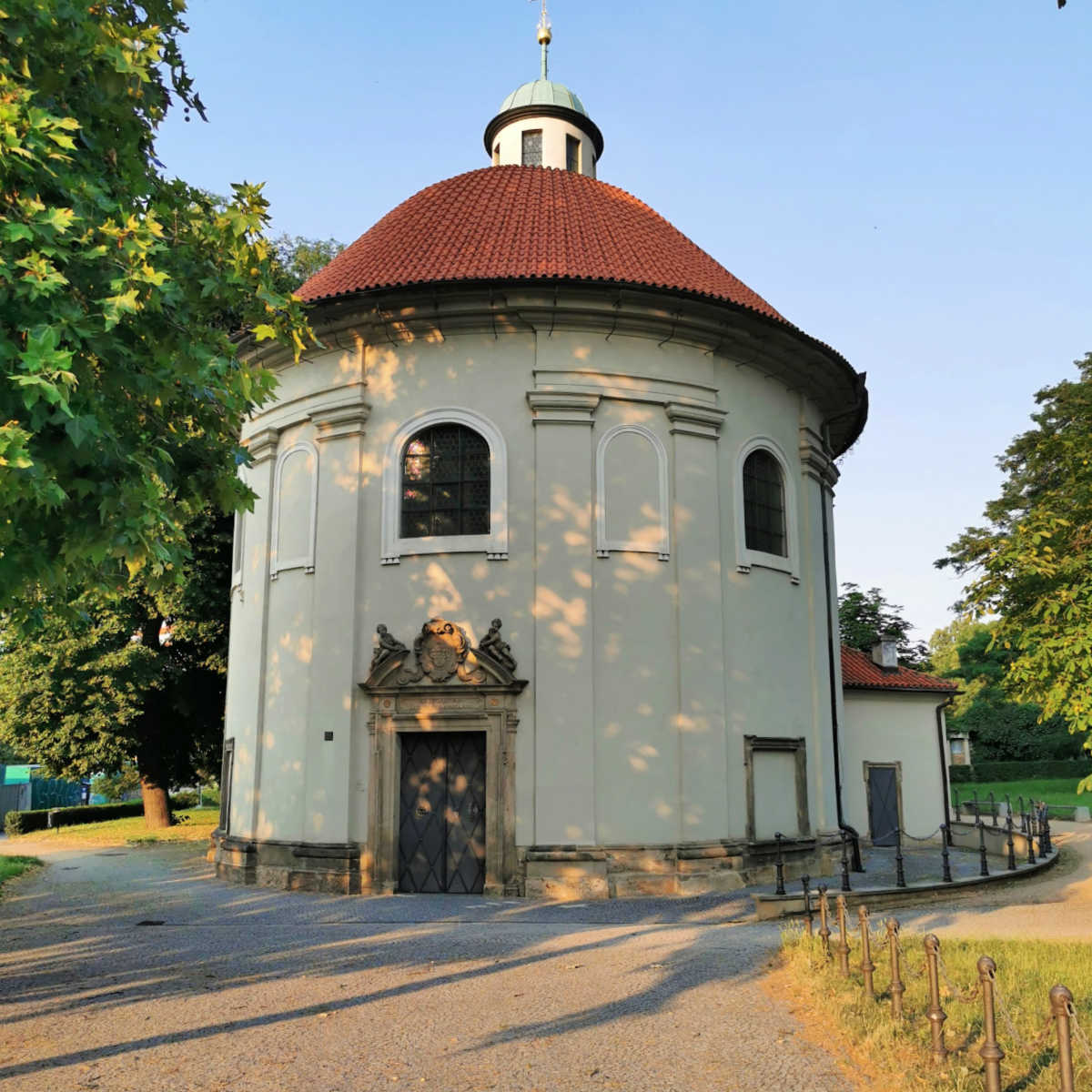
Along with the plague cemetery, a chapel was also built and dedicated to the saint patrons St. Roch, St. Sebastian, and St. Rosalia to protect people against the plague.
In addition to ordinary citizens, many important figures of social and cultural life are buried at the Olsany cemetery. There is an educational trail and display boards that take you through the most important parts of the cemetery, but you can also just wander around and the most important graves are marked with little introduction text.
You can visit the graves of Josef Jungmann (writer), František Čelakovský (writer), playwright Ladislav Stroupežnický, mathematician Bernard Bolzano, Josef Lada (illustrator), Jaroslav Ježek (musician), or Voskovec and Werich (comedy partners, actors & playwright).
Once you cross the main road to the newer part of the cemetery, you can also walk through the orthodox part of the cemetery with a beautifully painted chapel. The other side of this part of the cemetery is dedicated to soldiers who died fighting in the First and Second World Wars.
Location: Vinohradská 1835/153, 130 00 Prague 3, Zizkov
How to get there: One option is to take tram number 5, 9, or 26 to the Lipanská stop, which is located near the cemetery. Or you can take the underground line A to the Želivského stop (for the Jewish and more modern part of the cemetery) or Flora underground for the old part of the cemetery.

2. Vinohrady Cemetery
Vinohrady Cemetery, which is just across the street from Olsany Cemetery, was established in 1885. This cemetery is used as the final resting place for many important Czechs, including painter Jakub Schikaneder, sculptor Otto Gutfreund, poet Stanislav Kostka Neumann, and writers Karel Václav Rais and Zikmund Winter, among others.
You can also find the family tomb of ex-president Vaclav Havel here. He was the first president after the Velvet Revolution in 1989.
Location: Prague 10, the Vinohrady Cemetery (Vinohradský hřbitov)
How to get there: underground (metro A) to the stop Želivského or tram 11, 19, or 26 to Vinohradské hřbitovy.
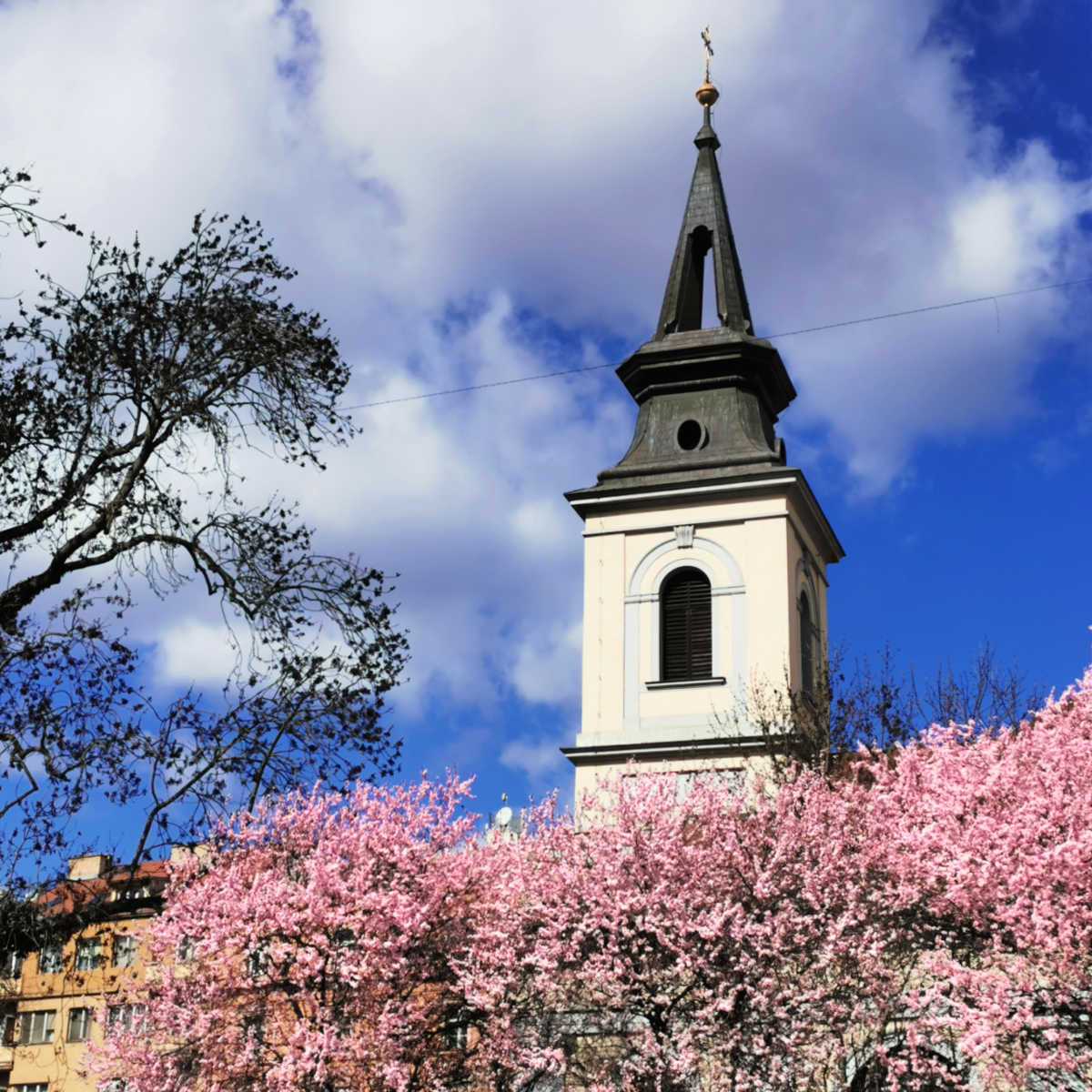
3. The Lesser Town Cemetery
The name of the cemetery is pretty misleading as it is not located in Lesser Town. The reason for this is that after a change in burial practices during the reign of Joseph II, cemeteries around churches were abolished, and for hygiene reasons, it was permitted to establish cemeteries only outside the city walls.
This is why in 1786, a new cemetery was established on the site of the former plague burial ground, intended for the Lesser Town, Hradčany, Smíchov, and Košíře. At that time, it was surrounded by only a few farm buildings with vineyards. The industrial development of Smíchov, especially the establishment of the Ringhoffer factory in 1852, influenced the growth of residential buildings, which gradually surrounded the cemetery.
In 1884, almost 100 years after its establishment, the last burial took place here. Many of the graves were abolished, and tombstones and remains of the deceased were relocated to other cemeteries, especially to the Olšany Cemetery and Vyšehrad. This was also done because Plzenska Street was being widened and a part of the cemetery together with the graves and a small part of the church had to go.
I know the cemetery really well as I live nearby. It feels very strange to know that when I walk on the pavement next to the cemetery to catch my tram, I’m actually walking over the old graves, including that of Karel Jaromir Erben, who was a well known writer.
Location: Plzeňská, 150 00 Praha 5-Smíchov
How to get there: The cemetery is outside tram stop called ‘Bertramka’, which is one stop from Andel (underground and tram station), tram numbers 9, 10, 15, 16
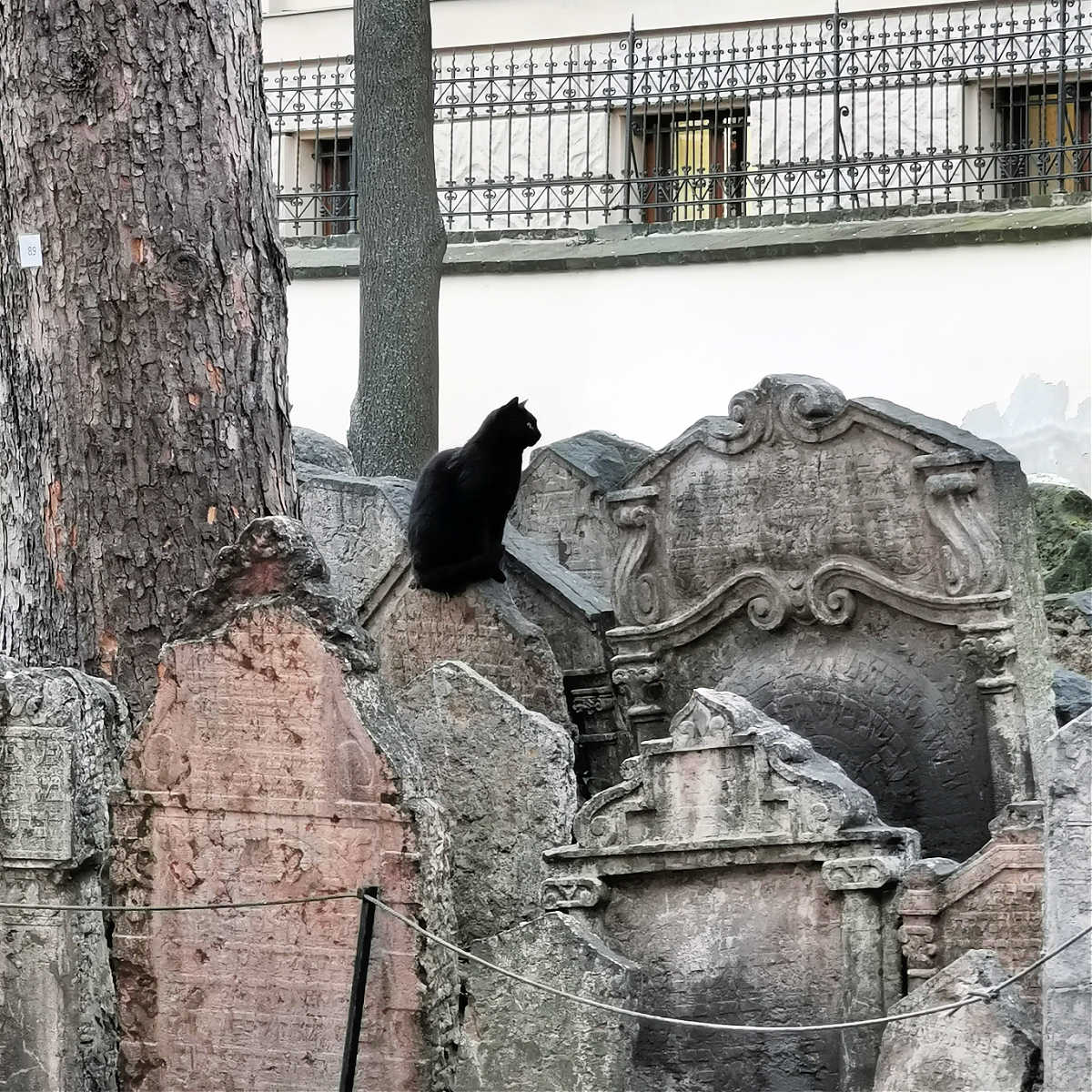
4. The Old Jewish Cemetery
The Old Jewish Cemetery is part of the Jewish Quarter in Prague and covers an area of approximately 11,000 m2. People were still buried here until 1787 and there are about 12,000 tombstones. It’s estimated that around 40,000 people were buried here.
The oldest tombstone was engraved in 1439 and belongs to scholar and poet Avigdor Karo. The cemetery has been expanded several times in the past, but at some point, it couldn’t be expanded further, so the space problem was solved by adding layers of soil on top of existing graves.
The most significant person buried in the Old Jewish Cemetery is undoubtedly the great religious scholar and pedagogue Rabbi Jehuda Liwa ben Becalel, known as Rabbi Löew (died in 1609), who is associated with the legend of Golem and creating an artificial being from a clay.
Location: U Starého Hřbitova 243/3A, 110 00 , Prague 1, Josefov
How to get there: 5 minutes walk from the Old Town Square, nearest underground is Staromestska and trams number 1, 18, 17, 2, 25.

5. The New Jewish cemetery
This cemetery is the newest of all the Jewish Cemeteries in Prague. It is a separate part of the Olšany Cemetery and is also the largest Jewish cemetery in the Czech Republic. It’s protected as a cultural monument.
The new cemetery is ten times larger than the Old Jewish Cemetery in Josefov (in the centre of Prague) and is the main Jewish cemetery in Prague – a resting place for more than 25,000 people.
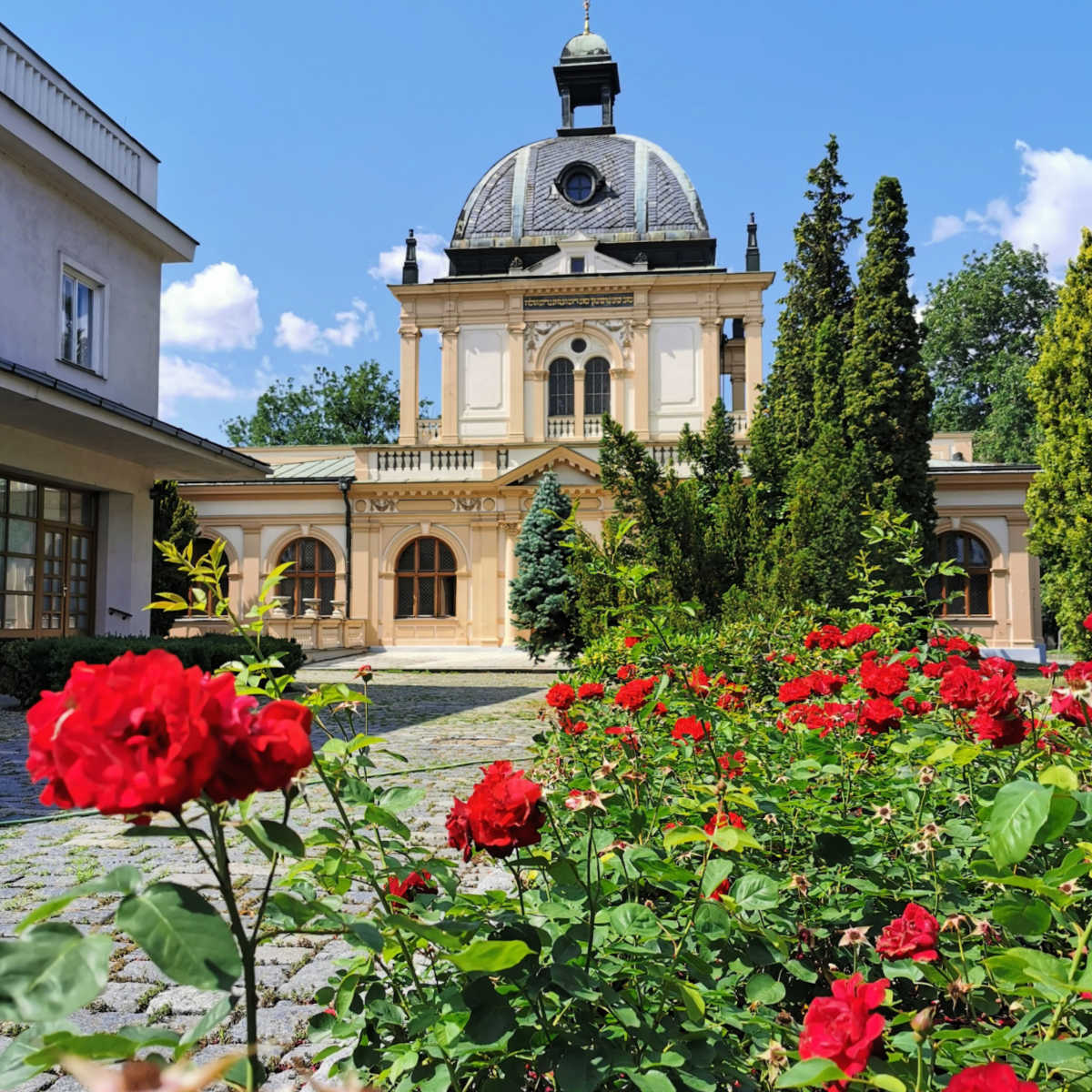
You walk into the cemetery through a very impressive entrance gate. The buildings inside are mostly built in the Neo-Renaissance style. These include the ceremonial hall designed by architect Bedřich Münzberger with a prayer room, a purification house for funeral ceremonies, and administrative buildings.
The original ceremonial hall was built between 1891 and 1893. The second ceremonial hall, was built in 1933 in the functionalist style based on the design of architect Leopold Ehrmann.
The tombstones are in various styles (Neo-Gothic, Art Nouveau, or Classicism) and often come from the workshops of significant Czech sculptors and architects such as Jan Kotěra, Josef Zasch, Josef Fanta, Jan Štursa, or Čeněk Vosmík.
There is also a memorial to Czechoslovak Jewish victims of the Holocaust and resistance from 1985.
You should not miss the grave of Prague’s Jewish writer Franz Kafka. On the opposite wall, there is a memorial plaque for Kafka’s friend Max Brod, who is buried in Israel. The cemetery is also the final resting place of writer Ota Pavel, Jiří Orten, and painters Jiří Karas and Max.
Location: Izraelska Street 1, Prague 10
How to get there: take the tram number 9 or 10 from the centre of Prague (about 25 minutes) or underground to station ‘Zelivskeho’ – the cemetery is just outside the underground station.
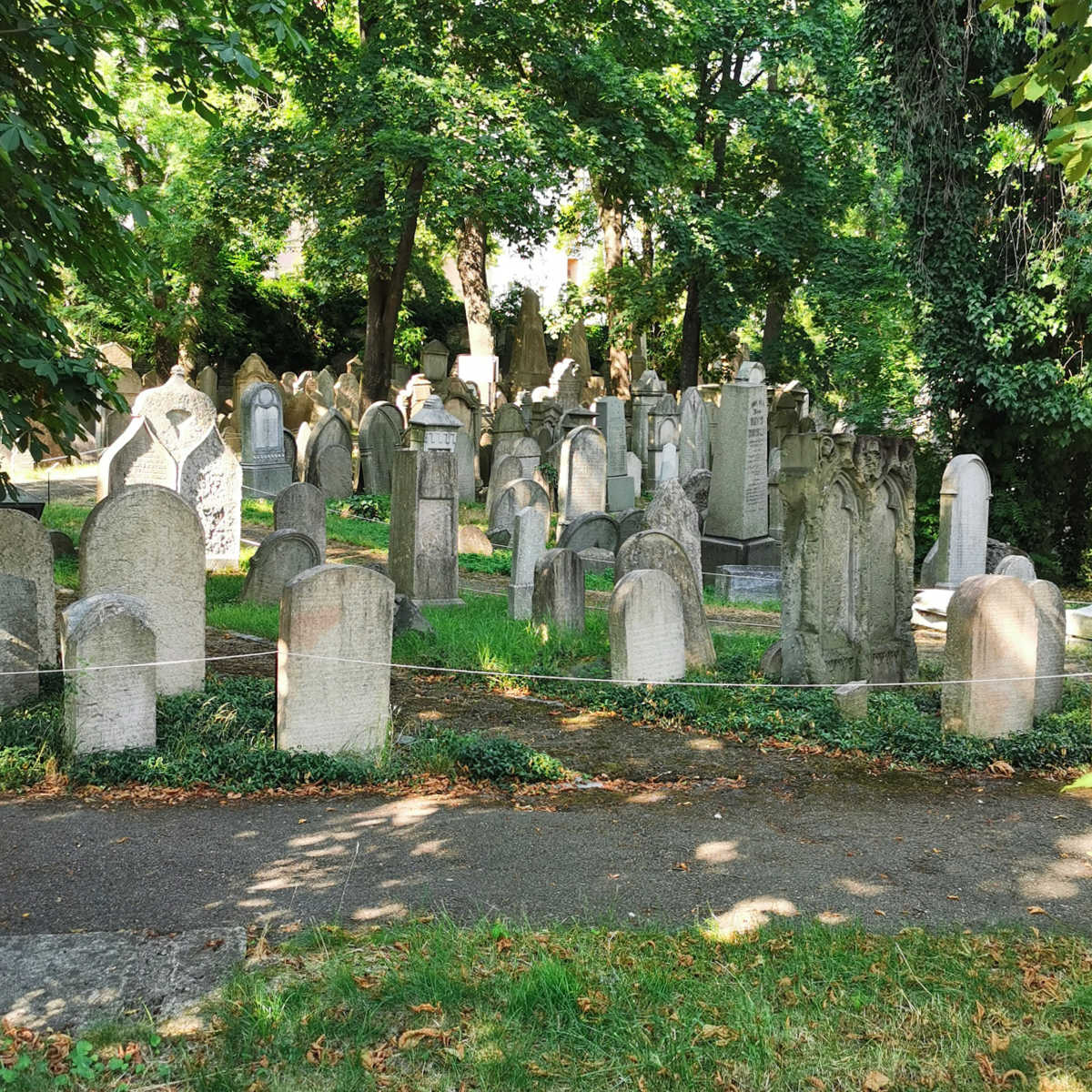
6. Old Jewish Cemetery – Zizkov
The cemetery was founded in 1680 during a major plague epidemic as a burial ground for the Prague Jewish community. During the 10-month epidemic, about 3,000 people from the Prague ghetto were buried there. Additional burials took place during the plague epidemic of 1713-1714, during wartime events in 1742-1743, and during the exodus of Jews from Prague in 1747-1750.
When Emperor Joseph II banned “burials in old cemeteries inside city centres for hygienic reasons” in 1787, this local cemetery in Zizkov became the central Jewish cemetery in Prague. Because of that the cemetery had to be expanded.
The first expansion took place in 1787, and another in 1855. During this time the cemetery grew from its original 427 m2 to almost five times its size, doubling the area of the old Jewish cemetery in Josefov in central Prague. In 1884, when the Žižkov community banned further burials, the cemetery covered an area between 21,601 and 28,000 m2.
In the 1960s the town council decided to turn the cemetery into a park as they built new housing around the area. At that time a large part of the cemetery wall was demolished, tombstones were overturned and buried with soil, and about three-quarters of the cemetery was converted into a public park called Mahlerovy sady. Later the new Zizkov Television Tower was built right next to the cemetery.
Location: Fibichova 2818, 130 00 Prague 3-Žižkov
How to get there: the nearest underground station is Jiriho z Podebrad and then about 15 minutes walk. Nearest tram stop (which is still about 10 minutes walk) is Olsanske Namesti on tram lines 1, 5, 9, 15, 17 or trams that go to Jiriho z Podebrad (tram line 1, 11, 13)
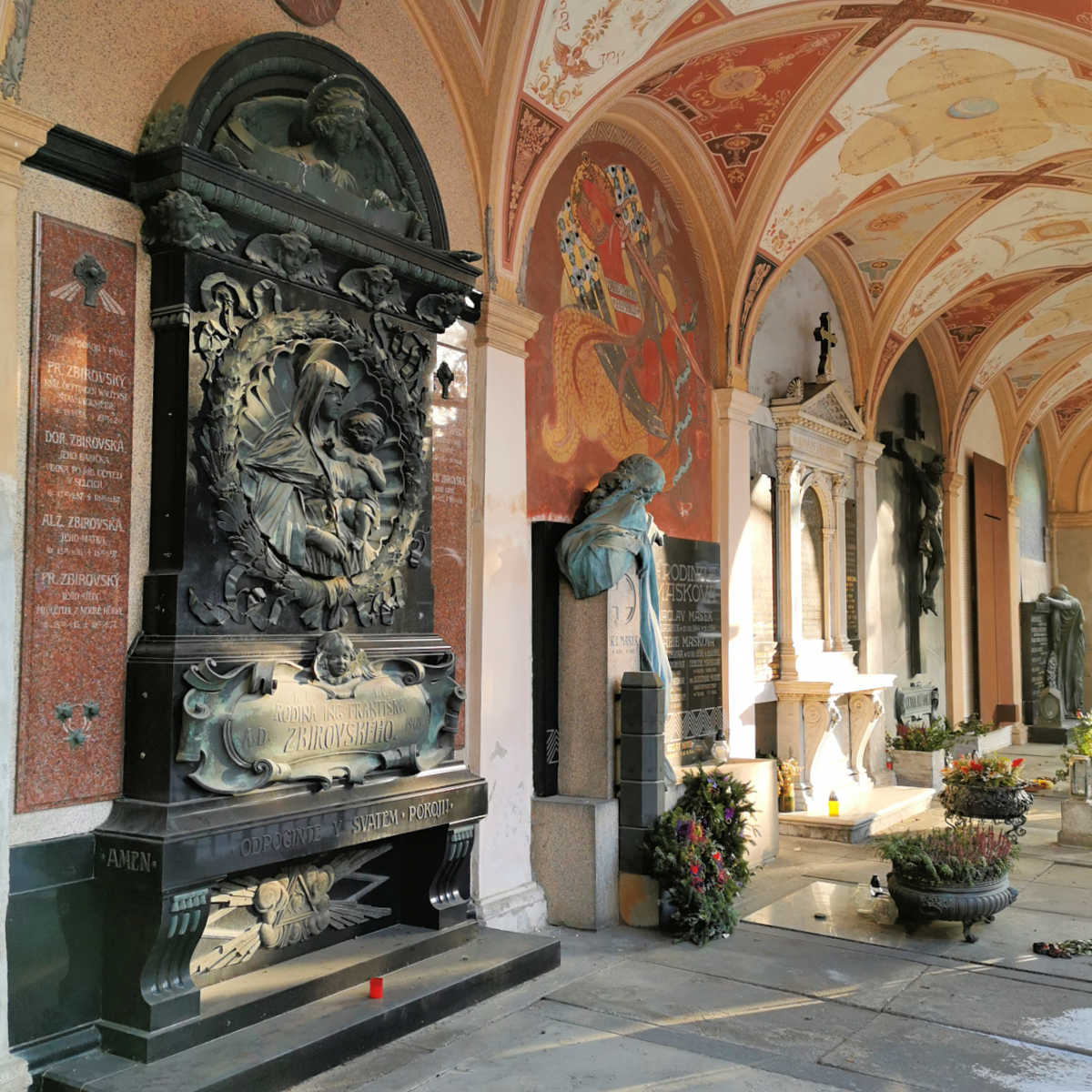
7. Vysehrad Cemetery
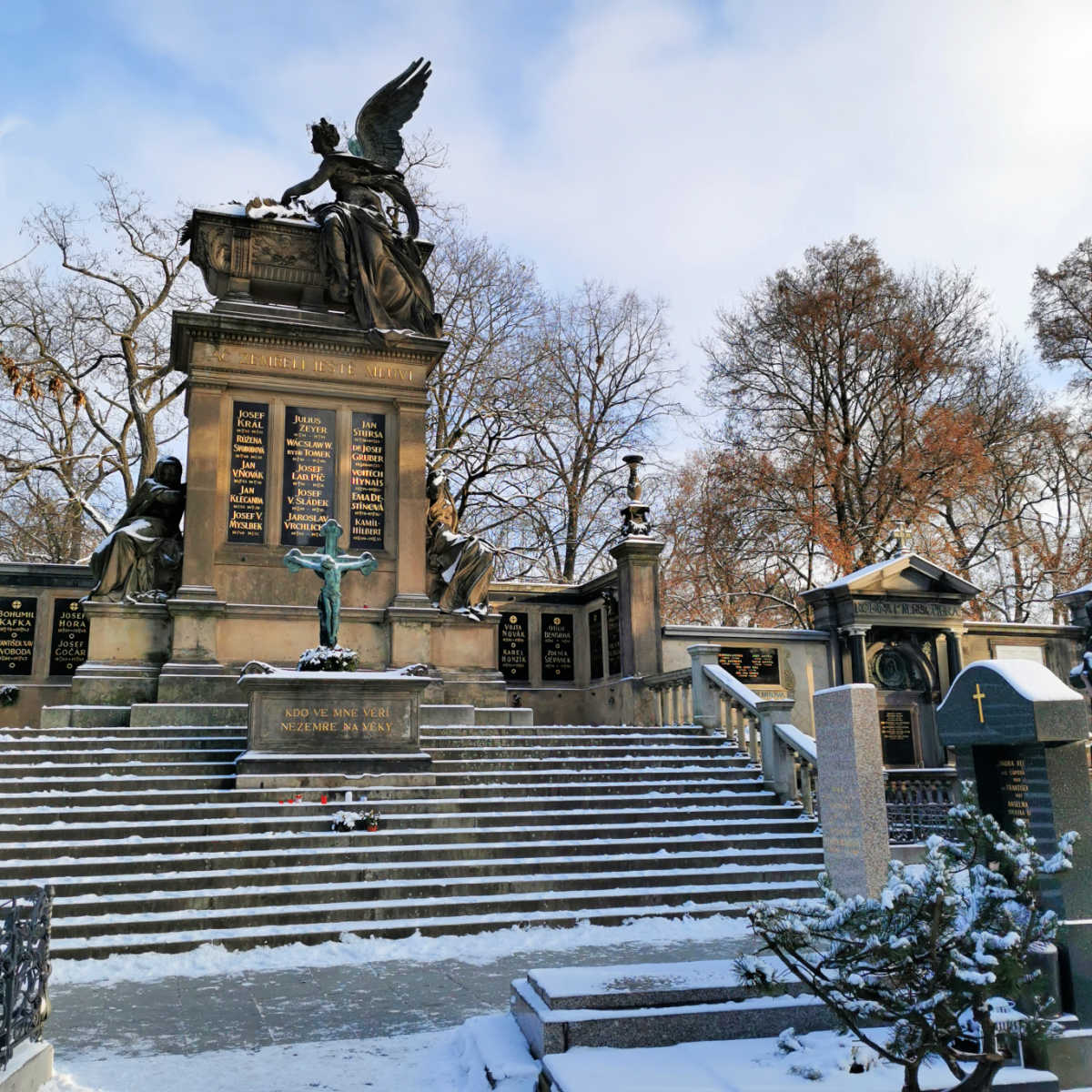
The Vyšehrad Cemetery is right next to the Basilica of St Paul and St. Peter at the Vysehrad Castle grounds and park area. It was properly established in 1869 and is the final resting place of many important Czech people, including writers, artists, composers, scientists, politicians, and other prominent figures.
The cemetery was built on the site of an older cemetery that had been in use since the 13th century. The new cemetery was designed by Antonín Wiehl and Josef Mocker in the neo-Gothic style, and it quickly became the most prestigious cemetery in Prague, where many of the city’s elite were buried.
The cemetery has over 600 graves, including those of famous Czech figures such as Antonín Dvořák (composer), Bedřich Smetana (composer), Karel Čapek (writer), Karel Hynek Macha (Writer), Jan Neruda (Writer), Mikolas Ales (painter), Ema Destinnova (opera singer), Antonin B. Svojsik (founder of Czech Scouts), Waldemar Matuska (popular singer of 60 & 70s ), Josef Gocar (architect) and Alphonse Mucha (painter). The graves are arranged in a park-like setting, with paths winding through the trees and around the graves.
When you visit, don’t miss the Slavín tomb, which is a large, imposing tomb built in 1893 to honour Czech cultural figures. The tomb is located at the highest point in the cemetery and is accessible by a grand staircase. The tomb is a group resting place of many important Czech figures, including the composer Bedřich Smetana and the writer Karel Čapek.
Location: V Pevnosti, 128 00 Prague 2-Vyšehrad
How to get there: Take trams 3 or 17 to Vyton and walk up to the Vysehrad (10-15 minutes – steep walk) or use the underground to station ‘Vysehrad’ and then walk 10-15 minutes (level walk)

8. Dablice Cemetery
Prague seems to be winning with cubist architecture, so it’s probably no surprise when I tell you that Dablice Cemetery is the only cubist-style cemetery in the whole world!
The design of the Ďáblice municipal cemetery was put together by Vlastislav Hofmann, an employee of the city’s building authority department, in 1912. This was a completely new cemetery, which included cubism elements in every aspect, including a cubist-shaped torso of the cemetery wall and two polygonal kiosks with impressive tiered roofs and a three-part gate built between them.
There should have also been a large mortuary building in the similar design as the entrance kiosks, but in the end, Hofmann’s original design was greatly simplified.
When you look at the cemetery plan, you can see that even the shape, paths and everything inside the cemetery were designed with a style – from the top, the cemetery looks like inside a steampunk watch. That’s not an official description, by the way, that’s how it looks to me…
The Ďáblice cemetery has 29 hectares, which makes it the second-largest cemetery in Prague after the Olšany cemetery.
Location: Ďáblická 564/2a, Prague 8, Dablice (few minutes walk from the last stop ‘Sidliste Dablice’ on tram line 10, 34 – about 25 minutes from the centre of Prague)

9. Malvazinky Cemetery
The Malvazinky Cemetery, also known as the Smíchov Cemetery, is a large urban cemetery located in the Smíchov and it’s named after a former estate “Na Malvazinkách”.
It was founded in 1876, after the original Smíchov cemetery near the church on today’s Arbes Square was closed. Since 1884, the rapidly growing population of the Prague suburbs could no longer use the closed Lesser Town Cemetery in Smichov, so Malvazinky become the main cemetery for the area.
Malvazinky is quite a large cemetery (over 7,5 acres) and is the final resting place for many well-known Czech people, such as President Antonin Novotny, writer Ondrej Sekora, philosopher Egon Bondy, actor Ferenc Futurista and Eman Fiala, footballer Frantisek Vesely, businessman Josef Walter and also singer Karel Gott.
I also have a personal connection to Malvazinky cemetery as my grandfather and great grandfather who was fighting in the Italian Legion to help to establish the new Czechoslovakia during the first world war, are buried here.
Location: U Smíchovského hřbitova 1, 150 00 Prague 5
How to get there: Bus number 153 (to stop Smichovsky Hrbitov or 137 (to stop Urbanova) from Na Knizeci (underground station Andel on the B line). There is also a nice walk from Andel through parks and 19 century pretty town houses, but it’s a bit steep in places.

10. Jewish Garden Cemetery
The Jewish Garden is a little bit different from the other cemeteries on my list. When you visit today, you’ll only see a memorial in a shape of Jewish tombstones and you can walk through a building courtyard to see where the cemetery used to be.
The Jewish Garden is the name of the second oldest Jewish cemetery in Prague. The cemetery was located in the New Town between today’s streets of Spálená, Purkyňova, Jungmannova, and Lazarská.
People were buried in this cemetery from at least 1254 until 1478, when this area was divided by Vladislavova Street and turned into building plots. Today, the entire cemetery is built on or paved over.
In September 2016, a memorial in the shape of medieval Jewish gravestones was installed by the Prague Jewish community to commemorate the place of the oldest Jewish cemetery.
Location: Vladislavova Street, Prague 1, New Town
How to get there: The Jewish Garden is within walkable distance from the Old Town Square (about 15 minutes) and the memorial is located in the same square as the Kafka’s Rotating Head Sculpture, just behind the shopping centre at Narodni Trida – underground station (line B) or trams number 9, 22, 2 etc.
This blog post was originally written on 5 July 2023 and last updated on 1 November 2025


