
My peaceful visit to Emauzy monastery: Prague’s hidden gem
Emauzy Monastery is a bit of a hidden gem – it is the closest monastery to the centre of Prague and is definitely worth the visit.
I’ve really enjoyed my recent trip there, it was so calm and I’ve learned so much about the monastery’s amazing history. It was also great to explore the area around the monastery and stay for a coffee at the terrace cafe with a fabulous views over the houses below and distant hill on the other side of Vltava river.
Emauzy was the only Slavic monastery during the reign of Bohemian King Charles IV and because of that, it became a centre of education and art. The monastery taught its students in the original Slavic language the Cyril and Methodius language and one of its famous students was Jan Hus.
A lot of ilustrated literary masterpieces were created here, including the so-called Reims Gospel book, which eventually became part of the coronation treasure of the French kings.
So, if you want to explore a place that’s both beautiful and packed with history, make sure to add Emauzy to your Prague itinerary! You won’t regret it.
PIN TO KEEP FOR LATER

Is Emauzy Monastery worth visiting?
Yes, in my opinion, the Emauzy Monastery is definitely worth visiting! When I was growing up the monastery wasn’t open to the public, so I’ve only visited it recently and I was amazed at how beautiful and interesting the place was.
There is no other monastery in central Prague that’s open to the public, where you can see not only the church, but also the cloisters and the surrounding buildings. You can also see amazing frescoes and even a peaceful courtyard garden where you can relax.
Emauzy is not as crowded as other places, so you can enjoy it at your own pace.

My local tip & what to see nearby
Don’t rush back to the centre of Prague and stay for a coffee at the Emauzy cafe (outdoors as you are approaching the entrance to the monastery) with a great view of Prague.
Or pop into CAMP buildings at the entrance to the complex for homemade soups, sandwiches and cakes. This cafe is part of an exhibition area and library and has a great layed back vibe. From 2026 the CAMP buildings are undergoing a large reconstruction project, so the indoor cafe and facilities will be moved into temporary buildings on site.
I’ve also walked around the monastery and the monastery gardens because it gave me an idea of how the monastery and the area around it looked like in the olden days. This little part of Prague feels quite untouched by tourism and is as completely authentic as it was before.
Just at the end of the Emauzy garden walls, you can also see the entrance to one of the Botanical Gardens in Prague (the outdoor part is free to enter and the greenhouse ticket is very affordable).
I also like to visit the Rockery Garden next to Faust House on the Karlovo Namesti (Charles Square) opposite the CAMP buildings. The garden is only open for a special exhibitions several times a year, but if you see it open, definitely peek inside. There is also a beautiful church of Jan Nepomuk on the Rock at the end of the garden.
If you fancy trying the best sourdough bread this side of Vltava River, you need to pop in to ‘I need Coffee!’ just across the road on Na Morani road. It’s a small cafe, which also runs an artisan bakery next door (the same amazing company that used to run the Tramp Cafe in the old printing building closer to the centre of Prague – now being sadly turned into a posh hotel).

Practical Information for visiting Emauzy Monastery in Prague
Location: Vyšehradská 49/320, 128 00 Prague 2,
Opening Times
Main season (May – October), Monday – Saturday 11 am – 5 pm, Sunday closed
Winter season (November – April), Monday – Friday, 11 – 4 pm , Saturday + Sunday closed
Entry Fee
Adult ticket: 90 CZK, Concessions 60 CZK, Family ticket 150 CZK, children under 6 years – free
How to get there
Metro: Karlovo náměstí (Metro Line B) leave through the ‘Palacke Namesti’ exit and then it’s only 10 minute walk to the monastery.
Trams: Karlovo Namesti (na Morani), Palackeho Namesti are the nearest tram stops with tram lines 7, 10, 16, 14, 18, 24, 2, 3, 17, 21 and then 10 minutes walk
If you wanted to walk from the centre of Prague to Emauzy, you could either walk through the town towards Narodni Trida and Karlovo Namesti or you could walk by the Vltava River from Charles Bridge until you get to Smichovska Naplavka, where you’d see the church towers in a distance. It’s a good 45 minutes walk, but both walks will take you through interesting parts of the town.
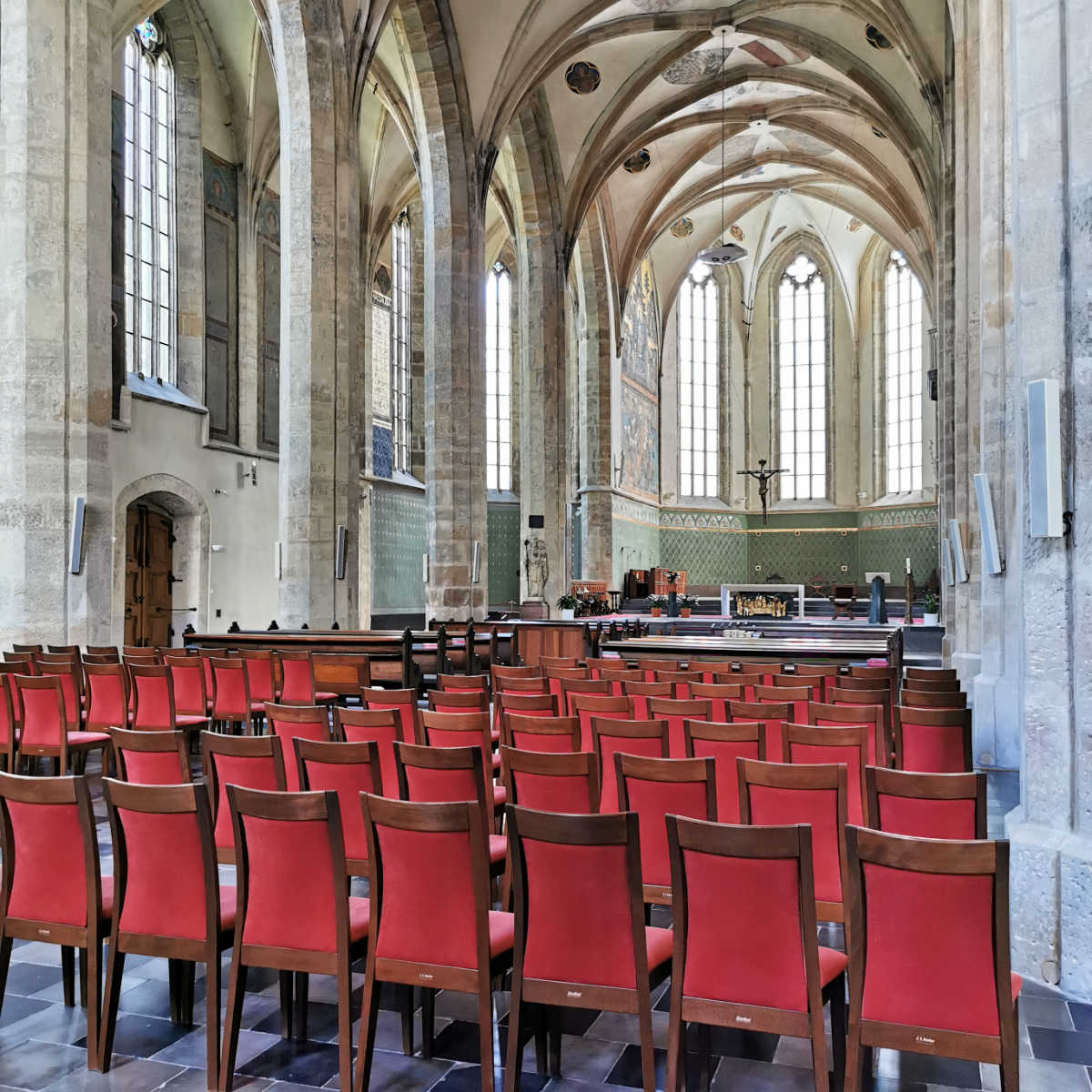
Emauzy Monastery History
The monastery was founded by Charles IV in 1347 because he wanted to promote the Slavic language and culture in his kingdom. He even insisted that the Prague bishop blessed the new monastery rather than the Vatican Catholic Bishop, which was a pretty big step from the norm at the time.
The monastery was built for Benedictine monks, invited from Dalmatia and Croatia, who used Old Church Slavonic as their liturgical language.
The beginnings of Emauzy Monastery
The monastery was built near the old parish church of St. Cosmas and Damian in Podskalí, which as the legend goes was built by St. Wenceslas. The church is still here, looking slightly lost in the shadow of the large monastery complex, but it has a fascinating history. The church was first mentioned in 1178, when it was the main church of a now-lost village called ‘Podskali’ (Under the rocks).
On the day the monastery was consecrated, the gospel about Christ’s meeting with the disciples in Emmaus was read, which is why the monastery was also called Emmaus – Emauzy in the Czech language. Interestingly the construction cost was the same as money spent on the Charles Bridge, but the builder of the monastery is unknown.
Monastery during the Husita’s wars
During the Husitas wars, the monastery was mainly used as lodgings for the Husitas brothers and because of that it was never attacked. But during this time (15 century) the monastery started to get neglected in more than one way!
The last of the Utraquist abbots and also the rector of the Prague University, Matouš Benešovský, known as Philonomus, married the daughter of an innkeeper from nearby Spálená Street and opened his own inn right in the monastery. To make matters worse, he also set up a shooting range for his guests in the monastery garden!
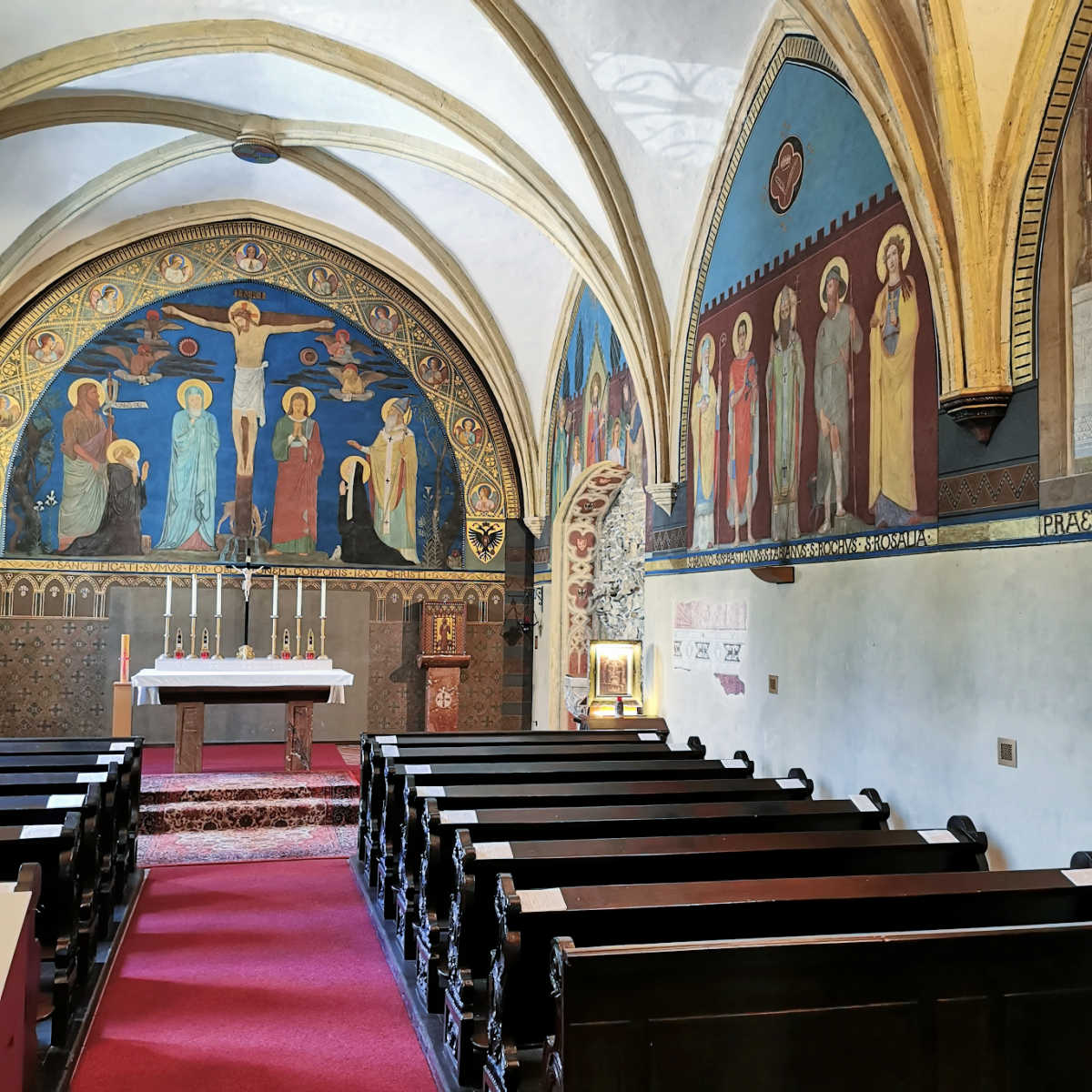
The arrival of Spanish Monks
After the Battle of White Mountain in 1621, which took place near another historic monastery of White Mountain in Prague, the Bohemian king Ferdinand III invited Spanish Benedictines to take over the monastery and send the Czech monks to the monastery and the church of St. Nicholas in the Lesser Town in Prague. During their time, the monastery and the church were rebuilt in a Baroque style.
Emauzy during the monastery closures
After king Josef II made drastic changes to all monasteries in Bohemia in the 18 century, the monks had to take over the running of the college in Klatovy (about 130 km from Prague).
Because of the distance, most monks had to move to Klatovy to work there and Emauzy was left with just a few retired monks.
One abbot, called Prokop Skoda used this time to buy out cheaply all the books, paintings, art and other religious collectables from the closed-down monasteries and built quite an impressive collection at Emauzy.
The Beuron Monks from Germany
After 1880, Emauzy changed hands again and the monastery and church were restored and rebuilt to meet the needs of Benedictines from Beuron in southern Germany.
They replaced most of the Baroque elements with a pseudo-Gothic style, now known as Beuronese. Their music-loving abbot founded a special Beuronese painting school and also made the monastery a centre for church singing in the style of Gregorian chant.

Emauzy during the First & Second World War
After the First World War, the Beuron monks were told to leave and in 1919 the building was used as a music college. The Beuron monks returned the next year, but only the Czech ones, the German monks had gone to the other monasteries outside then Czechoslovakia.
In the spring of 1941, an illegal radio transmitter broadcasted several times from the monastery. It was operated by resistance radio operators Bohumil Bachura, František Chyba, Jindřich Fröde, and Otakar Batlička. This illegal group was connected both to the Soviet consulate in Prague (through its employee Leonid Mochov) and to the Defense of the Nation.
At the beginning of July 1941, the Germans closed the church to the public. On Sunday, July 13, 1941, a Schutzpolizei unit dispersed the faithful who had gathered in front of the church for a defiant mass.
Three days later (on July 16, 1941), the Gestapo searched the office of Abbot Arnošt Vykoukal and he had to leave Prague. He was later captured by the Gestapo and died in Dachau concentration camp.
The monastery and church were definitively closed on July 18, 1941, the monks were expelled from the monastery, and it was then used by the Germans as a military hospital.
On February 14, 1945, the church was badly damaged during an American air raid on Prague. The two big church towers were completely demolished and most of the monastery buildings have burned out.
Modern history of Emauzy monastery
After 1947, the damaged Gothic frescoes in the cloister were restored, but the roof was only covered with flat reinforced concrete as a temporary measure.
During the 1950s the monastery was closed down by the communist party and became the property of the Czech Science Academy. Most monks had left the country at the time and some even tried to keep the Emauzy community going in a small monastery in Italy.

Reconstruction of the Emauzy Monastery in the 1960s
It wasn’t until the 1964 that the town decided to run a competition for the architectural design of the roof and towers that were destroyed during the war. The winning design by architect F. M. Černý led to the installation of an asymmetrical 32-meter modern structure made of white concrete to replace the original towers.1.3 kg of 24-carat gold was used for the gilded spires.
My favourite fun fact is that an optical illusion makes the southern tower, which is closer to the river, appear taller, although it’s exactly the same height as the other.
During the reconstruction, fragments of wall paintings and inscriptions were uncovered in the chapter hall of the monastery.
An inscription written in Croatian Glagolitic script (probably the text of the Old Czech Ten Commandments from 1412) is the first and so far the only evidence of Glagolitic epigraphy in the Czech Republic and in Western Slavic countries in general.
After the Velvet Revolution in 1989 the Emauzy Monastery was given back to the Benedictine order and they started the new community with just seven monks.

The Emauzy Monastery Gardens plans
The monastery gardens were never opened to the public and in fact suffered decades of neglect. The gardens were badly damaged at the end of the Second World War and never really recovered.
But in 2018 the reconstruction finally began. The gardens are surrounded by a high wall, so you can’t really see them, but they were originally established around the same time as the monastery around 1347. At one point there was a vineyard, fruit orchard, herb and vegetable garden, which must have looked amazing on the slopes of Moran next to the monastery.
The good news is that the plans are to open the gardens to the public and include a cafe, children’s playground and other facilities for visitors. As I’m updating this article mid summer 2026, the reconstruction is ongoing, but no official opening is available just yet.
This blog post was originally written on 10 October 2024 and last updated on 13 July 2026


