
17 hidden gems in Old Town Prague – A local’s guide for 2026
I’ve lived in Prague for years now, and whilst tourists flock to the Astronomical Clock and Charles Bridge, both undeniably spectacular, I’ve discovered that Old Town’s real magic lies tucked away in its forgotten corners and quiet courtyards. After countless hours wandering these cobblestone streets, I’ve learnt that the best of Staré Město reveals itself only to those willing to look beyond the obvious.
Most visitors never venture past the main square, but I’m here to share the secret spots that locals actually cherish, the medieval passages that feel frozen in time, the baroque gardens hidden behind unassuming doorways, and the historic cafés where you won’t find a single tour group. These aren’t just Instagram-worthy locations; they’re places with genuine stories, often overlooked even by guidebooks claiming to show you the “real” Prague.
In this guide, I’ll take you through the hidden gems I’ve personally explored and returned to time and again. Whether you’re planning your first visit or you’re a fellow Prague resident looking to rediscover your neighbourhood, I promise you’ll see Old Town through entirely new eyes.
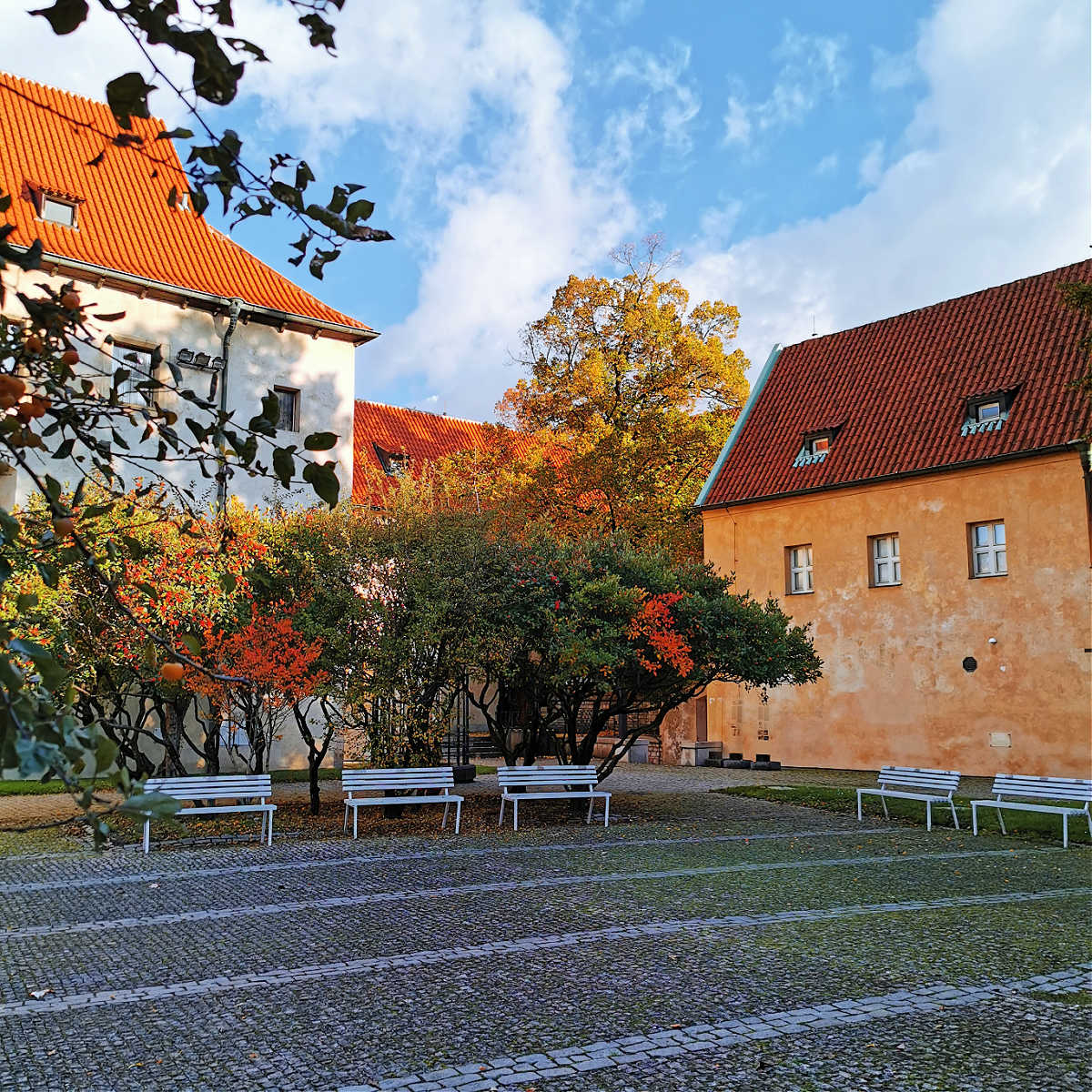
1. Gardens of the Convent of St. Agnes
What I really like about the Gardens of the Convent of St. Agnes is that they offer a complete escape from the city noise without actually leaving the centre. While the monastery itself is a Gothic masterpiece now used as an art gallery, the gardens at the back have only recently been open to the public. They’ve been beautifully restored to show off the medieval architecture from a different angle, and they are dotted with contemporary Czech sculptures.
The gardens are split into several sections, including the Orchard of the Poor Clares and there is a hidden cafe at the entrance to the gallery with seating at the corner of the garden.
My Local Tip: Make sure you walk around the whole area to see the gardens behind the main walls. Here the space (and the gardens) is part of what would have been several streets of very poor quarter of the town torn down in 19th and beginning of the 20th century. If you look down you can see the outlines of the old houses (mainly on the U Milosrdnych Street) with descriptions of the house history and who lived there.
- Location: U Milosrdných 17, Staré Město
- Opening Times: Daily 10:00 AM – 6:00 PM (Standard hours, though gardens often stay open a bit later in summer)
- Ticket Prices: Free admission to the garden areas (through the Anezka cafe or round the back streets)

2. Ungelt (Týn Courtyard)
I think Ungelt (also known as the Týn Courtyard) is one of the most historically significant squares in Prague. Back in the 11th century, this was a fortified merchant’s yard. The name “Ungelt” comes from the German word for “customs” or “tax,” because every foreign merchant coming into Prague had to stay here and pay a tax fee to have their goods protected. It was a city within a city, with its own hospital, church, and stables.
Now you can find here boutique shops, high-end restaurants, little theatre and outdoor cafes. My favourite is (still) the Botanicus shop with handmade soaps, shampoos and other natural cosmetics. It’s originally a Czech company and all products are still made (and the herbs grown) just outside Prague.
My Local Tip: If you visit in the evening, the amber streetlights illuminates the Renaissance frescoes on the walls, and it feels exactly like the 16th century. It’s also much quieter than the main Old Town Square just a few metres away.
- Location: Týnská 639, Staré Město
- Opening Times: Public courtyard open 24/7
- Ticket Prices: Free to explore the courtyard

3. St. James the Greater Church & Minorite Monastery
This church is tucked away just behind the Týn Church, and while the Baroque interior is jaw-droppingly beautiful, most people come for something a bit more… gruesome. If you look up just inside the entrance to the right, you’ll see a shrivelled, blackened human hand hanging from a chain. Legend says a thief tried to steal the jewels from the Virgin Mary statue, and the statue grabbed his arm so tight it had to be cut off!
The Minorite Monastery was founded by the King Wenceslas and build around 1232. This is one of Central Europe’s oldest Franciscan monasteries, and it became pretty important in medieval Prague, so much so that they held King John of Luxembourg’s coronation feast here.
This was partly because the monastery had the biggest room in the whole Prague at the time to fit all the guests. And to top it all, the second wedding of John of Luxembourg few years later was also held here, which tells you something about how significant this place was.
My Local Tip: The monastery has only recently been reopened to the public after being closed for years and there are various self-guided route options to look around (including the main hall, church, cellars, museum and rooms on the first floor).
The pricier ticket options also include tastings of locally made herbal syrups. There is even a little cafe with seating in another courtyard with herb garden, which is pretty cool. The cafe has recently become free to enter, which makes it a great hide away from the busy streets outside.
- Location: Malá Štupartská 6, Staré Město
- Opening Times: Daily 10- 5 pm
- Ticket Prices: Prices from 180 CZK – 350 CZK depending on which route you choose (free entry to the cafe)

4. Kodl Contemporary Art Gallery
The Kodl family has been dealing with fine Czech art for five generations (well over 130 years) and it’s basically the most successful auction house in the country.
The family tradition started in the 19th century with Jan Kodl, who was even a friend with the first Czechoslovak president. If a painting by a Czech master like František Kupka or Bohumil Kubišta sells for millions of euros, it usually happens through the Kodl auction house.
The family recently expanded with a very sleek glass cube gallery on Pařížská Street, the Kodl Contemporary, which is perfect for the modern art you can see here.
My Local Tip: Don’t be intimidated by the “Auction House” label. You can usually walk in and view the pre-auction exhibitions for free. It’s essentially a world-class museum of Czech art that changes every few months, and it’s rarely as crowded as the National Gallery.
- Location: Pařížská 43/30 (Entrance from Dvořákovo nábřeží), Staré Město
- Opening Times: Tuesday–Sunday 10:00 AM – 6:00 PM
- Ticket Prices: Usually free admission for exhibitions

5. The “Infinity” Book Tower (Idiom)
I know that this is not as hidden gem as it used to be, but I think the Infinity Book Tower is still pretty cool art installation to see. It’s right inside the foyer of the Prague Municipal Library and I walk by it every time I go to the library to work on my blog.
It’s a huge cylindrical tower made of hundreds of real books, created by artist Matej Kren. But the best thing about it? There are mirrors at the top and bottom inside the tower, so when you peek through the tear-shaped opening, it looks like a never-ending well of knowledge.
It’s a great spot for a quick, cool photo, but just remember it’s a working library, so keep your voice down!
My Local Tip: It’s totally free to see, but since it become very popular the queue is usually quite long. It’s best to arrive early in the morning after opening otherwise it’s (probably) not worth waiting to see it.
- Location: Mariánské náměstí 1, 110 00 Staré Město
- Opening Times: Mon–Fri 9:00 am – 8:00 pm, Sat 9:00 pm – 7:00 pm, Sunday – Closed
- Ticket Prices: Free

6. The “Man Hanging Out” (Sigmund Freud Statue)
If you’re walking down Husova street and you see a group of people pointing at the sky with worried faces, don’t panic! They’re looking at a statue of Sigmund Freud hanging by one hand from a pole high above the street. It’s a piece by a Czech sculptor David Černý, and it represents Freud’s struggle with his own phobias.
My Local Tip: I’ve walked past this hundreds of times, and I still double-take. It’s best seen at dusk when the silhouette looks most real. If you walk from Bethlehem Square towards the Old Town Square along Husova; the angle is perfect for a photo where it looks like he’s about to fall right onto the cobblestones. It’s quirky, it’s weird, and it’s exactly why I love this city.
- Location: Husova street (near the intersection with Na Perštýně)
- Opening Times: 24/7 (Look up!)
- Ticket Prices: Free
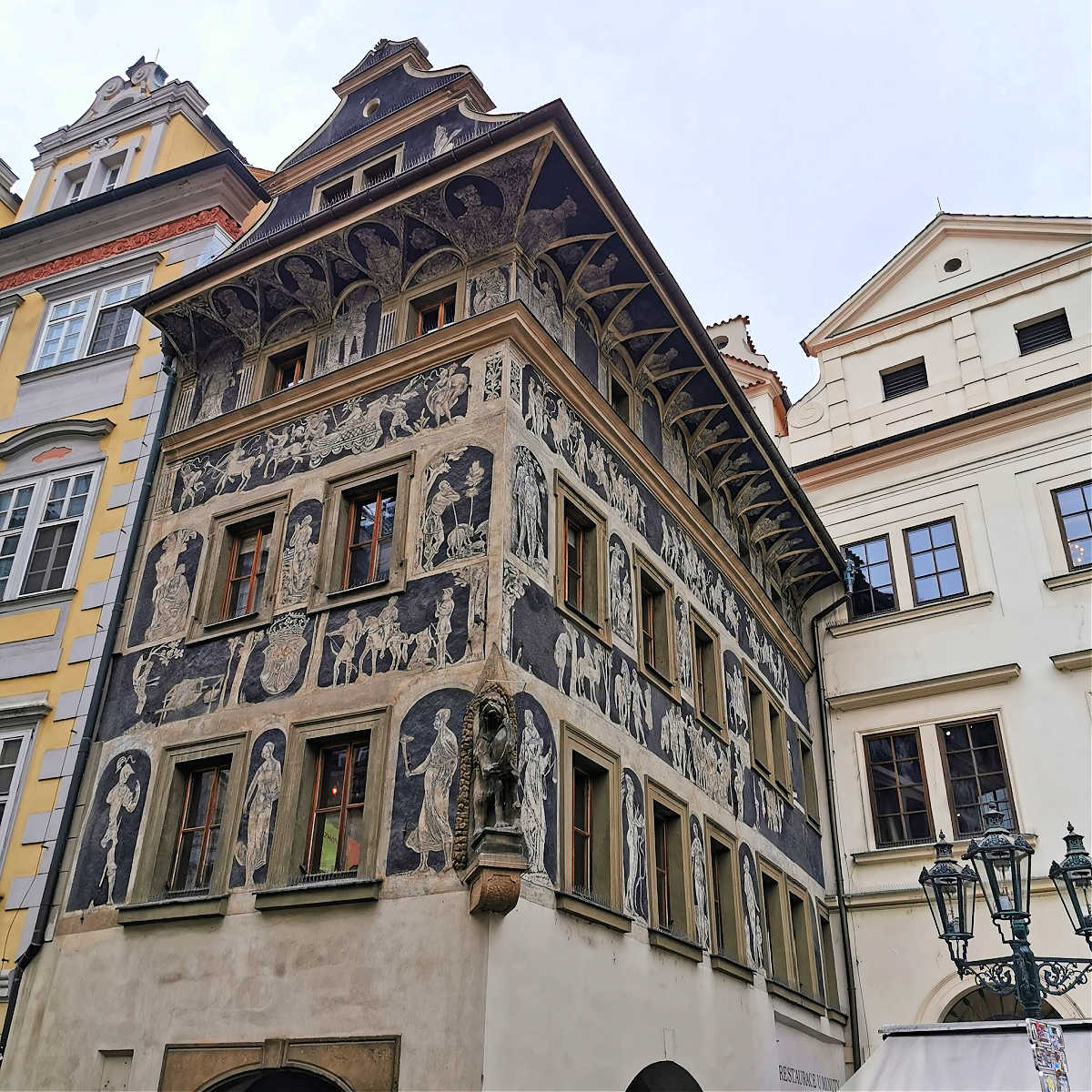
7. House at the Minute (Dům U Minuty)
You’ve probably walked past this house and admired the black-and-white “drawings” on the walls without knowing what it was. This is a 15th-century house covered in sgraffito, a technique where they scratch through layers of plaster to create art.
There is a lot of detail there and you can see everything from Greek mythology to Habsburg rulers. Most importantly, Franz Kafka lived here as a child from 1889 to 1896!
My Local Tip: This house is a great starting point for my self-guided tour of Franz Kafka life in Prague. He spend a lot of his time living very close to Old Town Square and I had a great time researching (and walking!) all the houses where he used to live and work.
- Location: Staroměstské nám. 2, 110 00 Staré Město
- Opening Times: Exterior viewable 24/7 (Ground floor is an Italian restaurant)
- Ticket Prices: Free (no public access inside)
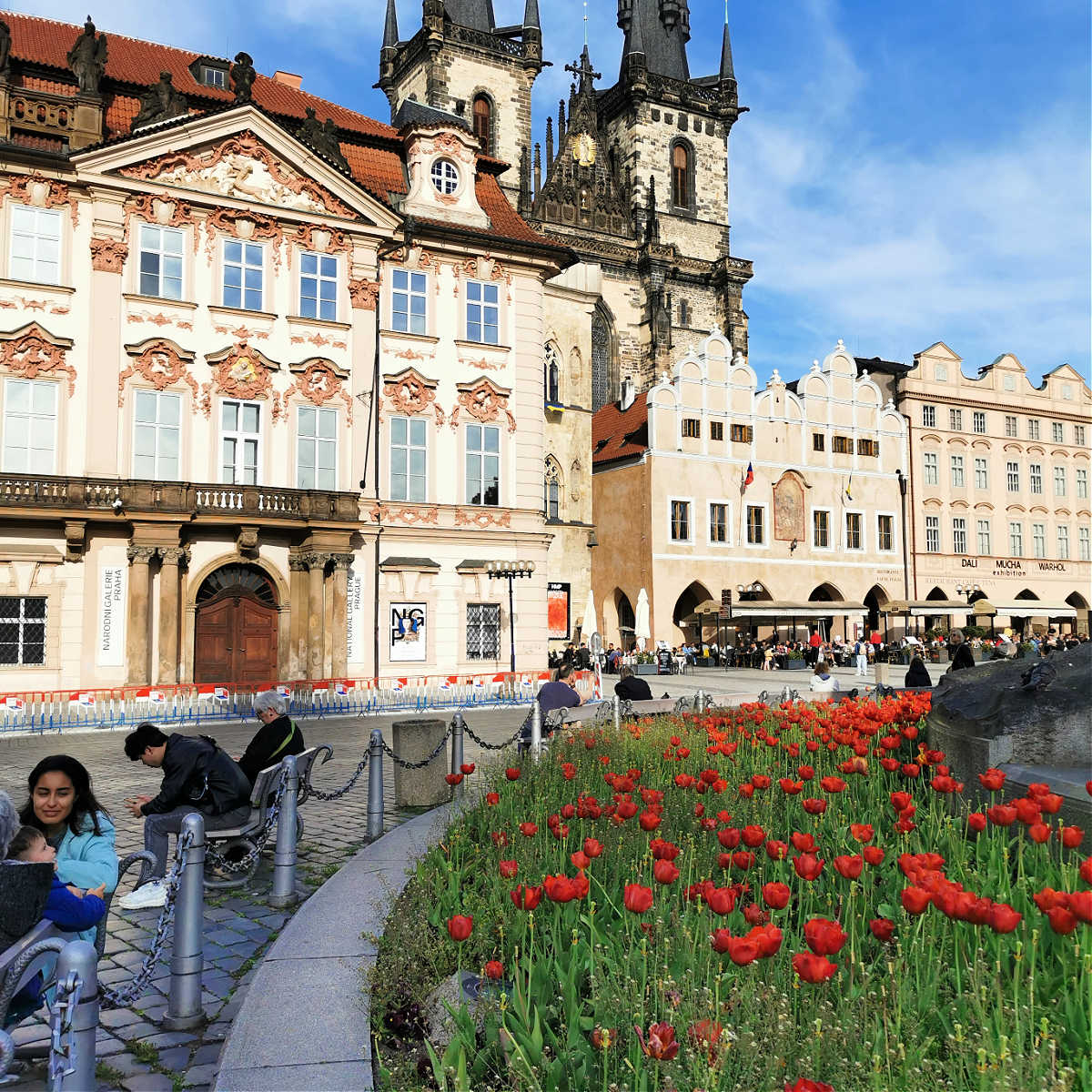
8. Bertha von Suttner Memorial at Kinský Palace
Most people walk past the Kinský Palace and just see a pretty pink building, but it holds a story of a woman who literally changed the world.
I’m talking about Bertha von Suttner (born Countess Kinský). She wasn’t just some aristocrat; she was the first woman ever to win the Nobel Peace Prize in 1905.
She was born right here in Prague in 1843, and her connection to Alfred Nobel is truly fascinating. She actually worked as his secretary and housekeeper in Paris for a brief time, and though she left to marry the love of her life, she and Alfred stayed close friends for twenty years.
I also found out, that it was Bertha who actually inspired Alfred Nobel to create the Peace Prize in the first place. She was a fierce pacifist and wrote the world-famous anti-war novel Lay Down Your Arms! (Die Waffen nieder!). She kept writing to Alfred, pushing him to do something for the cause of peace, even though he had made his fortune from dynamite. Without this Prague-born woman, the world’s most famous prize might not even exist!
My Local Tip: What I really like about this is that her memorial is quite subtle. You’ll find a bronze bust of her on the wall of the Kinský Palace (to the left of the main entrance as you face the building).
Look at her face, she looks incredibly determined. I always tell people to stop here for a second before heading into the Art Gallery, which is inside the palace.
- Location: Staroměstské náměstí 12 (On the facade of Kinský Palace), 110 00 Staré Město
- Opening Times: Viewable 24/7 on the exterior wall.
- Ticket Prices: Free to admire.

9. Rotunda of the Finding of the Holy Cross
You’d never think, that on the corner of a fairly ordinary street just a few meters away from the main road, you’d find the oldest rotunda in Prague! The beautifully restored Rotunda of the Finding of the Holy Cross was built at the end of the 11th century and it’s even older than the one at the Vysehrad.
In the 1860s, it was actually scheduled for demolition to make way for a new house, but thankfully, the local artistic community (led by the painter Josef Mánes) stepped in to save it. It’s a small, circular stone building that looks totally out of place—and utterly magical—sitting on a modern street corner.
My Local Tip: The only time you can visit is during Sunday service, but if you do you can see 14th-century frescoes that are remarkably well-preserved.
- Location: Karoliny Světlé 1013, Staré Město
- Opening Times: Generally closed to the public except for Sunday services (usually around 6:00 pm) or special events.
- Ticket Prices: Free to view from the exterior

10. Náprstek Museum of Asian, African & American Cultures
The Náprstek Museum of Asian, African and American Cultures is one of my favourite places to hide on a quiet Tuesday. What’s truly special is the building itself, because it’s inside the former U Halánků brewery and distillery.
It is here, where Vojtěch Náprstek, a 19th-century philanthropist and industrialist, turned his family’s brewery into a museum and a hub for explorers and intellectuals. He was obsessed with progress and travel, and he used this space to store the thousands of artefacts brought back by his globetrotting friends. It was actually the first museum of its kind in the country!
My Local Tip: Look for the exhibit on the first women’s club in Prague (The American Ladies’ Club), which Náprstek founded right here. It’s a fascinating slice of social history. Also, the courtyard is a lovely, quiet spot to escape the noise of Bethlehem Square and there is a little cafe here too.
- Location: Betlémské nám. 1, Staré Město
- Opening Times: Tuesday–Sunday 10:00 am – 6:00 pm, Closed on Mondays
- Ticket Prices: Adults 150 CZK (concessions available)

11. páternoster Lift tour at New Town Hall
The Prague New City Hall itself was built between 1908 and 1911 in a beautiful Art Nouveau style, but for me, the real hidden gem is the paternoster lift inside. It’s an open-compartment elevator that never stops moving! You have to be quite quick to hop in and out. It’s one of the best-preserved examples in the city, and honestly, it’s just great fun to ride it all the way around the top.
My Local Tip: The paternoster is now only accessible through a guided tour, but you do get to learn about the history and have the chance to see the engine room too, so I think it’s still worth it.
- Location: Mariánské nám. 2/2, 110 00 Staré Město
- Opening Times: Saturday and Sunday 1:00 PM – 7:00 PM
- Ticket Prices: Adults 150 CZK (concessions available)

12. The Old Pharmacy at the Church of Saints Simon & Jude
This 17th-century church was part of the Brothers Hospitallers monastery and it has a secret hidden in plain sight. If you follow the side wall, you’ll find a beautifully preserved old pharmacy dispensing entrance door. Back in the day, the monks were famous for their medicinal knowledge and people would come to this specific door to get tinctures and remedies.
The church itself is no longer used as a church, but as a Prague symphonic orchestra practice space.
If you can, book a concert here; the interior is lavish and the acoustics are amazing. Inside, you can also see a famous organ, which was played by both Mozart and Haydn.
My Local Tip: Most people walk right past the “pharmacy door” because it’s towards the back of the building, but if you look closely you can see there is an old staircase that leads you down to it from the street level.
- Location: U Milosrdných, Staré Město
- Opening Times: Viewable from outside 24/7; open to public only during concerts
- Ticket Prices: Free to admire the exterior, concerts are payable
13. Hospital Na Františku
I think what is most impressive about the Hospital Na Františku is its sheer longevity, it has been a site of healing since the 14th century! When you look at it from the outside, especially from the river side, you see a massive, imposing complex that has evolved from a medieval convent to a modern hospital. It’s one of the oldest continuously operating hospitals in Europe. The architecture is a fascinating mix of Gothic foundations and later Baroque and modern additions.
My Local Tip: This is still a working hospital, so there is no public access, but you can read about the history on the display boards outside.
- Location: Na Františku 847/8, Staré Město
- Opening Times: Exterior viewable 24/7
- Ticket Prices: Free to admire from the street

14. Bethlehem Chapel
This place was super important in Czech history but often skipped by tourists. Founded in 1391, it was the first preaching church in central Europe where services were held in the Czech language instead of Latin.
This is where Jan Hus, our famous national hero and reformer, preached to thousands. The building you see now is actually a very clever reconstruction from the 1950s, using the original walls that were hidden inside other buildings for centuries!
My Local Tip: Each year, the cellars under the chapel are used for an amazing Christmas exhibition of traditional crafts. I’ve been coming here since the 1980s as a child and to this day, it’s always on my Christmas list of places to visit.
Also, check the schedule for university graduation ceremonies; it’s owned by the Czech Technical University, and seeing the students in their robes here is quite a sight!
There is also a hidden cafe in the chapel grounds with outdoor seating serving great coffees and homemade lemonades.
- Location: Betlémské nám, 110 00 Staré Město
- Opening Times: Daily 10:00 am – 5:30 pm
- Ticket Prices: Adults 150 CZK (concessions available)
15. The Streets of Stínadla (Haštalská Quarter)
If you want to understand the mysterious side of Prague that locals grew up with, we have to talk about Stínadla.
For those who don’t know, Stínadla isn’t a single official district on a map, but instead it’s a legendary, shadowy neighbourhood from the famous Rychlé Šípy (Rapid Arrows) stories by Jaroslav Foglar.
For generations of Czech children (myself included!), these narrow, winding alleys between the Old Town Square and the Vltava river were the backdrop for adventures involving secret societies, lost inventions like the “Flying Bicycle,” and the mysterious puzzle of hedgehog in a cage.
The area around Haštalská Square, Řásnovka and the dark, narrow lanes leading toward the St. Agnes Convent is what we call the real Stínadla. When you walk through these streets, especially at dusk, you’ll notice they feel different. They are quieter, narrower, and the tall old houses seem to lean in towards you. It’s a place of shadows, yellow lanterns, and hidden courtyards.
My Local Tip: What I really like about this area is that it’s one of the last places in the Old Town that hasn’t been “glossed up” for tourists. To experience the true Rychlé Šípy atmosphere , head to Ve Stínadlech street (yes, they eventually named a small passage after the popular books!) or wander down Řásnovka.
Look out for the yellow pin symbols painted on the walls or tucked into corners, fans of the books leave them there as a nod to the “Vonts” secret society.
- Location: The area bounded by Revoluční, Dvořákovo nábřeží, and Kozí streets (Focus on Řásnovka and Haštalská).
- Opening Times: 24/7 (Best visited at twilight or after dark for the atmosphere).
- Ticket Prices: Free—just bring your imagination and a sense of adventure!

16. Public toilets Uhelný trh
Most people would walk right past this and think it’s just a decorative staircase or a maintenance hatch, but for me, the underground toilets at Uhelný trh are part of every day people’s history and one of the oldest public toilets in Prague.
They were built in 1926 (exactly a hundred years ago from now!), when Prague took its public infrastructure very seriously, and these were designed to be elegant, functional, and most importantly hidden underground so as not to spoil the look of the market square above. Sadly, none of the inside decor has remained, but the outside sign is still in the original style.
You’ll see these two separate, ornate wrought-iron railings leading down into the ground, one for “Muži” (Men) and one for “Ženy” (Women).
My Local Tip: I know it sounds funny to recommend a toilet as an attraction, but also, the square itself, Uhelný trh, is a great place to stop & rest on the wooden benches because it’s much quieter than the nearby Havelská Market.
- Location: Uhelný trh, 110 00 Staré Město
- Opening Times: 24/7 from the outside, Toilets daily, usually 7:00 am – 9:00 pm
- Ticket Prices: Free to view from the outside (20 CZK to use)
17. Speculum Alchemiae (Museum of Alchemy)
Prague was the capital of alchemy under Emperor Rudolf II, and this museum is actually a time capsule discovered after the 2002 floods. It’s an authentic 16th-century alchemy lab hidden under one of the oldest buildings in the city. You get to go down secret stairs into the tunnels where they actually tried to make gold and the Elixir of Youth.
My Local Tip: This is not one of those fake tourist museums, you can still see the soot on the ceilings from the old ovens. What I really like is that at the end of your visit, you can buy “elixirs” made from ancient recipes by local Benedictine monks. I can’t guarantee they will work, but the bottles are beautiful and they make the best souvenirs!
- Location: Haštalská 1, 110 00 Staré Město
- Opening Times: Daily 10:00 am – 6:00 pm
- Ticket Prices: Adults 250 CZK
This blog post was originally written on 20 April 2026 and last updated on 20 April 2026


