Visiting the Church of the Most Sacred Heart of Our Lord by Joze Plecnik
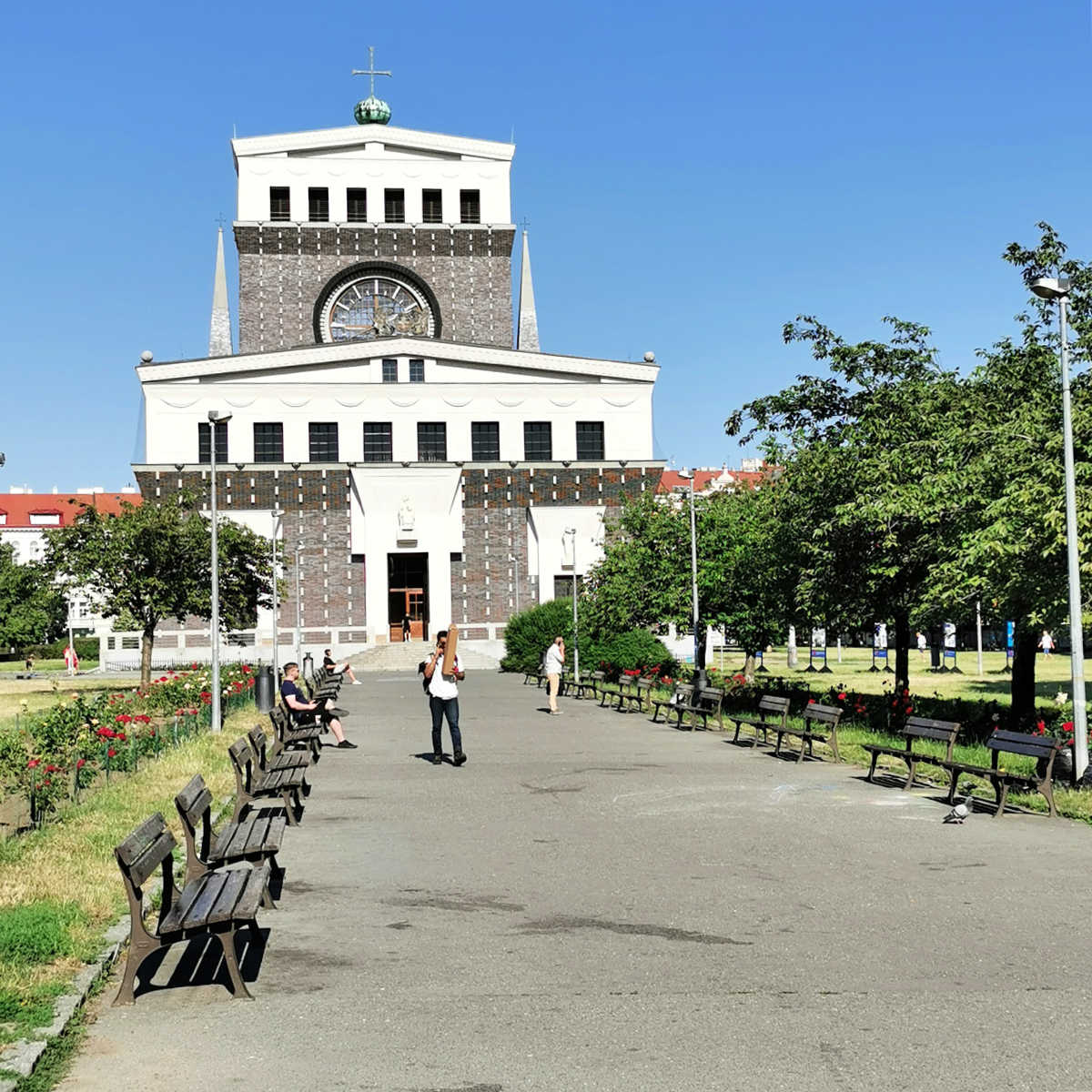
There are so many beautiful churches in Prague, but The Church of the Most Sacred Heart of Our Lord really stands out, because it quite modern and designed by the famous architect Joze Plecnik, who also worked on re-designing Prague Castle in 1920-30s on the president T.G. Masaryk invitation.
I always admire this church when I visit the local farmer’s market at the main Jiriho z Podebrad square and sometimes I’d stay for a while and just sit and admire the space inside the church. If you want to spend a bit more time in this area of Prague, you can also combine the visit with nearby Zizkov Television Tower and follow my self-guided tour of Zizkov for more local gems.

Church of the Most Sacred Heart of Our Lord History
The Church of the Most Sacred Heart of Our Lord was built between 1928-1932 and is the best example of Czech architecture between WW1 and WWW2 designed by a well-known Slovenian architect Josip Plečnik.
The church was built as the capacity of the St. Ludmila Church on Míru (Peace) Square wasn’t sufficient enough. The building has a striking design and it’s said that the architect Josip Plečnik was inspired by Noah’s Ark during the design process.
VISIT OTHER CHURCHES & MONASTERIES IN PRAGUE
Plecnik’s designs
Interestingly enough, before the church was built, the local catholic church run an anonymous competition for the best design, which Plecnik wasn’t part of. But, for some reason, the church representatives have asked Plecnik to submit plans separately. The first two design versions were so expensive to built, that the church couldn’t accept them until the third revised version, which was finally approved by the church board.
Although the last plan was less lavish than the previous ones, there was still not enough money to start building the church itself. The much revised and budget friendly plans were submitted in 1927, but it took another two years before the church started to be built in 1929, after the founding stone was blessed in 2028.
I should also mention, that Plecnik actually designed and submitted all three versions for free and continued to supervise the built and revise the plans as needed also for free.
MORE CHURCHES IN PRAGUE

Fundraising & Cost of building the new church
Whilst the new church was being built, the church board had to continue to fundraise more money to complete the building. This included lottery, selling sponsorship for ‘paper’ bricks to build the church and even collecting money by walking around the area and knocking on people’s doors.
Whilst the local woman’s groups tried their best to fundraise money, by for example organising garden party at Furstenberg Garden and collecting an impressive 10. 000 CZK, it was the individual benefactors, who contributed the most. For example the most amount of money (300.000 CZK) came from a professor of law medicine of Charles University, Doctor Slavik.
There was an extra expense of 700.000 CZK for a concrete slab that had to be put down as the foundation since the builders couldn’t reach rocks as a natural foundation for the tall and heavy tower.
Over the next two years, the church walls, tower and roof was build by 77 builders, who at the end received extra payment as a way of thank you for the work they have done. By 1931 work could start inside the church, including electricity, plumbing, internal walls and windows.
The church board was still frantically trying to fundraise money, but wasn’t always successful. For example one church bell was meant to be gold, but eventually was made from copper and the collected gold was used for decorating the interior of the church as there wasn’t enough to make the whole bell.
There was not even enough money for the church benches and fundraiser was set up at 600 CZK per bench to sponsor them. Just to give you an idea how expensive this was, a skilled manual worker would earn about 270 CZK per week, where woman in a similar position in a factory would earn only 170 CZK. The monthly rent was about 400 CZK at the time for a small flat. Going on the average rent in today’s money in Prague the bench would cost equivalent of 37,500 CZK, which is about £1250 !!!
The total cost of the church built was 4.7 million Czech crowns, but there was not enough money to built a new organ, so organ from a nearby church of St. Alois was installed instead. It wasn’t until few years later, when the church had enough money to commission the current organ.
MORE CHURCHES & MONASTERIES IN PRAGUE
The church clock
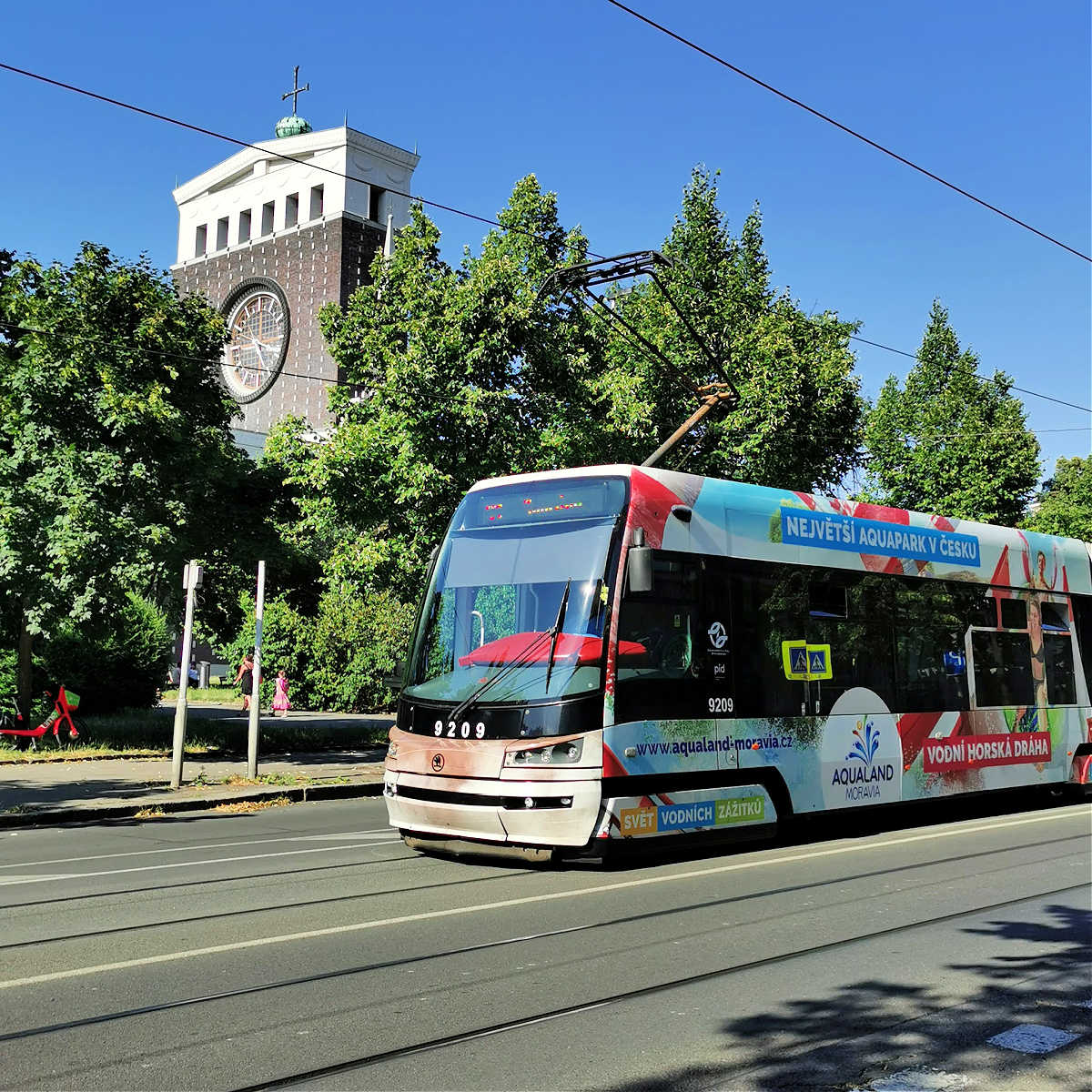
The church has a 42-meter bell tower with a flat copper roof, which is the largest clock in Prague and the Czech Republic measuring 7.6 metres. The clock was purchased by an anonymous benefactor. Because of the clock’s size it was always tricky to keep the clock working correctly and after only a year, the clock had to be repaired for the first time in 1933.
The clock was then working on and off, but recently repaired in 2014 and is again showing the correct time.
The church bells
Once the tower was built, the church board wanted to add the bells, but unfortunately didn’t have enough money. Then in 1931 a local businessman, Karel Ronovsky directly ordered and paid for the six bells from a Brno bell making company of Mr. Manousek.
During the Second World War, five bells from the tower were melted down for the production of weapons and only the smallest one was left. In 1992, two replicas were returned.
MORE CHURCHES IN PRAGUE
Statues & Inside the Church design
The western facade of the church is decorated with three sculptures (the Good Shepherd, the Madonna with Child, and the Orant) by Bedřich Stefan.
Inside the church is decorated in a modern style, with the main altar made of white Carrara marble.
This new altar was added in November 2018 and the new altar once again reveal light openings into the crypt, which used to be covered by the podium.
The parish commissioned architect Josef Pleskot to design it. The new altar replaced the one from 1992, which had originally been intended only as a temporary solution.
Above the altar, you’ll find a three-meter tall gold gilded figure of Christ, along with statues of six Czech patrons: St. John of Nepomuk, St. Agnes, St. Adalbert, St. Wenceslas, St. Ludmila, and St. Procopius. They are made of lime wood (Czech national symbol is a lime tree) and were created by sculptor Damián Pešan.
A traditional part of the church has an unusual form—a halved oval that appears to float on a podium at the front of the church.
The glass work was done by Ruckl glass making company, which exists to this date and it’s now based in Zbiroh. It makes a great day trip from Prague and you can also do the tour of the factory. I’ve done it recently and it’s a great way to learn more about glassmaking.
T.G.M visit & general perception of the new church
Plecnik continued to visit the church whilst it was being built and even re-designed certain elements as needed (usually because of the cost). When the church was nearly finished the Czech president T.G Masaryk also visited and was taken back by the church design so much that he wrote a personal thank you note to Plecnik afterwards.
Whilst T.G.Masaryk was very complimentary about the new church design, many others, including the main newspapers didn’t really like the new church, especially in contrast to the more traditional houses around the square.
The church architect Jože Plečnik
Jože Plečnik was born on January 23, 1872, in Ljubljana, then part of Austria-Hungary (now Slovenia). From an early age, Plečnik was interested in drawing and as a young man worked as a carpenter in his father’s workshop before moving on to study at the Vienna School of Arts and Crafts. In 1894, he was accepted into the Academy of Fine Arts in Vienna, where he studied under the legendary architect Otto Wagner, a founding figure of modern architecture and the Viennese Secession movement.
Plečnik’s career took off successfully in Vienna, where he worked on several important projects, including the Langer House (1900) and the Zacherlhaus (1903–1905). These buildings were already built with modern materials and their design had both classical and contemporary elements. Plecnik’s work from this period was marked by a strong influence from the Secessionist style, but always with a personal, expressive twist.
In 1911, Plečnik returned to his hometown of Ljubljana and over the next decades, he transformed the city with projects such as the iconic Triple Bridge (Tromostovje), the National and University Library, the Ljubljanica River embankments, and the Cemetery of Žale. His vision for Ljubljana was holistic; he believed in integrating architecture with urban planning, landscape, and public life.
Plečnik’s reputation extended beyond Slovenia. In 1920, the newly formed Czechoslovak government, led by President Tomáš Garrigue Masaryk, invited him to Prague. There, Plečnik was tasked with the sensitive renovation and redesign of Prague Castle. His work at the castle, including the Plečnik Hall, the Garden on the Bastion, and the Third Courtyard, brought a modern sensibility while respecting the site’s centuries-old tradition.
But one of Plečnik’s most significant and original works in Prague is the Church of the Most Sacred Heart of Our Lord (Kostel Nejsvětějšího Srdce Páně), built between 1928 and 1932 in the Vinohrady district.
Plečnik was also a dedicated teacher, shaping a new generation of architects as a professor at the University of Ljubljana’s School of Architecture from 1921 until his death. He influenced countless students, including Otto Rothmayer, who continued some of his work in Prague.
Jože Plečnik died in Ljubljana on January 7, 1957.
Practical Information for visiting the Church of the Most Sacred Heart of Our Lord
Location: Jiřího z Poděbrad Square, Zizkov, Prague 3
The church is directly on the main square and you can’t miss it as you walk up from the underground (Jiriho z Podebrad stop).
Opening Times
The church is open 45 minutes before the beginning of each service only, but the main door (with the view of the church inside through the inner doors) is open every day from 9 am to 5 pm. And of course, you are very welcome to attend the service, although services are held in Czech (or Latin) language.
The main services at the church are: Monday to Saturday – from 8 am and from 6 pm and on Sunday there are four services from 9 am, 11 am, 6 pm and 8 pm.
If you are not joining in for the service I’d strongly advise that you visit the church as early as possible (45 min before the service) to allow enough time to see the church and leave well before the service starts.
Tickets:
The church is free to enter, but you can also arrange an organised guided tour, which cost 160 CZK. The tour doesn’t include walking up to the clock tower, which is closed to the general public at all times, but it includes access to the crypt (as well as the rest of the church)
This blog post was originally written on 30 August 2025 and last updated on 30 August 2025