
Visiting the Dvořák Museum in a Baroque Villa by Kilian Ignaz Dientzenhofer
Hidden away in a quiet part of Prague 2, I came across the Antonín Dvořák Museum, and honestly, it felt like finding one of the city’s best-kept secrets. The museum is inside a gorgeous old Baroque villa called Amerika, and walking through the gate feels a bit like stepping back in time.
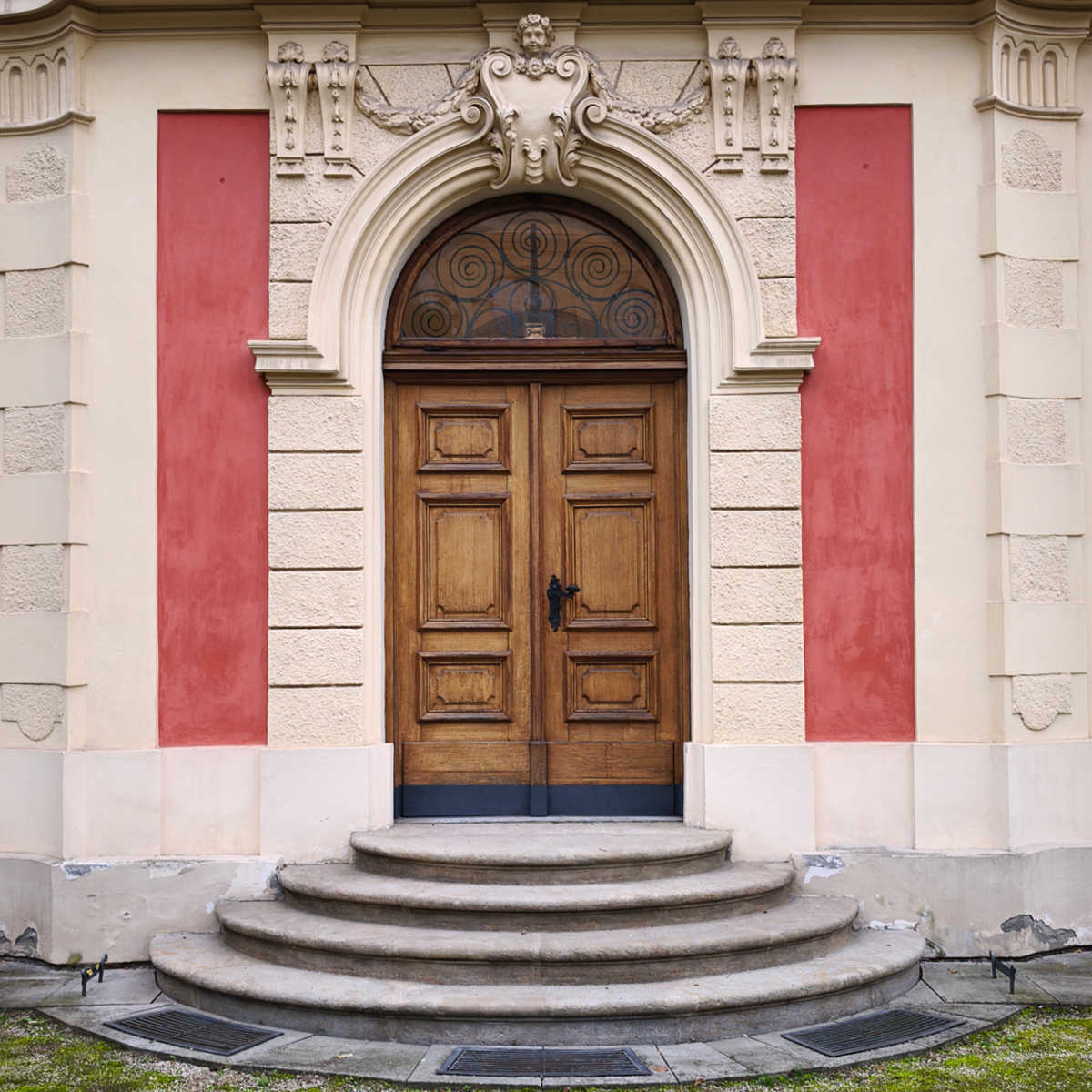
The house was designed by the famous architect Kilian Ignaz Dientzenhofer, and it’s one of the first buildings that went up in this area. Inside, everything is dedicated to the life and music of Antonín Dvořák, one of the Czech Republic’s most iconic composers. You can see his actual writing desk, his piano, and even some of his handwritten music.

My favourite reasons for visiting Antonin Dvorak Museum
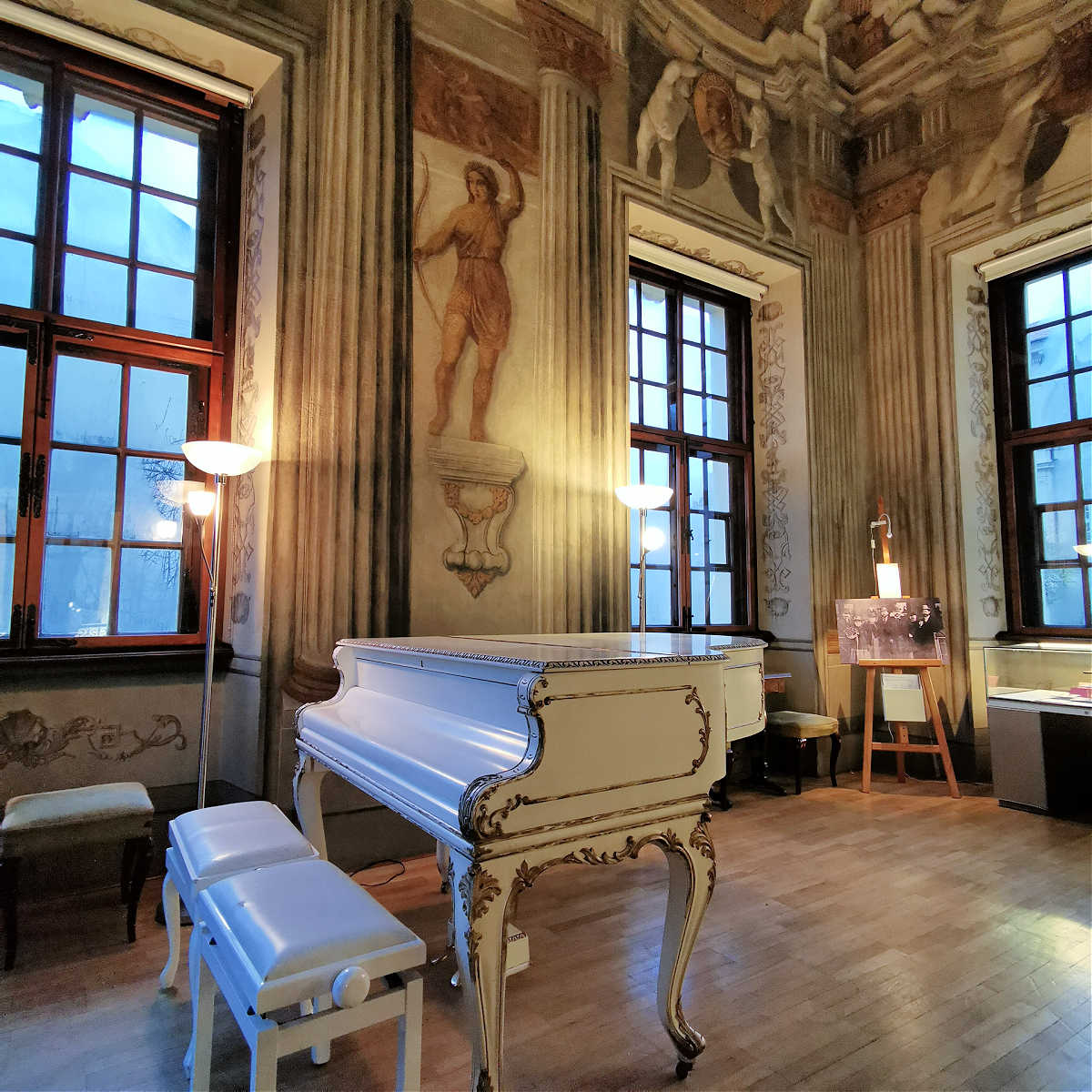
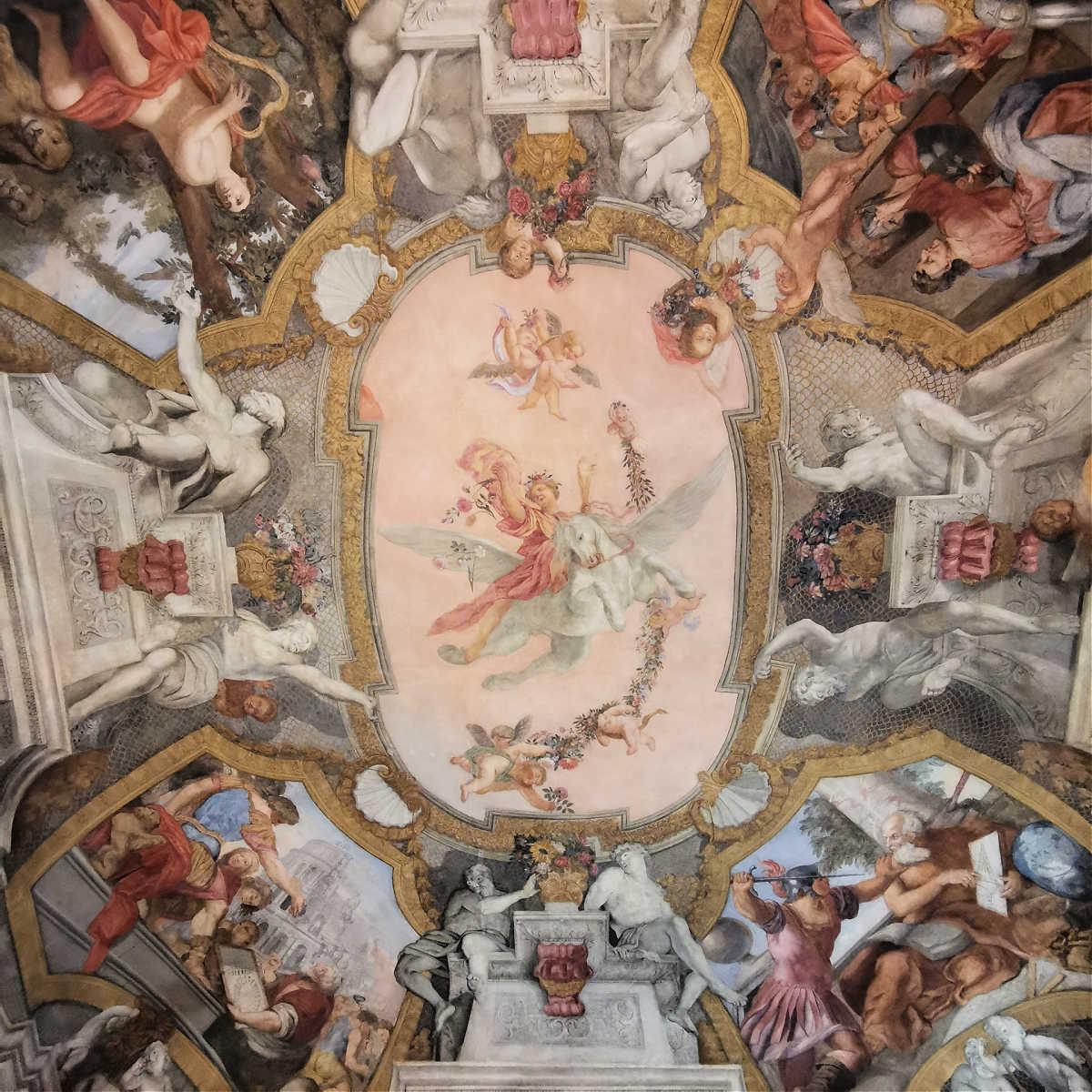
The museum is very interesting if you want to learn more about Antonin Dvorak, but to be honest, the reason why I visited was to see the house. I loved the beautiful painted ceiling on the first floor and I really liked that all the original parts of the house were restored and kept as they were.
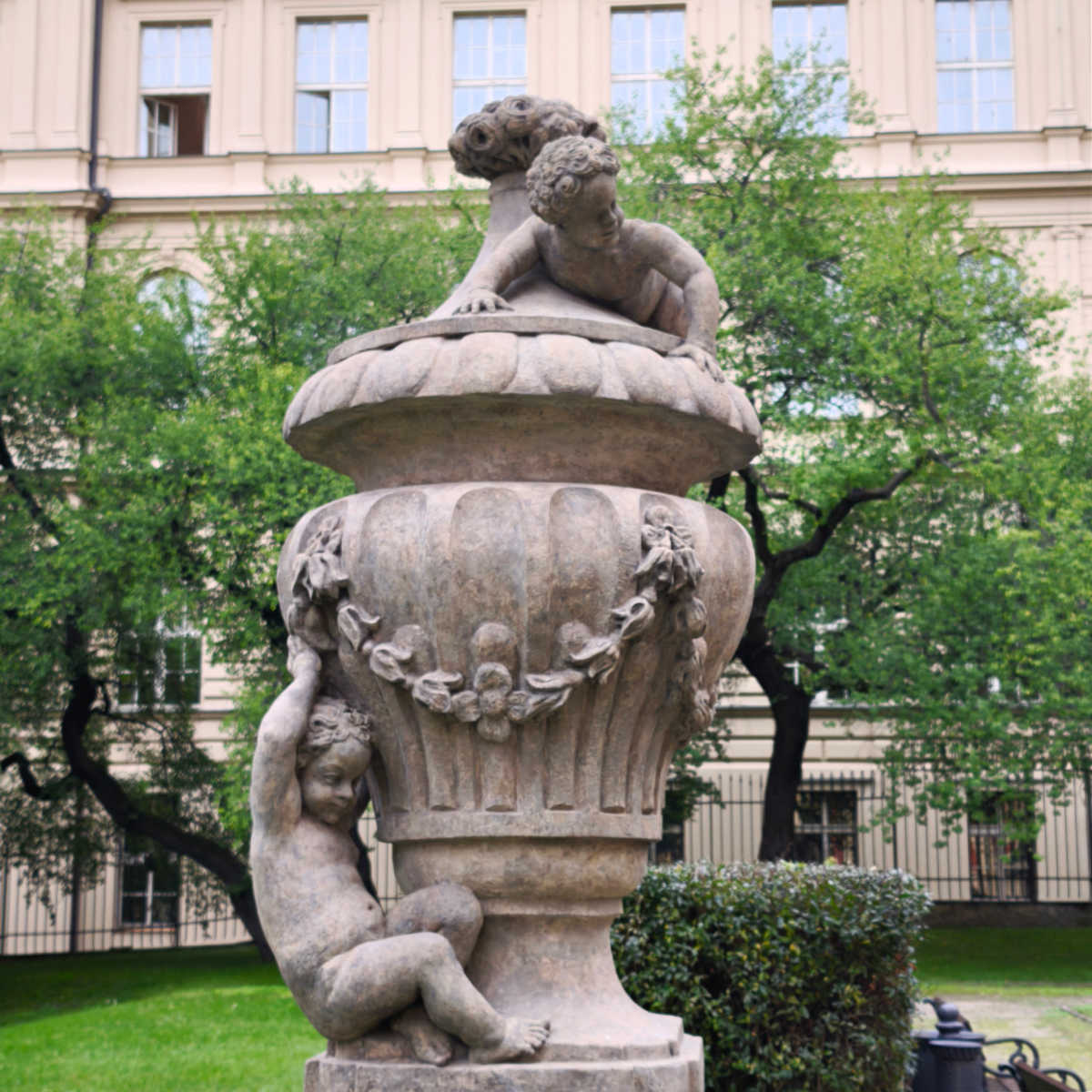
I also spend some time in the garden and saw the slightly unusual statues by the sculptor Matyáš Bernard Braun (they seem to be modelled on not always ‘pretty’ people and faces, which I guess is more realistic than most other statues).
There is a very modest entry fee to the museum, so the visit is well worth it.
MORE MUSEUMS IN PRAGUE
What can you see inside the museum
The Antonín Dvořák Museum was founded in 1932 and from the beginning was based here, at the Michna Summer Palace.
The museum is a branch of the Czech Museum of Music, which collects documents related to the life and work of the composer Antonín Dvořák (1841–1904).
These include, in particular, autograph musical manuscripts, correspondence and other written materials, artworks, period photographs, programs, posters, personal belongings, and more. It also preserves a substantial part of Dvořák’s music archive and library.
Among the exhibits is also a facsimile of the handwritten score of his famous Symphony No. 9 in E minor, Op. 95, known as the “From the New World” Symphony.
The museum also regularly hosts public events, including lectures, concerts, and workshops for children and young people.
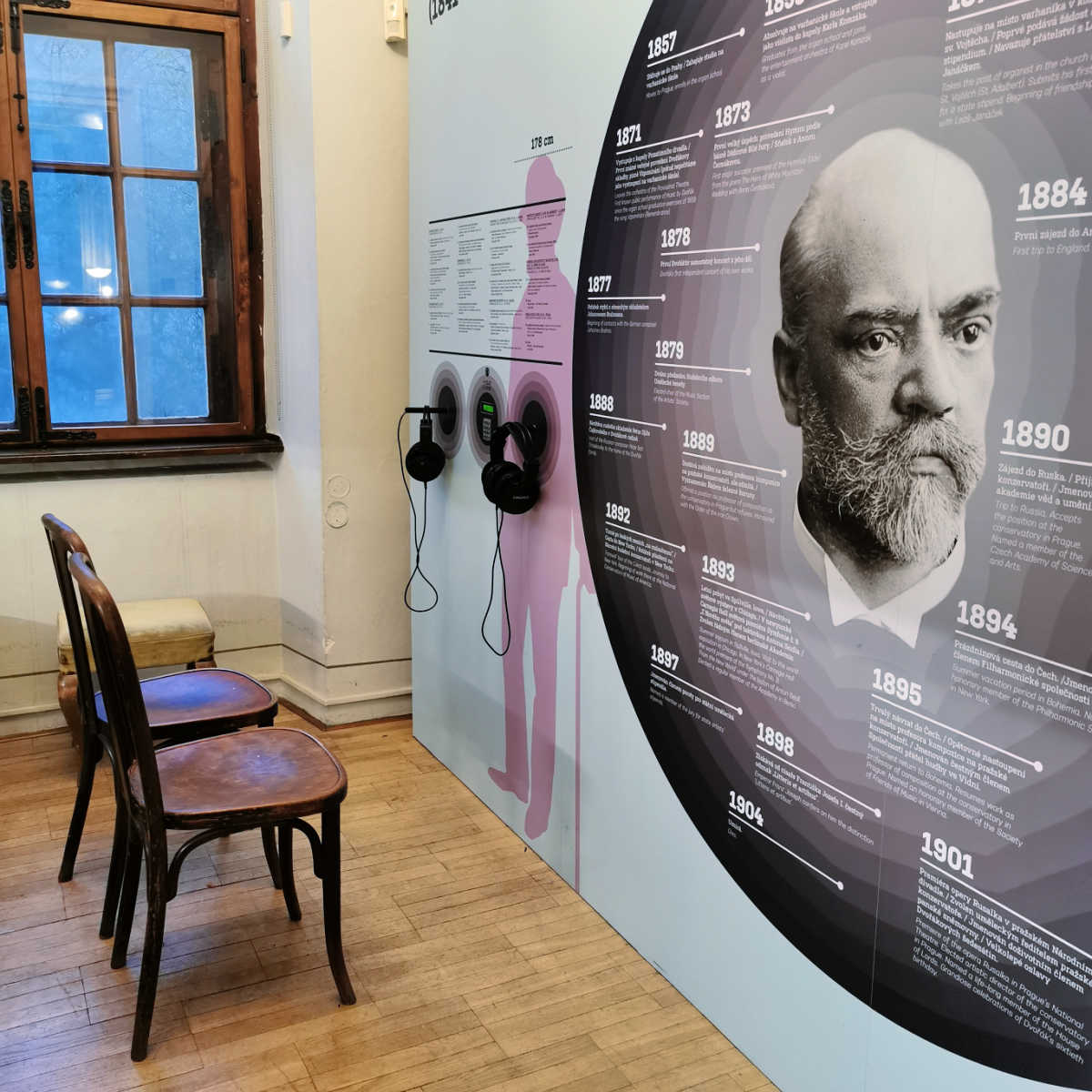
The exhibition documents the composer’s life journey and focuses on the travels he undertook. Dvořák was, in his time, one of the greatest Czech globetrotters. You can follow his journey from his birthplace in Nelahozeves to Prague, across Europe, and to America, before returning back to Bohemia.
All of this is presented through modern graphics and, above all, authentic personal items — including Dvořák’s glasses, viola, piano, furniture from his study, his Cambridge graduation gown, commemorative wreaths, and other trophies.
You can also listen to many of Dvořák’s compositions in both well-known and lesser-known arrangements and since there is usually not that many people there, it’s a nice to stay for a while and remember the music.
I think, even if you’ve not heard of Dvorak before, you’d recognise his music, because his music has reached far beyond concert halls and is instantly recognizable. One of the most famous examples is the 1973 Hovis “Boy on the Bike” advertisement, directed by Ridley Scott, which used the Largo from Dvořák’s Symphony No. 9 in E minor (“From the New World”). The nostalgic melody became deeply associated with British culture and is still remembered fondly today.
Dvořák’s New World Symphony has also appeared in several films, including “Alien” (1979), “The Shawshank Redemption” (1994), and even the “The Simpsons”!
His Humoresque No. 7 has been featured in classic Hollywood films such as “Mr. Deeds Goes to Town” (1936) and “Trainspotting” (1996) and the Slavonic Dances have accompanied everything from ballet performances to television series and commercials.
MORE MUSEUMS IN PRAGUE
- The complete guide to National Museum >>
- Postal Museum (in a baroque house with beautiful paintings) >>
The history of the house
The Michna Summer Palace is a Baroque suburban villa or summerhouse built between 1717 and 1720, by Count Jan Václav Michna of Vacínov, based on a design by Kilian Ignaz Dientzenhofer.
To built his house, Jan Václav first bought a piece of land from Josef Línek, a burgher of Prague’s New Town in 1715. The land also included an extensive garden and vineyard.
He clearly had a taste (and considerable amount of money), because he asked the famous baroque architect Kilian Ignaz Dientzenhofer to design and build his house. Dientzenhofer was known for designing beautiful churches, but this was his first house project, which was inspired by designs from France.
This was Dientzenhofer’s first building in Prague after his return from Vienna, where he had studied contemporary European architecture. The design clearly shows the influence of architect Lukas von Hildebrandt. The structure, with its strongly articulated palace composition and delicately executed decoration reflecting the French taste of the time, embodies these stylistic inspirations.
Its “small scale, elegance, and intimate character” already introduced into the Czech lands the ideas that would later develop into the Rococo style. The villa became the first building in Prague constructed in the French banded style, which had been introduced in Vienna by Dientzenhofer’s teacher, Lukas von Hildebrandt.
But, only nine years after the competition, in 1729, Bohuchval Michna sold the villa, along with its garden, to Karel Josef Desfours. In the following years, it changed owners several more times. After 1793, the garden was transformed into an English-style park based on a design by the imperial gardener Franz Weppel.
After 1826, the house was used as a garden restaurant called Amerika, frequented mainly by German guests. The name is said to have originated from the volunteers who accompanied Austrian Archduke Maximilian on his expedition to Mexico and used to gather there. Another version of the story suggests that the name refers to refugees who secretly left the Austro-Hungarian Empire for the United States in search of better work and wages — and, not least, to escape the politics of the absolutist minister Bach.
In 1843, the house was bought by the City of Prague, and for a the next 90 years it has served various purposes, including being used as a poorhouse, garden used for grazing cattle and a Museum of School Supplies! I would have loved to seen that, but sadly such museum doesn’t exist anymore.
In the school year 1897/1898, the Minerva Girls’ Grammar School built temporary pavilions in the spacious garden, with three classrooms and a headmaster’s office and run the school from there.
It wasn’t until after 1932, when the house was offered to the Antonín Dvořák Society, which established the Antonín Dvořák Museum there.
And just in case you are wondering, Antonín Dvořák never lived in this house, but in 1877, he moved to a house fairly close in 14 Žitná Street, where he lived until his death.
The courtyard and garden of the summer palace are decorated with sculptures from the workshop of the famous Baroque sculptor Matyáš Bernard Braun, dating from around the year 1730.
MORE MUSEUMS IN PRAGUE
Memories of living at the house
As a child during the end of 19th century, the actress Růžena Nasková lived with her family in a small garden house next to the main house (you can see there are two small garden houses as you come in from the main road).
From their courtyard, she could see into the yard of the neighboring pathological institute, where human skeletons were laid out on the low roof to dry in the summer sun. Little Růženka was never afraid of them. “They would stand or sit there as if having a chat, and I was never frightened,” she later recalled. “Even though I believed in ghosts and was afraid of the dark, these skeletons were too real. I had known them since my earliest childhood — they watched my games with their empty eyes, and it seemed to me that they were happy, even smiling at me.”
Far more unsettling to her were the living people across the way, in the asylum for the mentally ill. From the windows of the Kateřinky hospital, the wild eyes of patients often stared down into the garden of the summer palace. Among them was a beautiful young woman with long black hair, who would tie her hair to the window bars and sing arias from operas. The locals called her Viktorka.
I dare you to walk around the garden and sit there for a while. On one side you can still see the long low roof of the doctor’s university and the private psychology hospital is still there too (although not used for that exact purpose any more).
MORE MUSEUMS IN PRAGUE
Practical information for visiting the museum
Location: Ke Karlovu 20, Prague 2 – Vinohrady
Nearest metro/tram stop: I. P. Pavlova (Line C, trams 4, 6, 10, 16, 22) or Stepanska Tram Stop
Opening Times: Tuesday – Sunday 10 am – 5 pm (closed on Monday’s)
Facilities: No tearoom, small souvenir shop as part of the ticket office, toilets
Ticket Prices: 70 CZK Adults, concessions available for children, students and seniors
You can access the garden around the house for free and walk around to see the statues.
MORE MUSEUMS IN PRAGUE
How to get to the museum from the centre of Prague
By underground
Getting to the Antonín Dvořák Museum from Old Town Square by underground is quick and straightforward. From the square, walk for about five minutes to the Můstek metro station, located at the bottom of Wenceslas Square. Take the green line (Line A) in the direction of Depo Hostivař and travel two stops to Muzeum station. There, change to the red line (Line C) heading toward Háje and go one stop to I. P. Pavlova. When you exit the station, walk north along Sokolská Street, then turn left onto Na Bojišti Street, which leads you directly to Ke Karlovu Street.
The entire journey takes around 15–20 minutes and requires a 30 CZK ticket, valid for 30 minutes on all public transport.
By tram
If you’d rather enjoy a more scenic route through the city, you can take the tram from Staroměstská to reach the Antonín Dvořák Museum. From the Staroměstská tram stop, take tram number 17 in the direction of Sídliště Modřany. Ride for four stops and get off at Výtoň. At Výtoň, transfer to tram number 6 or 10 heading toward Kubánské náměstí or Sídliště Ďáblice. Travel for two stops and get off at I. P. Pavlova.
From I. P. Pavlova, the museum is just a 5-minute walk away. Exit the tram stop and walk north along Sokolská Street, then turn left onto Na Bojišti Street. Continue straight and you’ll soon reach Ke Karlovu Street.
If you are on the Lesser Town side, you can also take the 22 tram which will take you all the way to I.P Pavlova (or you can also get off a stop before at Stepanska and walk from there – the Ke Karlovu street pretty much start there).
The tram journey takes about 20–25 minutes in total, and you’ll need a 30 CZK ticket (valid for 30 minutes).
MORE MUSEUMS IN PRAGUE

What to see nearby
The area around the Antonín Dvořák Museum on Ke Karlovu Street is full of interesting places to explore. This is one of my favourite walks, so I thought I’d share it here with you, if you fancy stretching your legs a bit and continue to explore Prague outside the centre.
At the beginning of your walk from I.P Pavlova, you’ll first walk close to the Legionaries Museum (Muzeum československých legií), which has fascinating exhibition about the Czechoslovak Legions and their role in the country’s modern history and the museum is free to enter.
Right in front of the museum across the street is St. Catherine’s Garden (Kateřinská zahrada), a peaceful green oasis that surrounds the beautiful Church of St. Catherine of Alexandria, a striking Gothic church dating back to the 14th century.
If you’d like to take a break, stop by Café of Dreams (Kavarna Snu) on Ke Karlovu — a cozy spot with great coffee and homemade desserts (try their poppy seeds cake with lemon icing and plum filling, it’s amazing!)
As you carry on walking on the Ke Karlovu street, you can also admire the distinctive red-brick façade of the Apolinář Maternity Hospital (Porodnice U Apolináře), an architectural gem designed by Josef Hlávka in the Neo-Gothic style — well worth a look from the outside – it’s like a little bit of London in Prague!
At the end of Ke Karlovu street you can find the Police Museum of the Czech Republic (Muzeum Policie ČR), located in a former Augustinian monastery, where you can learn about the history of Czech law enforcement and see intriguing displays on crime investigation and forensics.
If you fancy a longer walk, you can continue to walk towards the New Town’s fortifications and visit the Bastion XXXI and also the Lost Garden (Zahrada Ztracenka).
This blog post was originally written on 16 October 2025 and last updated on 16 October 2025


