
Prague’s Jewish Quarter (Ghetto): Cemetery, Museum & Synagogues
The Josefov district is the smallest official district area in Prague and until 1850 it was called the Jewish Quarter. The original Jewish Ghetto was condemned to “sanitation” as a poor district at the end of the 19th century.
I love walking through the Jewish Quarter in Prague, especially early in the morning as it has such a different atmosphere than the rest of the Old Town.
Unfortunately, only a few buildings remain from the ghetto, including the Jewish Town Hall, the Old Jewish Cemetery, and six synagogues: Klaus, Maisel, Pinkas, Staronova (Old-New), Spanish, and High Synagogue.
The Old-New Synagogue is closely linked to the famous story about Golem, who’s creator is buried at the Old Jewish Cemetery.
Since 1992, the Jewish quarter is listed as one of the Czech UNESCO World Heritage sites and if you are visiting Prague, you should definitely see it. Not only as a reminder of a tragic part of the world’s history but also for its undeniable beauty and charm.
How to visit the Jewish Quarter in Prague
You have a couple of options here, well three really…
If you want to have a look inside the synagogues, museum and the old cemetery, you can buy one ticket combining all the attractions, which costs around 550 CZK. In my experience, the visits can take easily 2-3 hrs or more as there is so much to see.
If you have less time and you just want to see one synagogue, the only one you can buy a separate ticket for is the Old Synagogue. Since it’s the oldest synagogue the decor is very plain and the space is quite small.
The second option is to walk around the Jewish Quarter, to see all the synagogues from the outside, look through the gates to the old Jewish Cemetery and read a guidebook (or my blog!) to learn more about the Jewish community in Prague.
On top of that (as a third option), I’d recommend visiting the Jerusalem Synagogue (Jindriska Street), which is the only one, appart from the Old Synagogue where you can buy individual ticket for. The Jerusalem Synagogue is also beautifully decorated and definitely a great one to visit. Spanish Synagogue is also very colourful inside, but you can only visit it as part of the main ticket.
There are other historic Jewish cemeteries in Prague, that you can visit and the entrance is completely free. These are outside the centre of Prague, but within easy reach of public transport. The older cemetery is right next to the Zizkov Tower and the other one is at Olsany (Zelivskeho Underground Station, Prague 10). I’ve added few extra tips on where to find out more Jewish historic sites in Prague and beyond at the end of this blog post.

Practical information for visiting the Jewish Quarter in Prague
Location
The Jewish Quarter (“Josefov”) is located close to the Vltava River (“Dvořákovo nábřeží) and the Old Town Square. The nearest station is Staromestska (underground or trams number 1, 18, 17, 2, 25)
All the sites are within this area and within comfortable walking distance of each other. The only synagogue that’s a bit further away is the Jerusalem Synagogue (Jerusalemska Ulice, close to Wenceslas Square).

Ticket Prices
Before you buy your ticket, decide what you’d like to see and how much time you have for your visit.
If you are short of time, you can visit the Old-New Synagogue, which is the only one where you can buy an individual ticket for. All the other synagogues are included in the main ticket (but the Old-New Synagogue is excluded). The Jerusalem Synagogue tickets are also sold separately.
- Combined Ticket for the Jewish Museum & Synagogues – Self-Guided Tour (Maisel Synagogue, Pinkas Synagogue, Old Jewish Cemetery, Klausen Synagogue, Ceremonial Hall, Spanish Synagogue and Robert Guttmann Gallery)
- Adults: CZK 550
- Children aged 6-15: CZK 370
- Students (under 26): CZK 300
- Prague Jewish Quarter Guided Tour: (includes all sites, including the Old-New Synagogue, but not the Jerusalem Synagogue)
- Adults: CZK 1450
- Students: CZK 1300
- Old-New Synagogue:
- Adults: CZK 200
- Children: CZK 140

Opening Times
- Summer Time (April to October): 9 a.m. – 6 p.m.
- Winter Time (November to March): 9 a.m. – 4:30 p.m.
The museum & synagogues are closed on Saturdays and other Jewish holidays, but you can still walk around the area any time of the day. I think it’s also good to know that the sites are open on Mondays (which is normally a closing day for most state owned museums and attractions).
Before you visit
Whilst there is no specified dress code, I would suggest that you wear more modest clothing. As a man, you might be asked to cover your head in some synagogues and cemeteries (a hat or cap is fine and kippah is provided or you can purchase one).

History of the Jewish Quarter
The original Jewish Ghetto was labelled as a poor district by the city planners and at the end of the 1880s completely flattened and all the houses demolished. Only a few buildings survived from the original ghetto, including the Jewish Town Hall, the Old Jewish Cemetery, and six synagogues: Klaus, Maisel, Pinkas, Old-New, Spanish, and High Synagogue. The Old-New Synagogue is closely linked to the famous story about Golem, who’s creator is buried at the Old Jewish Cemetery.
During World War II, Jews were deported to concentration camps. The abandoned Josefov became a warehouse for confiscated property. After the war, much of the legacy remained in the hands of the Jewish Museum because its original owners didn’t come back from the concentration camps. Because of that the Jewish Museum became the second-largest Jewish museum in the world.
Although only a few of the most important monuments and buildings from the centuries-long history of Prague’s Jews have been preserved, they form the most preserved complex of Jewish monuments in Europe.

Jewish Museum
The Jewish Museum in Prague was founded in 1906 by historian Dr. Hugo Lieben and Dr. Augustin Stein, because they wanted to preserve valuable artefacts from Prague’s synagogues and other Jewish sites within Bohemia.
During the Nazi occupation in 1939, the museum’s collection was expanded as Jewish properties were confiscated, and it ironically became a storage for items the Nazis wanted to later display in a “Museum of an Extinct Race.”
After World War II, the museum reopened and continued to grow, eventually becoming one of the most significant collections of Judaica in the world. In 1994, the museum’s administration was transferred from state control to the Jewish Community of Prague, which carries on running the museum to this date.
History
The Prague Jewish Quarter is named after the Holy Roman Emperor and Bohemian King Joseph II (“Josef ” in Czech language), who finally made the Jewish population equal to other citizens within the Bohemian Kingdom. Before that, the quarter had been called simply a “Jewish ghetto”.
The first Jewish settlement around that area was officially mentioned in 1096. It was founded after other Jewish settlements were destroyed and Jews moved into the area.
The Jewish settlement became a ghetto when in 1215 the Roman Pope and the Fourth Council of the Lateran ordered segregation of the Jews from the Christian population.
As if segregating the community wasn’t enough, in the 14th, 15th and 16th centuries various kings ordered Jews to leave the town and country and many were also killed.
During World War II, all Jews were deported first to the Jewish Ghetto in Terezin and then to the concentration camps. Tragically, most Jews never returned back home.
The Golem of Prague Legend
During the reign of Rudolf II, Rabbi Judah Loew, also known as Maharal, created the Golem to protect the Jewish people of Prague.
According to Jewish Cabalistic tradition, a person who is knowledgeable and faithful enough to know the exact sequence of God’s 27 letters can create a human-like being and bring it to life by placing a parchment (or a shem) with the letters sequence inside its head.
Rabbi Loew created Golem to protect the Jewish community from pogroms and assist with difficult physical work around the synagogue and the Jewish quarter. Each week, on the eve of the Jewish day of rest – Friday, the Rabbi would remove the parchment from the Golem’s head and Golem would ‘go to sleep’.
However, one day, the Rabbi forgot to remove the parchment, and since Golem had no instructions on what to do, he started to destroy the Jewish ghetto and caused havoc in the city.
The Rabbi realized his mistake and ran after the Golem and eventually managed to remove the parchment. Afterwards, Rabbi realised that it would be irresponsible to leave the Golem alive and it appeared he couldn’t be trusted and was way too strong to let him continue to be around the Jewish quarter. Instead, the Rabbi chose not to revive the Golem and he hid the Golem in the attic of the Old New Synagogue.
Which famous rabbi is buried in Prague?
The most important person buried in the Old Jewish Cemetery is the great religious scholar and teacher Rabbi Judah Loew ben Bezalel, known as Rabbi Löw (d. 1609), who, according to a legend, created a Golem – a person from clay to help him to carry out manual tasks around the house.

The Spanish Synagogue
The Spanish Synagogue was completed in 1868 and stands on the site of the city’s oldest Jewish house of prayer, the Old Shul or Altschul. It was designed by architects Vojtěch Ignác Ullmann and Josef Niklas and is decorated in a beautiful Moorish Revival style inspired by the Alhambra in Spain.
It was initially built for the Reform Jewish community and the synagogue aimed to modernize Jewish worship. During World War II, the Nazis used it as a warehouse for confiscated property. After significant restoration in the 1990s, it became part of the Jewish Museum in Prague. You can find exhibitions on Jewish history in the Czech Republic here. The synagogue is also often used as a classical music concert venue.
Old-New Synagogue
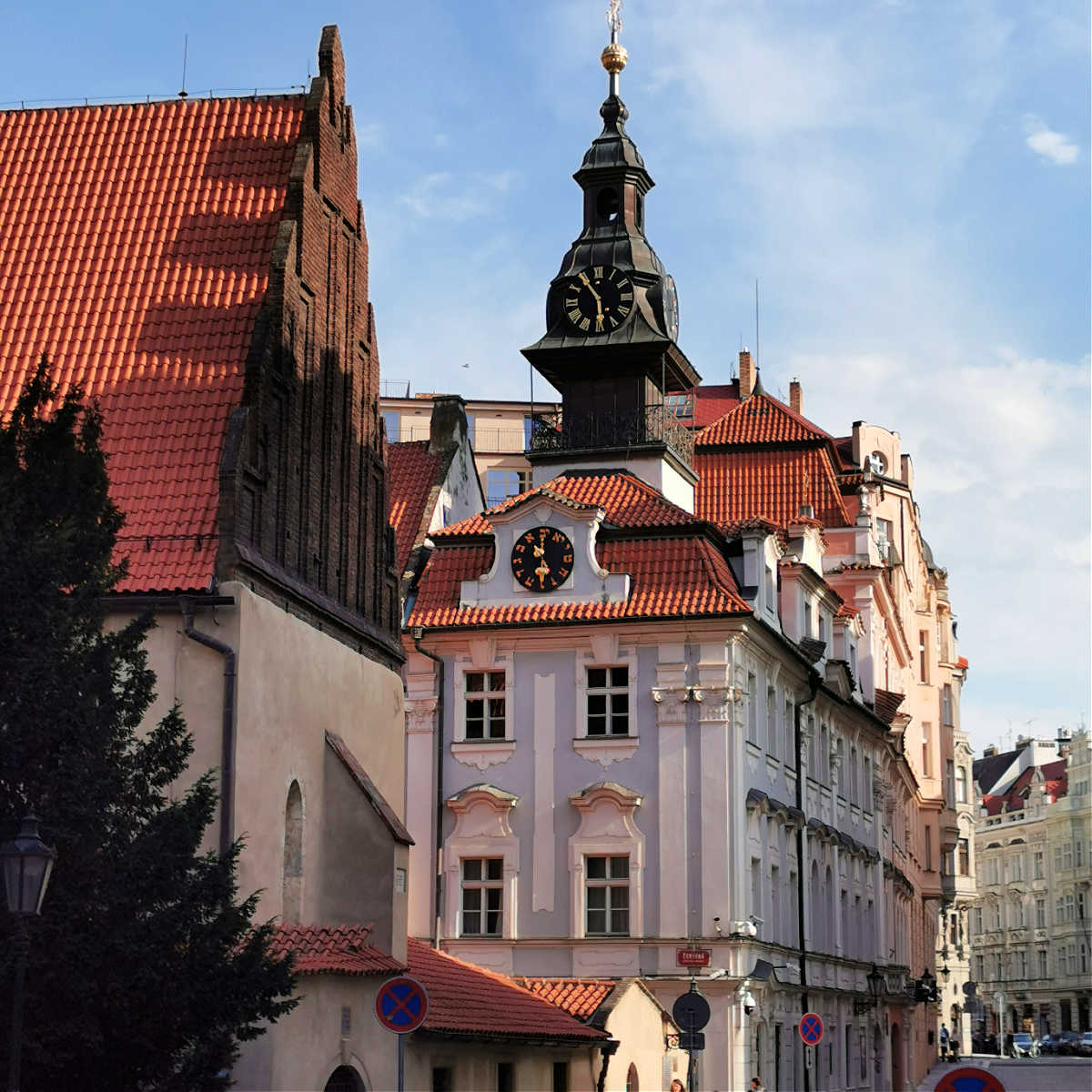
The Old-New Synagogue was completed in 1270 and is one of the oldest surviving synagogues in Europe and the oldest active synagogue in the world.
The synagogue’s name, “Old-New,” originates from its status as a “new” synagogue when it was built, compared to an older synagogue that no longer exists.
The synagogue was built in the Gothic Cistercian style with double-nave structure with vaulted ceilings, but has very minimal decor inside.
I like the local legend, which suggests that the synagogue’s foundations are made from stones brought by angels from the destroyed Temple of Jerusalem.
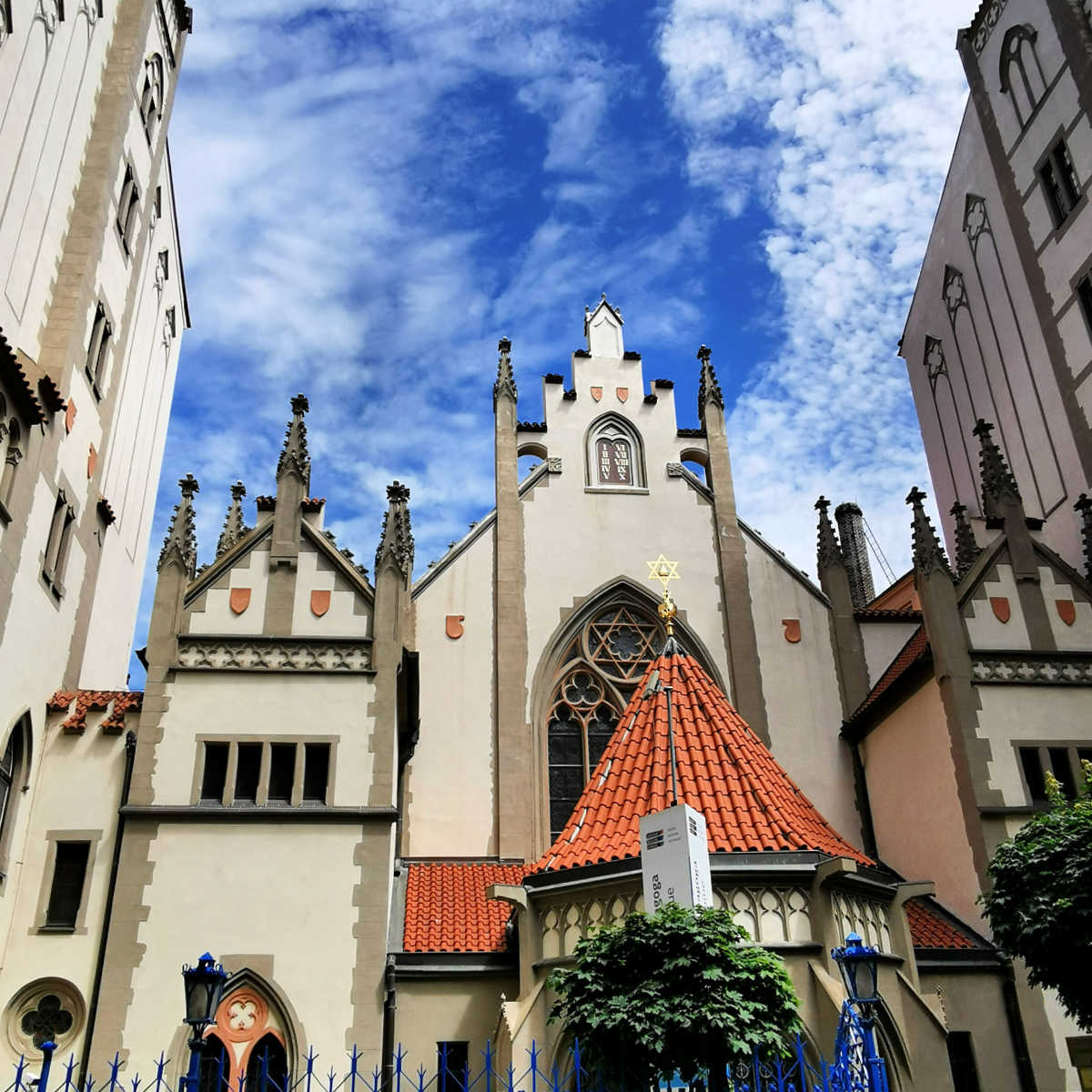
Maisel Synagogue
The Maisel Synagogue was built between 1590 and 1592 and was originally founded by Mordecai Maisel. He was the Mayor of the Prague Jewish Town, who had to first seek permission from Emperor Rudolf II. to have the synagogue built.
The synagogue was originally built in the Renaissance style with Gothic elements by architects Judah Tzoref de Herz and Josef Wahl, it was one of the largest and most impressive synagogues of its time.
The synagogue was renovated many times, especially after a devastating fire in 1689 and also in late 19th century , when it the building was re-built in neo-Gothic style.
The synagogue is no longer used for services, but it’s used as part of the Jewish Museum in Prague and you can find exhibitions there that detail the history of Jews in Bohemia and Moravia.

Pinkas Synagogue
The Pinkas Synagogue completed in 1535, was founded by Aaron Meshulam Horowitz and is the second oldest preserved synagogue in the city.
It was built in the late Gothic style and it was originally built as a private place of worship for the Horowitz family.
On the side of the building, you can also see the entrance to the only ‘mikvah’ still being used in Prague. Mikvah (or mikveh) is a specially constructed room with a small deep pool of freshly flowing natural water, which is being used for bathing in order to achieve ritual purity.
After World War II, the synagogue was transformed into a memorial to the victims of the Holocaust, with the interior walls inscribed with the names of 77,297 Czech Jews who perished.
The synagogue is now part of the Jewish Museum in Prague and has a detailed exhibition about the Jewish community’s history and what happened during the Holocaust.

Klausen Synagogue
The Klausen Synagogue was completed in 1694 a few years after the Great Fire of 1689 that sadly devastated the Jewish ghetto.
It was built in the early Baroque style and is was the largest synagogue in the original Prague Jewish ghetto at the time. It was named after the three smaller synagogues or “klausen” (from the German “Klausen,” meaning small buildings or chapels) that originally occupied the site, and it was used as the main place of worship for Prague’s Jewish community.
This synagogue is right next to the old Jewish Cemetary and you can find exhibitions about Jewish traditions and customs here.
The Old Jewish Cemetery
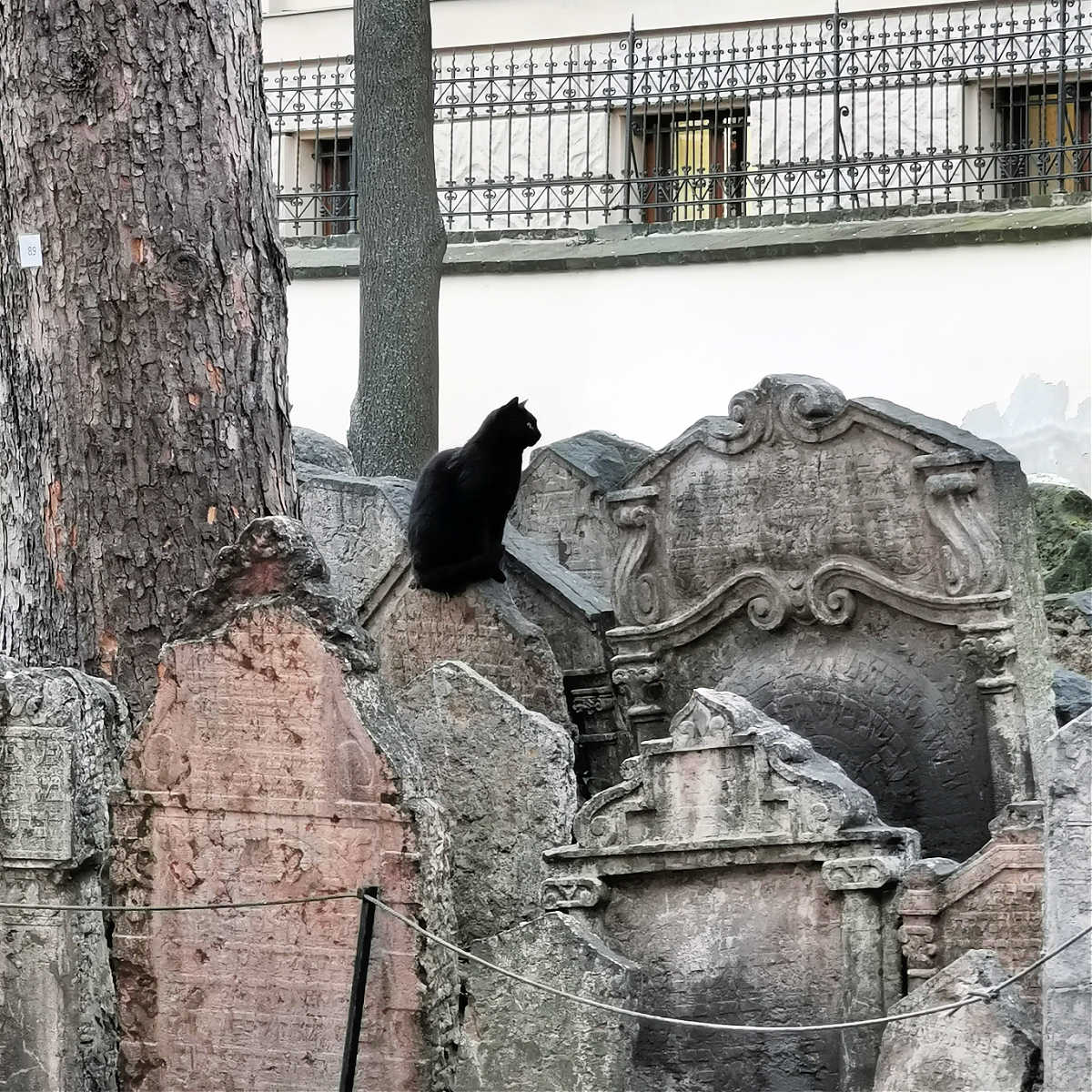
The Old Jewish Cemetery covers an area of approximately 11,000 m2 and people were still buried here until 1787. There are about 12,000 tombstones and it’s estimated that around 40,000 were buried here.
The oldest tombstone was engraved in 1439 and belongs to scholar and poet Avigdor Karo. The cemetery has been expanded several times in the past, but at some point, it couldn’t be expanded further, so the space problem was solved by adding layers of soil on top of existing graves.
It’s estimated that there could be up to 12 burial layers on top of each other in the cemetery. Picturesque clusters of tombstones from different periods were created by raising older tombstones to the upper layers.
The most significant person buried in the Old Jewish Cemetery is undoubtedly the great religious scholar and pedagogue Rabbi Jehuda Liwa ben Becalel, known as Rabbi Löew (died in 1609), whose figure is also associated with the legend of creating an artificial being – the golem.
However, there are also many other well-known Jewish personalities buried here, such as the primate of the Jewish city Mordechai Maisel (died in 1601), Renaissance scholar, historian, mathematician, and astronomer David Gans (died in 1613), scientist and polymath Josef Šalom Delmedig (died in 1655), and Rabbi and collector of Hebrew manuscripts and prints David Oppenheim (died in 1736).
Location: U Starého Hřbitova 243/3A, 110 00 , Prague 1, Josefov
How to get there: 5 minutes walk from the Old Town Square, nearest underground is Staromestska and trams number 1, 18, 17, 2, 25
Franz Kafka Monument
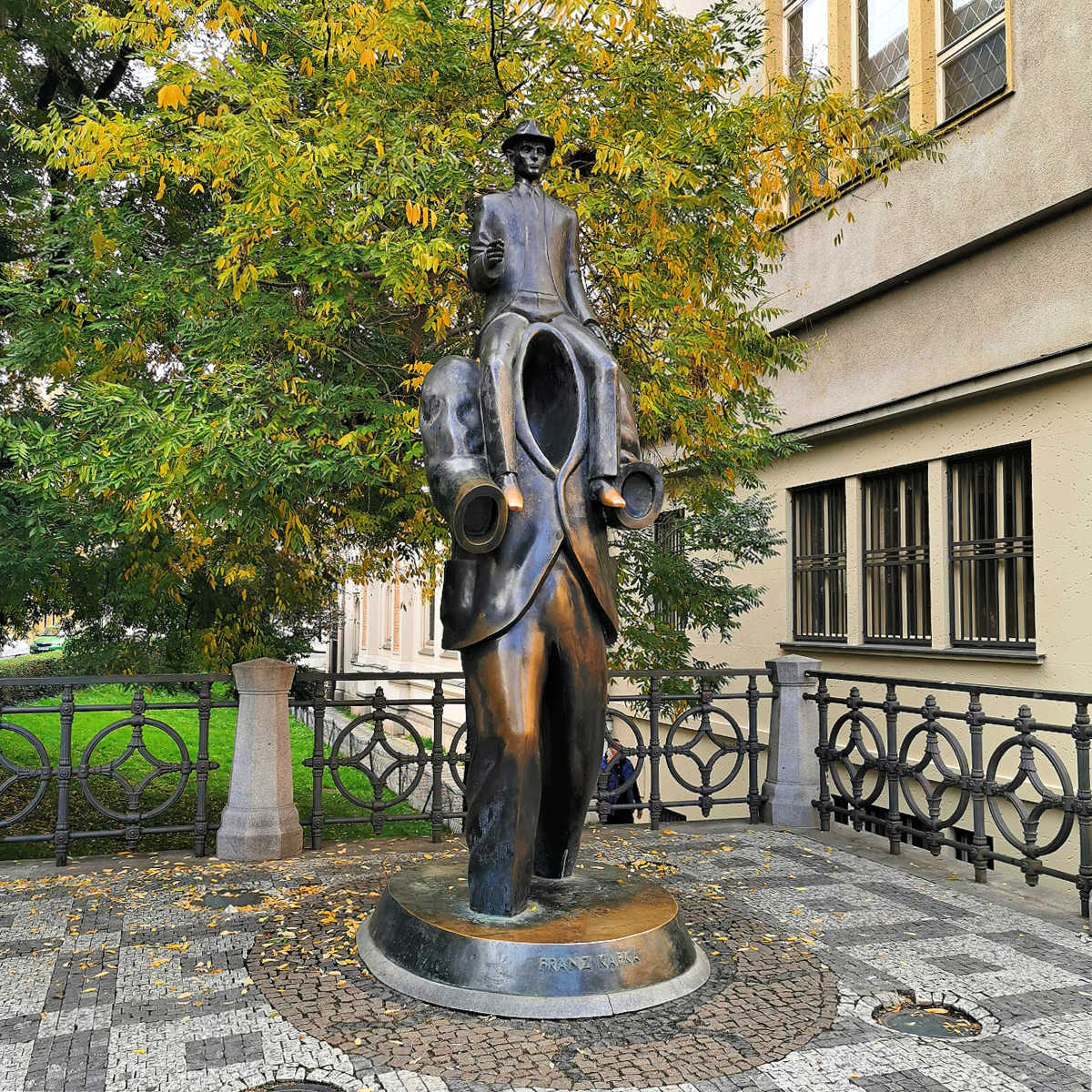
This statue is a tribute to the famous writer Franz Kafka, who was born into a German-speaking Jewish family in Prague, and you can find it right next to the Spanish Synagogue.
The statue was created in 2003 and it was inspired by one of Kafka’s short stories called the Description of a Match. The sculptor Jaroslav Róna created the statue out of bronze and it is about 375 centimetres tall and weighs more than 800 kilograms.
Learn more about the Jewish history beyond Jewish Quarter in Prague
The history of Jewish community in Prague goes further than the centre. There was a large Jewish community in the Zizkov district and you can still visit the Old Jewish Cemetery, right next to the Zizkov Television Tower.
There are all together 9 Jewish cemeteries in Prague, that you can visit and apart from the one in the Jewish Quarter, they are all free to enter. The oldest one – the Jewish Garden – is right opposite the Kafka Rotating Head installation at Narodni Trida.
There are also a few remaining synagogues, that you can see in Prague, such as the Jerusalem Synagogue (fully open – see below), the Smichov Synagogue at Andel Underground Station (now archive and minerals & stones shop) or Liben Synagogue (open for concerts and art events). You can still easily spot the Uhrineves Synagogue on the highstreet, although over the years it’s been converted into different shops and even a laundry!

Jerusalem Synagogue
If you are short of time and you want to see just one synagogue in Prague to learn more about the Jewish community, I would definitely recommend that you visit the Jerusalem synagogue. Unlike the cluster of synagogues close to the Old Town Square, you can buy separate ticket to this synagogue alone and you don’t need to rush your visit. If you wish you can easily spend a 60 – 90 minutes there, so it’s not like a whole day visit which the other synagogues tend to be (if you want to see everything and take your time).
The Jubilee (Jerusalem) Synagogue was built as a replacement for the demolished synagogues following the redevelopment of the Prague Jewish ghetto. It is the youngest and also the largest synagogue of the Prague Jewish community.
It’s also one of the most colourful buildings in Prague, built in an interesting mix of Art Nouveau and Moorish style. I always make a point of looking up the beautiful facade, when I’m walking up to get a train from the Main Train Station. This year, I finally made the time to visit inside the synagogue and I was so glad I did!
The Jerusalem synagogue is also beautiful to look at and walk around. A lot of people seems to be slightly disappointed with the Old Synagogues because there is ‘nothing’ to look at inside (yes, there are much, much older, so the decor is very minimalistic).
- Location: Jeruzalémská 7, Prague 110 00
- Opening Times: Sunday to Friday from 10:00 AM to 5:00 PM – closed on Saturdays
- Ticket prices: Adults: 150 CZK (135 CZK if purchased online), Children under 15 and students: 100 CZK (90 CZK if purchased online), Children under 6: Free
This blog post was originally written on 14 September 2024 and last updated on 14 September 2024
PIN TO KEEP FOR LATER


