
Guide to my favourite 8 theatres in Prague that are English- friendly
A local’s guide to my favourite 8 theatres in Prague, that are perfect for English-speaking visitors, including how to get tickets, dress code and insider’s tips.
If you’re planning a trip to Prague and enjoy live theatre performances, you’re in for a treat! Prague has many incredible theatres that are perfect for English-speaking visitors. Whether you prefer classic plays, musicals, ballet or operas, there is plenty to choose from.
I’ve always loved theatre having visited the National Theatre when I was about 10 years old and then spending my student’s money on standing tickets to see as many shows as I could.
I think it’s really great to see that there are more and more theatre performances, that are shown with English subtitles. These are mainly in the theatres run by the National Theatre, Opera or Estate Theatre, but I also regularly go to Svandovo Divadlo in Smichov and they have subtitles for some of their plays too.
PIN TO KEEP FOR LATER

What kind of shows can you see in Prague’s theatres?
The theatres in Prague run in a completely different way than for example in London. Each theatre has several plays, operas or ballets that they they keep playing for several years at a time. But each day is completely different play, so if you are in Prague for a few days, you can go to the same theatre and see a different show every night.
There are lots of traditional Czech plays, but also Sheakespeare, Moliere and operas by Smetana, Janacek and also Mozart, Verdi and Puccini.

Are Prague theatres English-friendly?
Whilst most of the performances are in Czech (or original language – such as Italian or German for some operas) quite a few performances have subtitles in English. The performances with English subtitles are clearly marked on the programme, but you can always ask at the ticket office, just to make sure.
The subtitles are usually above the stage, so it’s worth getting tickets on the first balcony or little bit higher up, so that you don’t need to keep looking up to read the text and then down again to see what’s happening. Some operas have also Czech subtitles (as well as English) and I have to say, I’m always super grateful for those!
The National Opera has additional little screens in front of every seat (apart from back seats in boxes and standing tickets) where you can also read the subtitles and find out more about the opera performance.

Buying theatre tickets
Buying theatre tickets is easy. I usually buy my ticket online through the theatre website and print the ticket, so that it can be scanned at the door.
Confirmation e-mail (with the relevant bar code) should be fine too, but do make sure you can access your e-mails through your mobile data provider, take a screenshot on your phone or download the ticket to your phone (wifi might not always be available).
You can also buy your tickets directly at the theatre before the show (usually about 60 minutes before the show) and pay with a card or cash.
The National Theatre ticket office (which sells tickets for the National Theatre, National Opera, New Scene and the Estate’s Theatre) is based at the New Scene next to the National Theatre and it’s open during normal working hours.
I should also mention, that you should only buy tickets from the official theatre websites, whether it’s the National Theatre or one of the smaller theatres. There are no official (or un-official) re-sale websites, so please don’t buy your tickets from anywhere else. It’s also not common to re-sell the tickets in front of the theatre just before the performance starts – if you see someone doing that, they are no official.
If people can’t make it the performance, they usually return the tickets back to the ticket office, so that should be the only place to buy your ticket even just before the performance starts.

My extra tip for buying the best seats
When it comes to visiting the theatre I’m all about the quantity! What I mean is that I tend to go to the theatre often, but I don’t have a huge budget, so I have to choose my tickets carefully.
Of course, if you want the best view in the theatre you buy a seat in one of the front rows, first balcony or private box, but these are usually the most expensive (easily around 800 – 1500 CZK or more). I’d rather see three shows for that!
I used to get the cheapest tickets at the back, but realised that these are often bought by organised school trips or by people who somehow don’t appear to want to be in the theatre and it can be a bit distracting to concentrate on the play in front of you.
So, recently I’ve tried a different tactic after scooping a back seat ticket in a box for an opening performance of a ‘Tajemstvi’- ‘Secret’ opera by Bedrich Smetana, where all the tickets cost 250 CZK and that ticket was all there was left. This was in the National Theatre and you get a comfy bar-style stool placed on a high platform so that you can see and hear everything perfectly. There are usually only other 3 people in the box with you.
I bought a similar seat in the National Opera for Ottello and sat in a box with other 4 people. This time, the stool was more like a bar stool, but it had a nice back and was really comfy. The best bit was that I paid 590 CZK (only 200 CZK more than the cheapest ticket), but sat with people who actually wanted to listen and watch the opera without talking! The front row in the box is usually around 1500 CZK, so you only get true aficionados who appreciate the theatre!
The next type of ticket I sometimes get is the standing ticket. It’s not only the cheapest ticket in the whole theatre (from 190 CZK – 290 CZK max), but you only have about 10 people in the standing area. In the National Theatre, there are two standing areas on each side of the theatre on the second level and you get to see and hear everything absolutely perfectly. I’ve seen the Nutcracker Ballet there because all the other tickets were already taken.
The standing area in the Estates Theatre is at the back on the second level and again, you can hear and see everything perfectly there. You can move around a bit if you need to as you have the whole back area and there are again only about 10 tickets sold.
I’ve also bought tickets with a ‘restricted view’ – these tickets are super affordable (usually the same price as the standing tickets), but they are cheap because you sit in front of a column. I mean, you don’t have the column right in your face, but you might need to turn your head from site to site to see everything on the stage.
But, when I go, for example to the opera, I can live with not seeing absolutely everything, since it’s more about hearing! And again, these tickets are on the first level (National Theatre, Opera and Estate Theatre), so right next to you there will be seats usually costing double or triple the price (so again somebody is very likely going to apprecitate the theatre).

How much are theatre tickets?
The best thing about theatre in Prague is that it’s a great value! If you are travelling to Prague on a budget you can get standing tickets for 190 – 290 CZK. I sometimes get standing tickets if the theatre is completely sold out because they are usually the last ones being sold.
Tickets to the back rows and 2nd balcony are around 350-450 CZK and the seats in the boxes are 590 CZK – 1500 CZK. Front rows and most of the ground floor are usually around 1500 – 1800 CZK. So, basically, the most expensive ticket is about the same as a regular ticket to a London West End show, which I think is an amazing value!
The smaller and independent theatres usually have ticket prices from 350 – 800 CZK, but it depends on the show.

prague opera & Theatre dress code
Although there is no written dress code (only suggested ‘smart dress’), most Czech people still dress up when they go to the theatre or opera, including black suits, long dresses and high heels, but it’s becoming more common to dress casually.
I like the official recomendation from the National Theatre website, which says something like: ‘Please dress to show appreciation and to honour the special occasion that a visit to the theatre is’
Twenty five years ago you would get stern looks if you arrived at the theatre in jeans, but these days things are more relaxed. Still, I probably would draw a line at hiking boots and outdoor jacket, which is what I saw somebody wearing last time I went to the State Opera (and no, that wasn’t me!)
Anyway, if you have the Prague Opera or the National Theatre on your itinerary, I’d suggest that you might like to think about bringing some smart clothes and shoes with you.
These days, I usually spend more time walking around Prague and the countryside than attending posh events, so I usually bring a pretty top or tunic that I can dress up with nice jewellery, rather than bring a separate dress and shoes just for the theatre.
Pretty earrings, necklaces or bracelets are much easier (and lighter) to pack than a pair of shoes you’ll only wear once on a theatre night. Plus once you are sitting down, nobody will see your shoes!
1. National Theatre
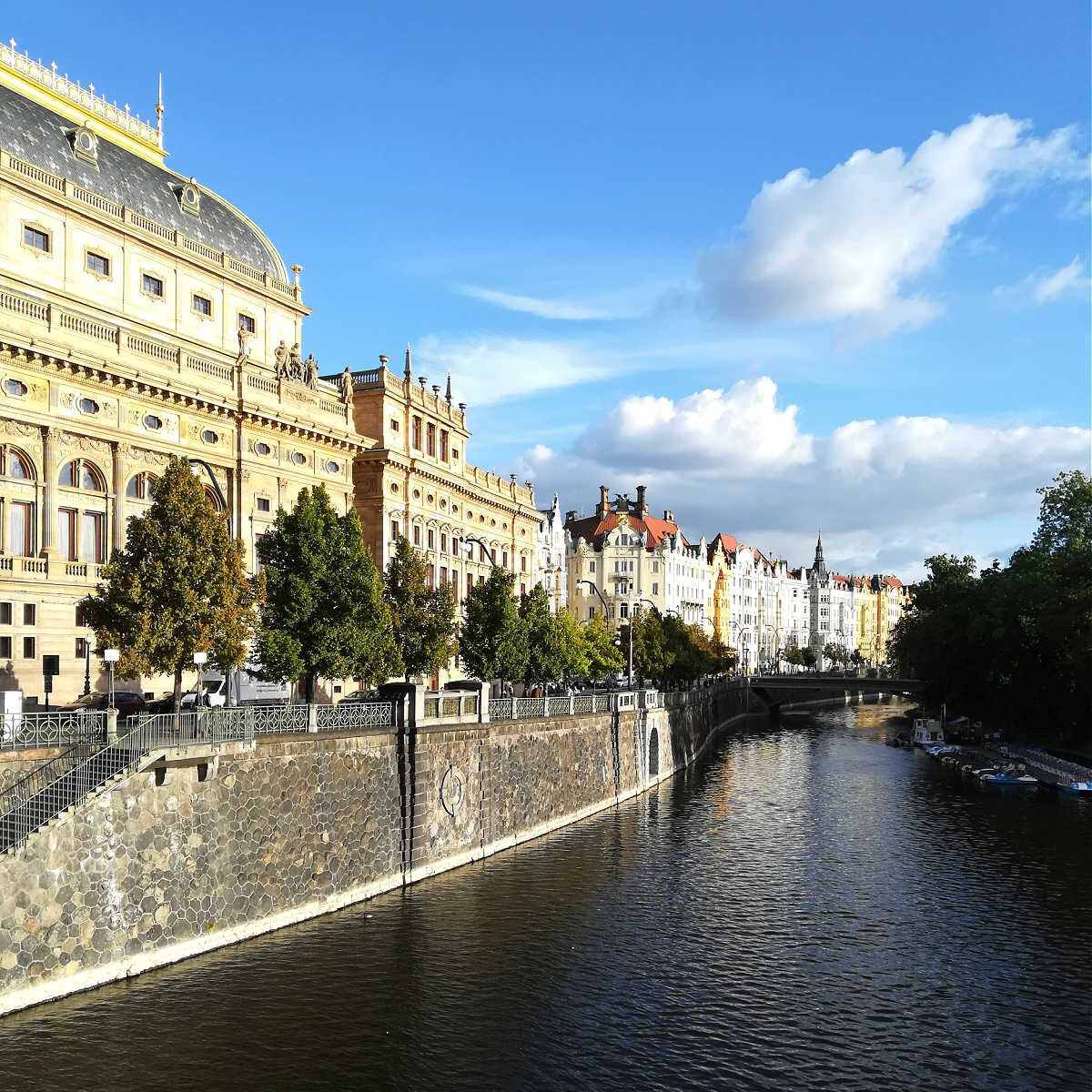
My grandmother always used to say, that every Czech should at least once visit the National Theatre as a mark of respect for what the National Theatre means to people – a first-ever theatre built by regular Czech people for everyone! I was about 10 when I first went to see a theatre performance at the National Theatre and I’ve been going ever since.
The National Theatre has an amazing history. The foundation stone (which you can still see on the lower ground floor) was laid on May 16, 1868, but the theatre wasn’t completed until 1881 when it opened to honour the visit of Crown Prince Rudolf of Austria.
Shortly after that, the theatre burned down, but throughout the whole of Bohemia, people were collecting money to rebuild the theatre. Only two years later, after extensive repairs, the theatre reopened in 1883. It was such a special day, that Bedrich Smetana composed the opera “Libuše,” especially for this occasion.
You can see mainly theatre plays, operas or ballet productions here. The ballet productions are always of the highest quality, and since the main language is in a dance form, you don’t need to worry about feeling out of place. I was really grateful for the subtitles last time I went to see the opera Rusalka, as I can never understand the singing (and that was in Czech!).
My local tip: If you happen to attend a matinee performance, don’t miss the opportunity to go up to the roof terrace. There is an amazing view of nearby streets, the river, Petrin Hill and Prague Castle in the distance.
- Location: Národní 2, 110 00 Praha 1
- How to get there: The nearest underground is ‘Národní třída’ station on the B (yellow) line (5-7 minutes walk) and the Národní Divadlo tram stop with trams 2, 9, 17, 18, 22, and 23 (right in front of the theatre)

2. State Opera
The State Opera was originally opened as the New German Theatre on January 5, 1888, with a performance of Wagner’s “Die Meistersinger von Nürnberg,”. It was renamed the Smetana Theatre in 1949 and changed name again in 1989 to the State Opera. The building was completely renovated in 1973 and in 2020 was upgraded with touch screens for each seat to make the subtitles reading easier.
You can mainly see opera and ballet performances here. I’ve recently seen the new version of Ottello Opera there and it was really well done with more modern stage settings, but the singing was amazing.
My local tip: As you walk from the Museum underground station, you can clearly see how this part of Prague would have looked like before the busy dual carriageway cut through the top part of the Wenceslas Square and the historic Main Train Station was reduced to the underground entrance.
You can still see all the buildings and the park and just have to imagine the tram lines instead of the road. When it was built, the State Opera was in the prime location between the Main Train station and the National Museum, but now it’s sadly squished between two busy roads.
- Location: Wilsonova 4, 110 00 Praha 1
- How to get there: The closest underground stop is Muzeum, which has both the A (green) and C (red) lines. Take the exit marked for Statni Opera (State Opera) and it’s only 3 minutes walk past the main entrance to the National Museum.
3. Estates Theatre
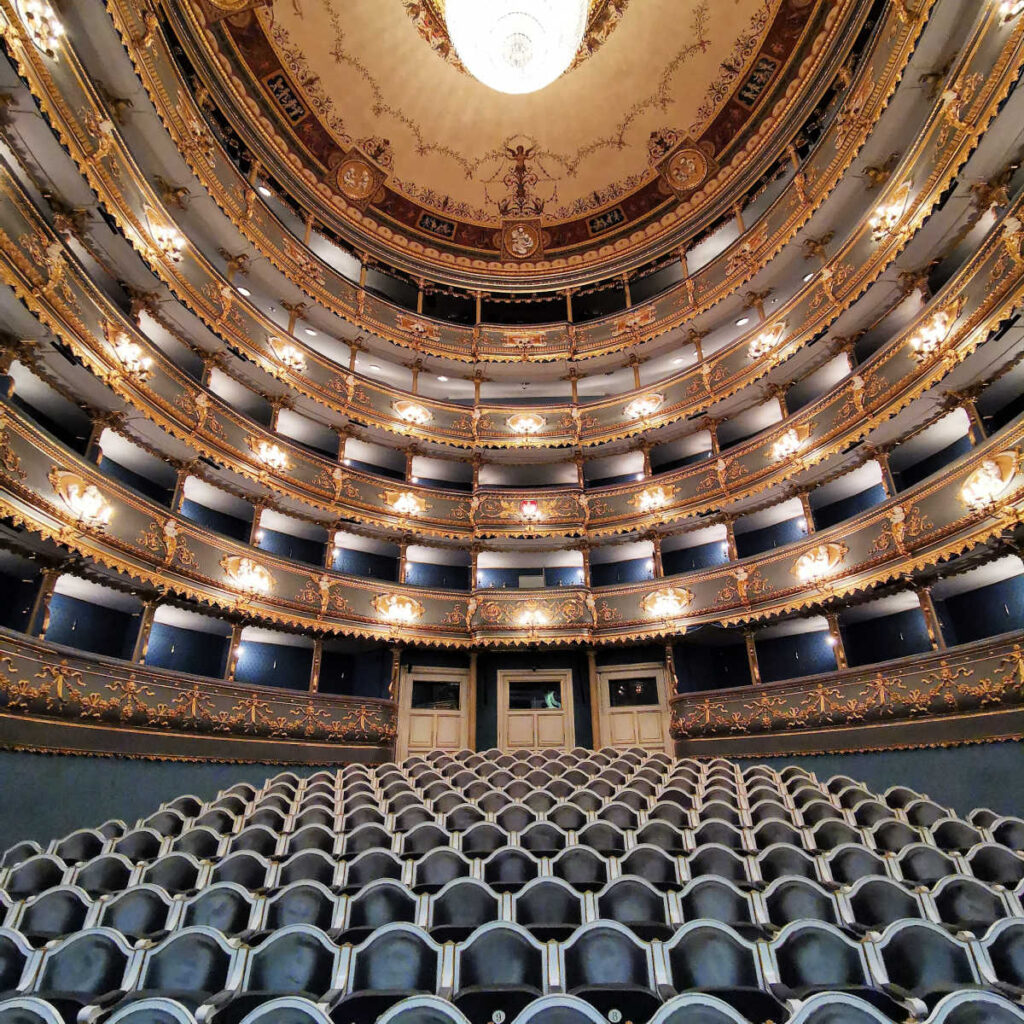
The historic Estates Theatre was opened in 1783 and is one of the oldest theatres in Europe that is still in use.
The theatre is famously associated with Wolfgang Amadeus Mozart, who conducted the premiere of his opera “Don Giovanni” here in 1787 and visited the theatre many times during his frequent stays in Prague.
I used to go there regularly as a student to see the plays, usually buying a standing ticket for 5 CZK when they were available and watching any play that was on that evening! I’ve recently seen the new version of Magic Flute and the theatre sets were beautifully designed and of course, the singing was amazing too.
There are always several operas by Mozart on the programme, like Magic Flute or Figaro as well as Shakespeare plays like Much Ado About Nothing.
- Location: Železná 540/11, 110 00 Praha 1
- How to get there: The nearest underground is the Můstek metro station, which has the A (green) and B (yellow) lines. It’s about 5-7 minutes walk from the underground following the main walk to the Old Town Square but turn right to the first street and you’ll see the theatre at the end.

4. Music Theatre Karlin
Hudební divadlo Karlín is one of Prague’s oldest and most significant theatres, established in 1881 by entrepreneur Eduard Tichý. Originally it was called the Théâtre Varieté and put on more lighthearted plays, variety shows, circus acts and operettas.
The theatre was badly damaged by floods in 2002 but reopened in 2006 with modernised facilities.
Today, the theatre still puts on musicals and operetta productions and it’s my favourite theatre to go to if I want to see something different to the traditional theatre. I’ve recently seen the Czech musical ‘Rebels’ based on the same film and also Dracula (which had English subtitles).
The current programme also includes well known musicals such as Jesus Christ Superstar, The Bodyguard and Beetlejuice. The English Subtitles are available for ‘non-Czech’ musicals, but you need to buy ground floor tickets (or VIP boxes).
Tickets are from 390 CZK (back seats) to 1300 CZK (first row & most of the ground floor).
- Location: Křižíkova 283/10, 186 00 Praha 8
- How to get there: The nearest underground station is Florenc with the B (yellow) and C (red) lines. You can also use tram no. 3, 8, and 24 to the same stop Florenc and walk from there (5 minutes). The theatre is also right next to the main Florenc Bus Station.

5. Rudolfinum Concert Hall
The Rudolfinum concert hall is in a beautiful Neo-Renaissance building, which was completed in 1884 and named after Crown Prince Rudolf of Austria.
The Czech Philharmonic Orchestra had its first concert here on January 4, 1896, conducted by Antonín Dvořák. The first year of the Prague Spring International Music Festival in 1946 was also held in this historic building. You can still hear mainly classical music performances here, but they also have more popular concerts, such as classical music orchestras playing Star Wars theme tunes or Christmas songs during the festive season.
The ticket prices depend on the type of performance, but generally speaking, they are much more expensive than the theatre. Some performances start from 250 CZK – 1500 CZK, but the popular film-themed concerts start from 1000 CZK – 2000 CZK per ticket.
My local tip: I think, it’s worth visiting Rudolfinum even if you are not attending a concert as there is a lovely gift shop with very unique gifts (including the honey, which is collected from beehives placed on the top of the Rudolfinum roof and looked after by one of the Czech Philharmonic Orchestra dirigent!).
There is also a side entrance to the Rudolfinum Art Gallery, which is one of few free art galleries in Prague. Once you are there you also need to visit the stylish cafe called (how else…) Rudolf, which is still undiscovered by many and a peaceful place to enjoy your afternoon coffee.
- Location: Alšovo nábřeží 12, 110 00 Praha 1, Czech Republic.
- How to get there: The nearest underground stop is Staroměstská on the A (green) line or Staromestska tram stop with tram lines 2, 17, and 18.
6. Svandovo Theatre
I really like Svandovo Theatre, not just because it’s my local theatre, but because it’s quite compact (you can see perfectly from anywhere) and the plays are always very professionally done. This theatre puts on more modern plays often by Czech authors, so it’s a good opportunity to experience something completely different.
Švandovo Theatre looks like it’s quite modern inside, but it’s the oldest theatre in Smíchov district! It was founded in 1871 by Pavel Švanda and originally called Arena Eggenberg. The first plays were performed in a local pub and the theatre has moved a couple of times before it ended up in the current building.
Tickets are from 380 CZK – 830 CZK depending on the distance from the front, but honestly, you get to see the performance perfectly from any seat.
My local tip: Not all performances have English subtitles, so just double-check when you are buying tickets. I find that the first row on the balcony is the best as you can easily see the subtitles display board and the whole theatre.
- Location: Štefánikova 57, 150 00 Praha 5
- How to get there: The nearest underground station is Anděl on the B (yellow) line and then 5 minutes tram journey (or it’s about 15-20 minutes walk). The Švandovo divadlo tram stop is right outside the theatre with tram lines 9, 12, 15, and 20
7. Jara Cimrman Theatre
Zizkovo Divadlo – Jara Cimrman Theatre puts on mainly productions of the most famous Czech playwriters – Jara Cimrman. While most plays are in Czech, once or twice a month the theatre puts on an English version.
If you are happy to be entertained, laugh and experience proper Czech humour and storytelling, this is a place to visit. But, I should probably warn you, that not everything is as it seems. Jara Cimrman never actually existed!
It’s the hilarious invention of a group of Czech actors and writers led by Zdeněk Svěrák and Ladislav Smoljak, who wrote plays as if they were written by Jara Cimrman. There are whole documentary films about his life.
He was the greatest explorer (who never made it anywhere and nearly died in the snowstorm), the most excellent writer (who had never properly been understood or published) and a talented teacher (possibly struck from the register for unconventional ways of running his lessons). It’s all great fun, everything is entirely made up and has a life on its own.
- Location: Štítného 520/5, 130 00 Praha 3
- How to get there: The nearest tram stop is Husinecká (tram lines 5, 9, 15, and 26), and the nearest underground is Jiřího z Poděbrad on the A (green) line and then 10-15 minutes walk.

8. Municipal Concert Hall
The Municipal House is an amazing Art Nouveau building from 1912. The main concert hall is named after the Czech composer Bedřich Smetana, because the premiere of Smetana’s “My Country” took place here in 1919.
The Municipal House also played a pivotal role in Czech history, as it was the site where the independence of Czechoslovakia was proclaimed on October 28, 1918. The whole building is beautifully decorated by Alphonse Mucha in bold colours and gold. My favourite place is the ladies’ pastry cafe room, which was used as a restroom during the concert intervals. There are of course gentement’s rooms, too, all fabulously decorated and with stylish furniture.
Smetana Hall is still a venue for classical concerts, including the annual Prague Spring International Music Festival.
My local tip: You can see the whole building and the rooms as part of a guided tour, which is run every day (tickets are around 300 CZK). Several times a year, usually on the aniversary of the Czech Independence Day (and other Czech public holidays), you can also have a look inside the building for free.
- Location: Náměstí Republiky 5, 111 21 Praha 1
- How to get there: Náměstí Republiky metro station on the B (yellow) line and then 5 minutes walk. There is also tram stop at Namesti Republiky with tram lines 6, 8, 15, and 26
This blog post was originally written on 10 October 2024 and last updated on 30 October 2025


