12 Best Spa Towns in the Czech Republic: Mineral Springs, Grand Hotels & Historic Colonnades
Czech spa towns are quite special, because they are still used as part of medical treatment by Czech doctors. People have been “taking the waters” for centuries here and the tradition is still going strong today. But apart from patients booked in for their treatments, you also get a lot of people (like me) visiting for a day to get the experience of what it’s like staying at the spa town.
The Czech Republic has more than 30 official spa towns, but I’ve picked out the ones, that I have visited and that combine healing traditions with stunning architecture and beautiful countryside.
You’ll find ornate colonnades, pretty houses, and spring waters that can have a bit of an acquired taste but supposedly work wonders for everything from digestion to circulation.

Using the Spa Facilities: A Quick Guide
Right, so you might be wondering whether you can actually use these spa facilities or if they’re just for people on serious medical treatments. The answer is: absolutely you can!
Most Czech spa towns offer two types of stays – the traditional medical spa stays (called “lázeňská péče”), which require a doctor’s prescription and last several weeks, and shorter wellness stays for tourists, which you can book just like a normal hotel.
You’ll find that many spa hotels offer packages combining accommodation with various treatments – massages, mineral baths, drinking cures, that sort of thing. You can usually book directly through the spa hotel websites or just turn up and ask about day treatments if you’re already in town.
If you want to experience the spas like Czechs actually do, I’d suggest staying for at least three nights and following a proper daily routine. You meant to wake up early, take a morning walk, drink the mineral waters at specific times (usually before meals), have your scheduled treatments, rest, take more walks or gentle exercise and have an early night!
It’s not about one indulgent massage, it’s about resetting your entire system through consistent, gentle therapies over several days. Book a basic wellness package at one of the spa hotels (look for “wellness pobyt” or “relaxační pobyt” on their websites), follow the daily schedule they give you, and resist the urge to fill every moment with sightseeing.

1. Karlovy Vary (Karlsbad)
This is the biggest and the most famous spa town in the entire country and for a good reason! Karlovy Vary has been attracting visitors since the 14th century, when Emperor Charles IV supposedly discovered the hot springs whilst out hunting. Well, it was actually his dog that fell into a hot spring and that’s how the healing waters were found here!
By the 19th century, this place was the absolute height of European glamour, Beethoven, Chopin and Goethe all came here to take the waters.
Walking along the main colonnade, you’ll find ornate drinking fountains dispensing mineral water at various temperatures (some, like the Vridlo – the Hot Spring – reaching 72°C, so be careful!).
There are at least 15 hot springs you can sample, though I’ll warn you now , they are warm and full of salty minerals and take some getting used to. The Vřídlo spring in the Mill Colonnade shoots water 12 metres into the air, which is pretty spectacular.
You’ll see people promenading with traditional spa cups, which look like little teapots with a spout you drink from and sampling waters from the springs as they go.
I like how the the town was built along the Teplá River, with pastel-coloured buildings climbing up the hillsides on either side. You will see a lot of architectural styles here, art nouveau next to baroque houses with a bit of functionalist modernism thrown in for good measure.
Don’t miss the Mill Colonnade (the largest and most beautiful), the white wooden Market Colonnade, and the Orthodox Church of St. Peter and Paul with pretty golden domes glinting on the hillside.
The Diana Observation Tower has magnificent views if you fancy the funicular ride up (or the walk, if you’re feeling energetic).
Also, the town is famous for Becherovka a herbal liqueur that locals call the “13th spring” and you can visit the Jan Becher Museum to learn all about it and of course taste it!
My local tip: This is perfect for people who like their spa experience with a side of glamour. There are plenty of shops, cafes and restaurants and in the summer the famous film festival takes place here every year. If you’ve got time, hop on the bus to Loket – a tiny medieval town just 15 minutes away with a spectacular castle.
How to get there from Prague:
- Direct buses run from Prague Florenc or Hradcanska bus station to Karlovy Vary
- Journey time: approximately 1 hr 40 min – 2 hours 15 minutes (one way)
- Direct train (Krusnohor) from Praha hlavní nádraží takes 3 hrs 30 minutes
READ MORE
2. Mariánské Lázně (Marienbad)
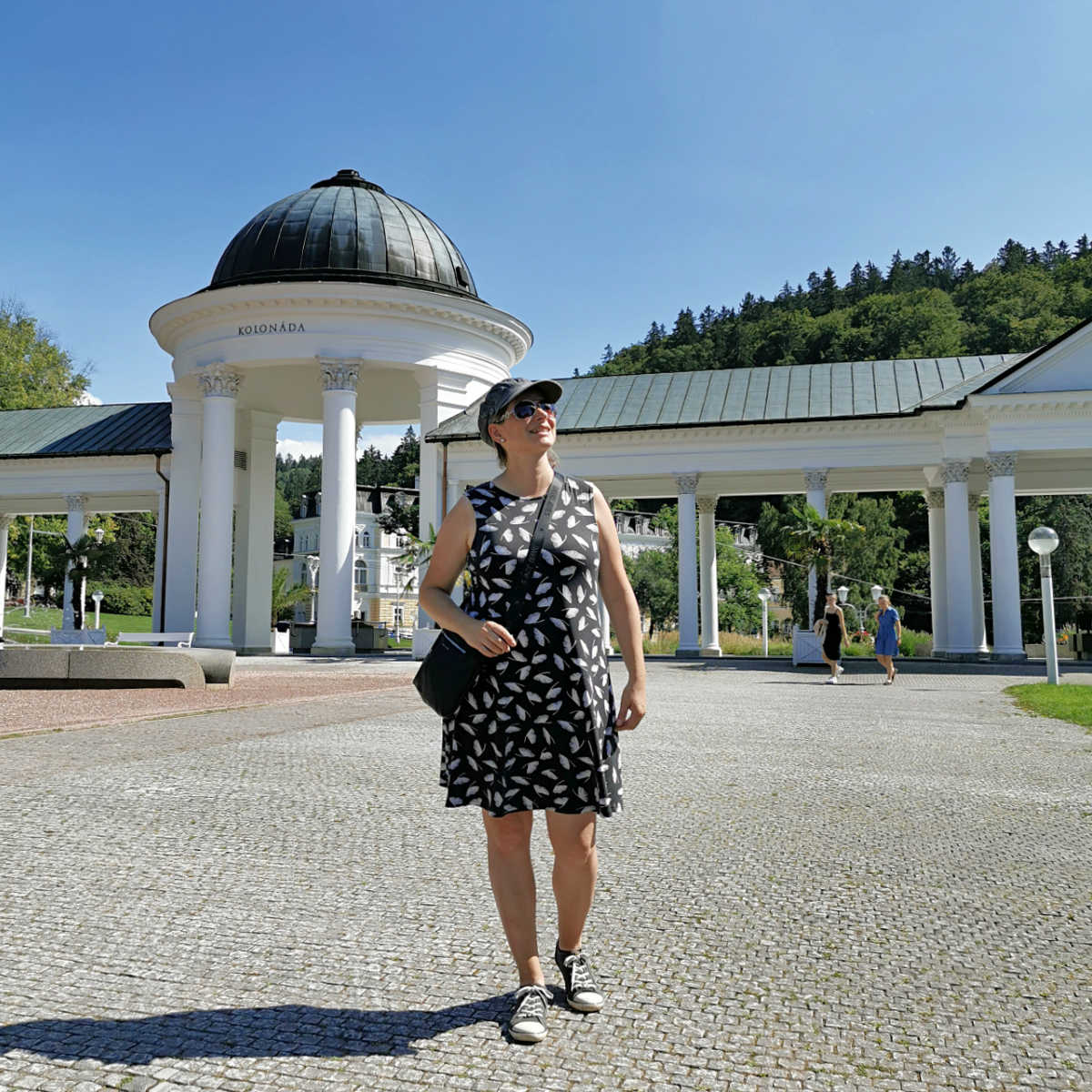
Mariánské Lázně is absolutely gorgeous and possibly even prettier than Karlovy Vary, though don’t tell anyone I said that. Whilst Karlovy Vary sprawls dramatically along a river valley, Mariánské Lázně was built on the side of forested hills, with manicured parks and gardens everywhere you look.
The town only really developed as a spa in the early 19th century (so it’s much younger than Karlovy Vary), but it quickly became the place for European royalty and celebrities. King Edward VII was a regular visitor, as were Franz Kafka and Mark Twain.
The main colonnade is the most beautiful yellow-and-white cast-iron, neo-baroque building that looks like a pretty wedding cake!
You’ll find the Singing Fountain here, which performs hourly musical shows with the water and light choreographed into the music. It’s quite charming, even if it sounds a bit touristy!
There are dozens of springs dotted around town, each with different mineral compositions, some are iron-rich (which taste particularly metallic), others heavy in magnesium. All are cold springs, which I was supper happy about, when I visited last time during a very hot summer.
What I also really like about Mariánské Lázně is how green and peaceful it feels. The town parks merge seamlessly with the surrounding forest and there are lovely walking trails heading out in every direction.
The town has managed to preserve that quiet atmosphere that spa towns are supposed to have. You won’t find as many crowds here as in Karlovy Vary, which is absolutely fine by me.
Make sure you also visit the Cathedral of the Assumption with its Byzantine-influenced design and the little pavilion protecting the Cross Spring, which is supposedly the coldest spring in the region.
The Goethe House museum is worth a look if you’re into literary history. He visited here several times and fell rather inconveniently in love with a local teenager when he was 74!
My local tip: The spa wafers that you see in all the spa towns are made mainly here (and in Luhacovice). I always pop in to the factory outlet shop (which is on the way to the train station) and stock up on these, as they make a really good gifts. Not only that, here you can get like 20 different flavours and the prices are also very reasonable.
How to get there from Prague:
- Direct train (Zapadni Expres or Ostravan) from Praha hlavní nádraží takes 2 hr 30 min (Bavorsky Expres takes slightly longer with one change in Plzen)
3. Františkovy Lázně
This is the smallest of the famous “spa triangle” towns, but it’s still a great destination for a longer day trip from Prague.
The spa tradition here goes back to 1793 and it’s one of the oldest purpose-built spa towns in Europe. The town has 24 mineral springs and also uses the local peat for treatments, apparently it’s particularly good for rheumatism.
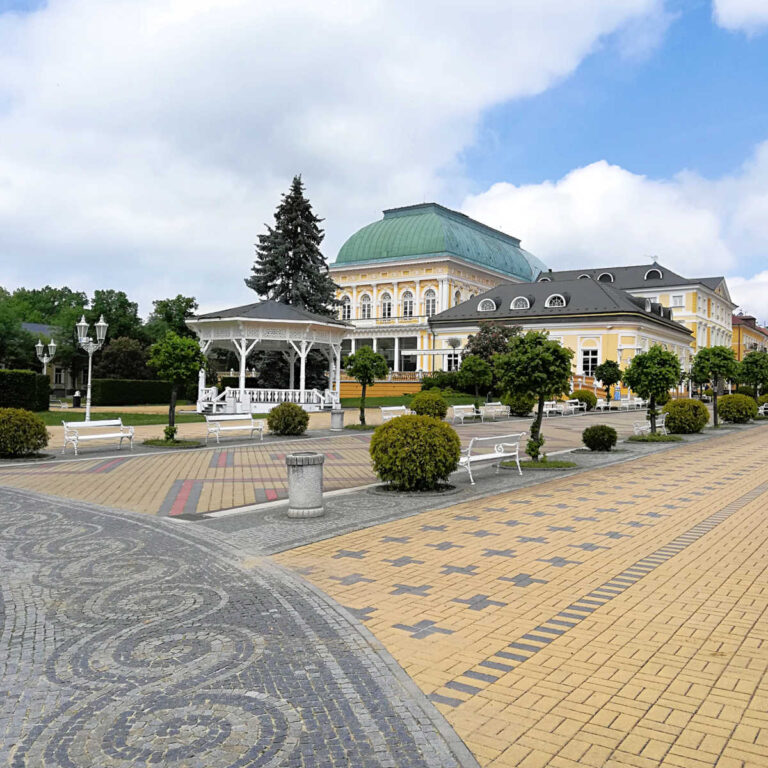
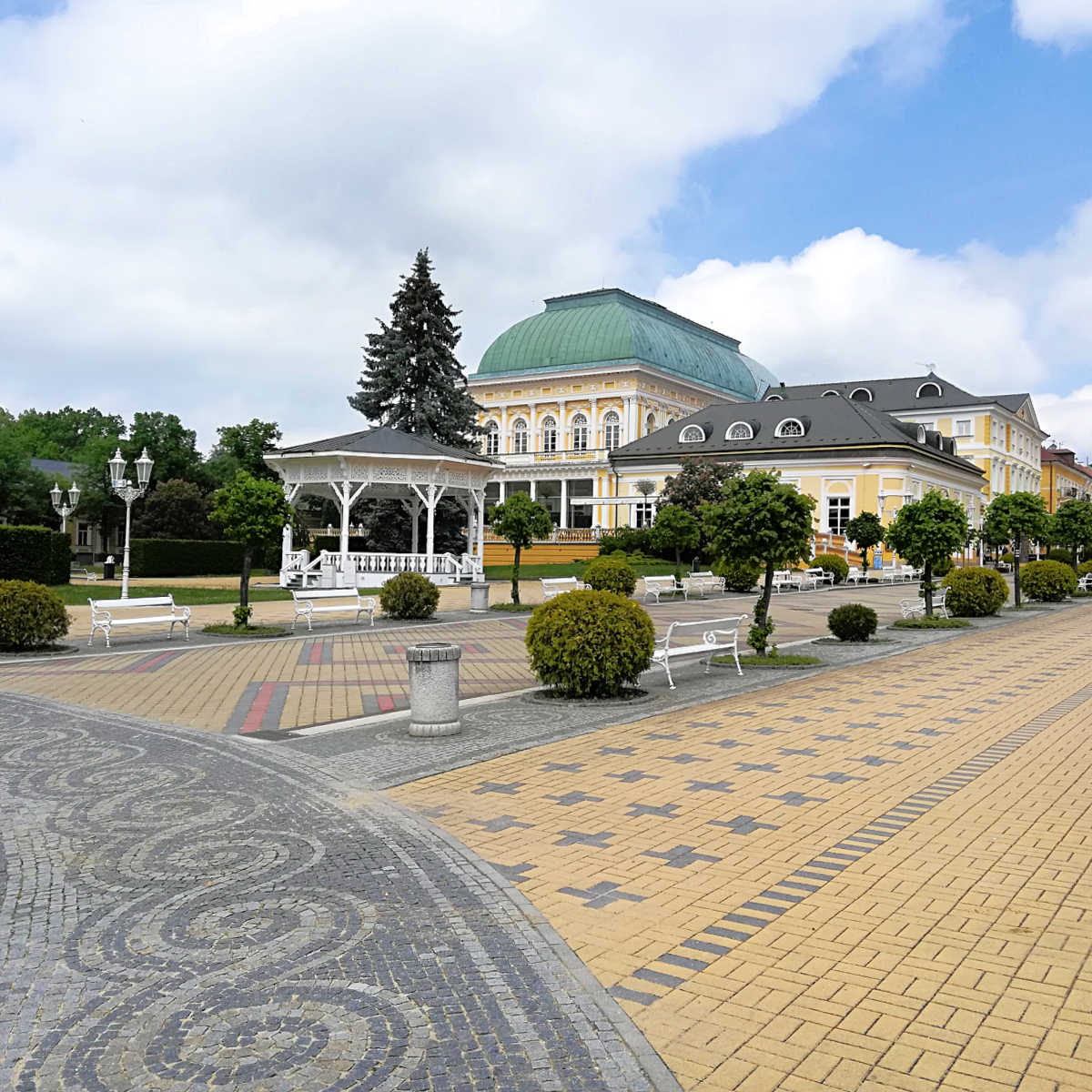
Františkovy Lázně (named after Emperor Franz I) has a wonderfully compact, grid-pattern layout that makes it easy to explore on foot. The whole town centre is essentially a neoclassical spa complex, painted in cheerful yellows and creams, with parks and gardens filling every available space.
What makes Františkovy Lázně different is its specialisation, it’s particularly known for gynaecological treatments and helping with fertility issues, which means you’ll see lots of statues and symbols related to this.
There’s a famous little bronze statue of Frantíšek (Little Francis) sitting on a globe, legend says that if women touch a specific part of the statue, it brings fertility. The statue is now quite polished from all the touching, I’ll leave you to guess which part!
Last time I visited, the whole place had this wonderfully calm, unhurried feeling. I also really enjoyed the local museum, which is dedicated to spa history in the area. I think, it really makes you see the whole town as it was in it’s heyday.
You’ll want to see the main Colonnade (much simpler than the others, but still charming), the peaceful Městské sady park with little lakes and flowerbeds and the Aquaforum – a modern spa complex that’s surprisingly well-integrated into the historic town.
The Church of the Exaltation of the Holy Cross has a beautiful Baroque organ if you can catch a concert.
My local tip: Frantiskovy Lazne is perfect for couples or anyone wanting a genuinely peaceful spa experience without too much fuss. Café Elefant on Národní třída does excellent traditional Czech cakes in a lovely old-fashioned setting.
How to get there from Prague:
- Direct bus from Prague Florenc takes 3 hrs 30 minutes
- Trains (Zapadni Expres) from Praha hlavní nádraží with one change in Cheb take just over 3 hrs
4. Poděbrady
I like Poděbrady because it feels like a real Czech town that happens to have a spa, rather than a spa town that’s been preserved for the sake of it. You can easily visit from Prague for the day, wander along the riverside, visit the castle, sample the waters and be back in time for dinner.
The spa waters here were only discovered in 1905 (quite recently compared to the others), when they were drilling for oil and found mineral springs instead. Rather a happy accident! The waters are rich in minerals and carbon dioxide and Poděbrady quickly developed as a spa town specialising in cardiovascular diseases.
The castle, originally built in the 13th century and reconstructed in Renaissance style has a local history museum about King George of Poděbrady (the “Hussite King”).
My local tip: Perfect for people who want a gentle introduction to Czech spa culture without travelling far from Prague. There are great easy to walk trails following the river Elbe in both directions ( you can easily walk into the next historic town Nymburk, which is only 8 km or 2 hrs far way and has good connections to Prague)
How to get there from Prague:
- Direct trains from Praha hlavní nádraží take 45 minutes (fast train) or 1 hr 15 min (regular train)
- Direct bus from Praha, Cerny Most take 1 hr 10 minutes

5. Třeboň
The best thing about visiting Třeboň is that it’s a lovely historic town that happens to have excellent spa facilities, rather than existing purely as a spa destination.
It’s in the middle of South Bohemia’s fish pond region, surrounded by literally hundreds of ponds and wetlands that stretch as far as you can see.
It’s a proper medieval town with gorgeous Renaissance houses and the spa tradition here is all about peat treatments. The surrounding wetlands have created vast peat deposits over thousands of years, and since the 1880s, people have been coming here to bathe in warm peat baths that are supposed to work wonders for joints, muscles and skin conditions.
The peat baths here are quite an experience – you’re essentially sitting in warm, dark brown mud that looks rather alarming but feels surprisingly pleasant. After twenty minutes soaking in peat, followed by a shower and a rest, your skin feels incredibly soft and your joints genuinely do feel looser.
The main spa facilities are at the Bertiny lázně and Aurora spa hotels, both of which have been modernised, but they have still kept their historic character.
You’ll want to explore the magnificent town square with Renaissance and Gothic buildings, visit Třeboň Château and walk around at least one of the surrounding fish ponds – the Svět pond right next to the town is the largest and has a pleasant walking path all the way around.
The town is also famous for carp fishing and beer brewing and the Regent brewery produces excellent beer that you’ll find in local restaurants.
My local tip: Perfect for people who want spa treatments combined with sightseeing and good food. It’s also brilliant for cyclists – the South Bohemian fish pond region has hundreds of kilometres of flat cycling paths. The Šupina restaurant on the square does exceptional fish dishes (this is carp country, after all) and has a lovely terrace.
How to get there from Prague:
- Direct fast train from Praha Hlavni Nadrazi (Silva Nortica Train or Luznice – 2 hrs) or one change in Veseli nad Luznici (2 hrs 20 min)
- Buses from Prague Roztyly ( or Na Knížecí or Florenc take up to 3 hours with change in České Budějovice

6. Teplice
Teplice claims to be the oldest spa town in the entire Czech Republic and possibly in all of Central Europe. There was a mention of healing springs at the beginning of 15th century in a local monastery founding document. That’s pretty impressive!
The town is in the valley between the Central Bohemian Highlands and the Krušné Mountains, not far from the German border, and it’s had a rather colourful history involving everyone from Goethe to Beethoven to Casanova (who apparently enjoyed the spa atmosphere for reasons beyond just the healing waters!).
The thermal springs here reach temperatures of up to 44°C and are particularly good for musculoskeletal problems.
I really enjoyed visiting Teplice, although from the moment I got of the train, I felt like this spa town has seen a better days. The train station is one of the most decorated ones I’ve seen in any local town and whilst all the buildings are amazingly grand, you can also see that they could do with a lick of paint.
And whilst Teplice is historic town and spa, it’s certainly not all polished up for tourists. Yes, there are beautiful spa buildings and parks, but this is also a working town with normal shops and locals going about their daily business.
The Castle Chateau, which is now a regional museum, has a beautiful landscaped gardens and there are lots of pretty spa buildings and hotels as you walk through the town.
The Botanical Garden is one of the oldest in Central Europe and has some really impressive tropical glasshouses. I also walked all the way to the star observatory and the Doubravska Hora – mountain with a fab views of local countryside, ruins of old Doubravka castle and small restaurant, perfect for cold drink or ice-cream after the hike.
My local tip: Teplice is much less touristy than other large spa towns, which also means better prices and fewer crowds. The nearby Bohemian Central Highlands are brilliant for hiking if you fancy combining spa relaxation with some countryside exploration.
How to get there from Prague:
- Direct bus from Prague Florec or Holesovice take 1 hr
- Direct train from Praha hlavní nádraží takes 1 hr 30 min
7. Lázně Kynžvart
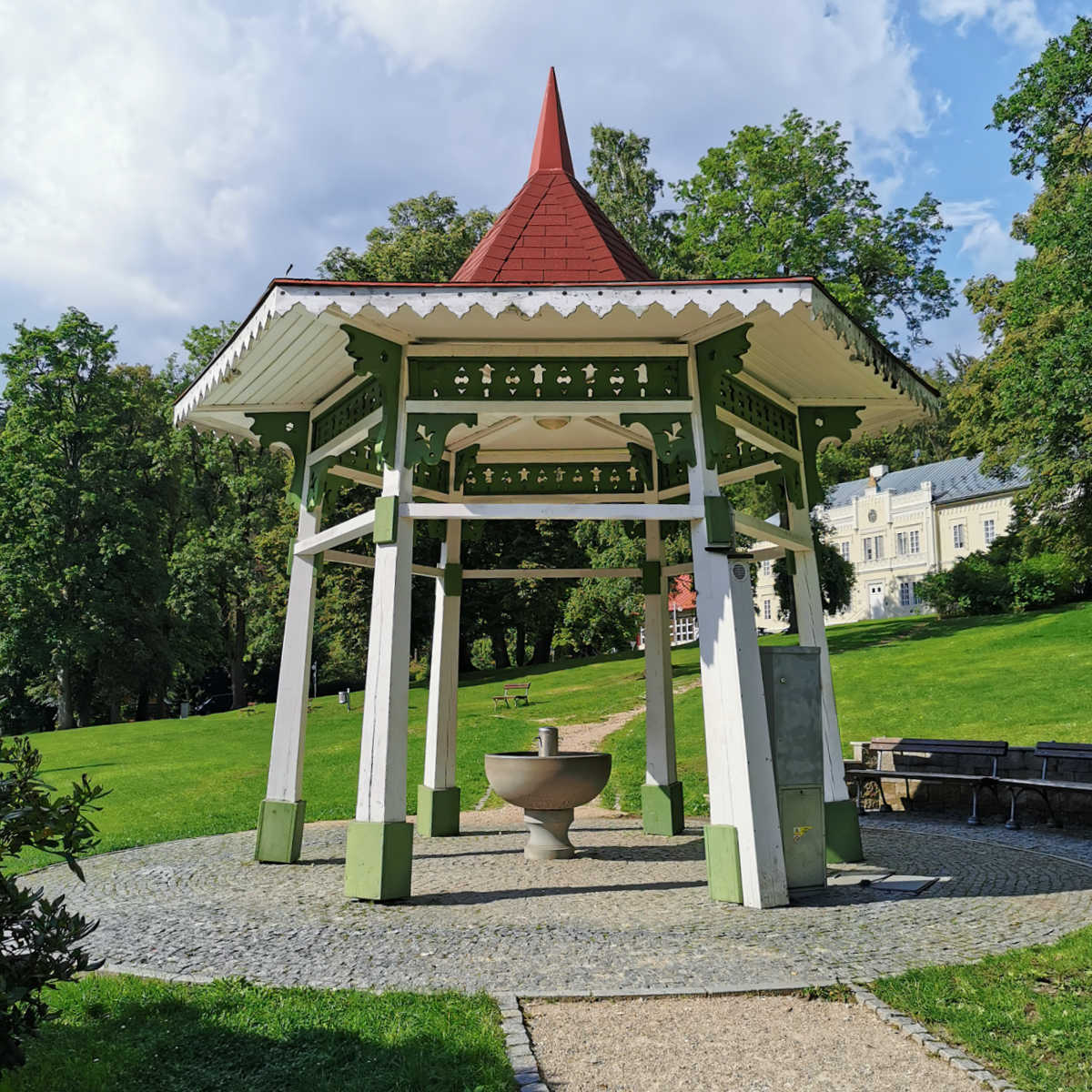
Lázně Kynžvart is probably not on most people’s list, but I think, that’s a shame. It’s a tiny spa village on the edge of Slavkovský Forest, not far from Mariánské Lázně.
There are only about 1,500 permanent residents and only a handful of spa buildings, but that’s precisely what makes it so special. The village developed as a children’s spa in the mid 19th century. It was founded by Prince Metternich (yes, the famous Austrian diplomat), who realised that the iron-rich springs on his estate are particularly effective for treating anaemia and respiratory problems in children.
The spa buildings are on the side of a hilly forest, so be prepared for a bit of a hike.
Since the spa area is so tiny, I combined my trip with visiting the Kynžvart Chateau, which is just outside the village. This neoclassical château was the summer residence of the Metternich family and has one of the most eccentric private collections you’ll ever see, everything from Egyptian mummies to a Turkish tent to peculiar curiosities from around the world.
From the chateau I walked to the spa through the castle’s English landscape park which stretches all the way to the village. Afterwards I took a little detour loop through the surrounding pine forests, because the air here is meant to be particularly beneficial for respiratory health.
My local tip: You can easily combine this with a visit to Mariánské Lázně, which is only about 10 kilometres away. The little café in the castle grounds has amazing homemade cakes. Don’t miss the Rudolf Spring in front of the main spa building (up in the hills) as this is one of the best drinking springs I’ve ever tasted (yes, one that you can actually drink!).
How to get there from Prague:
- Train from Praha Hlavni Nadrazi with change over in Marianske Lazne (or Plzen) and then local train or bus (total journey time about 3 hrs)
8. Luhačovice
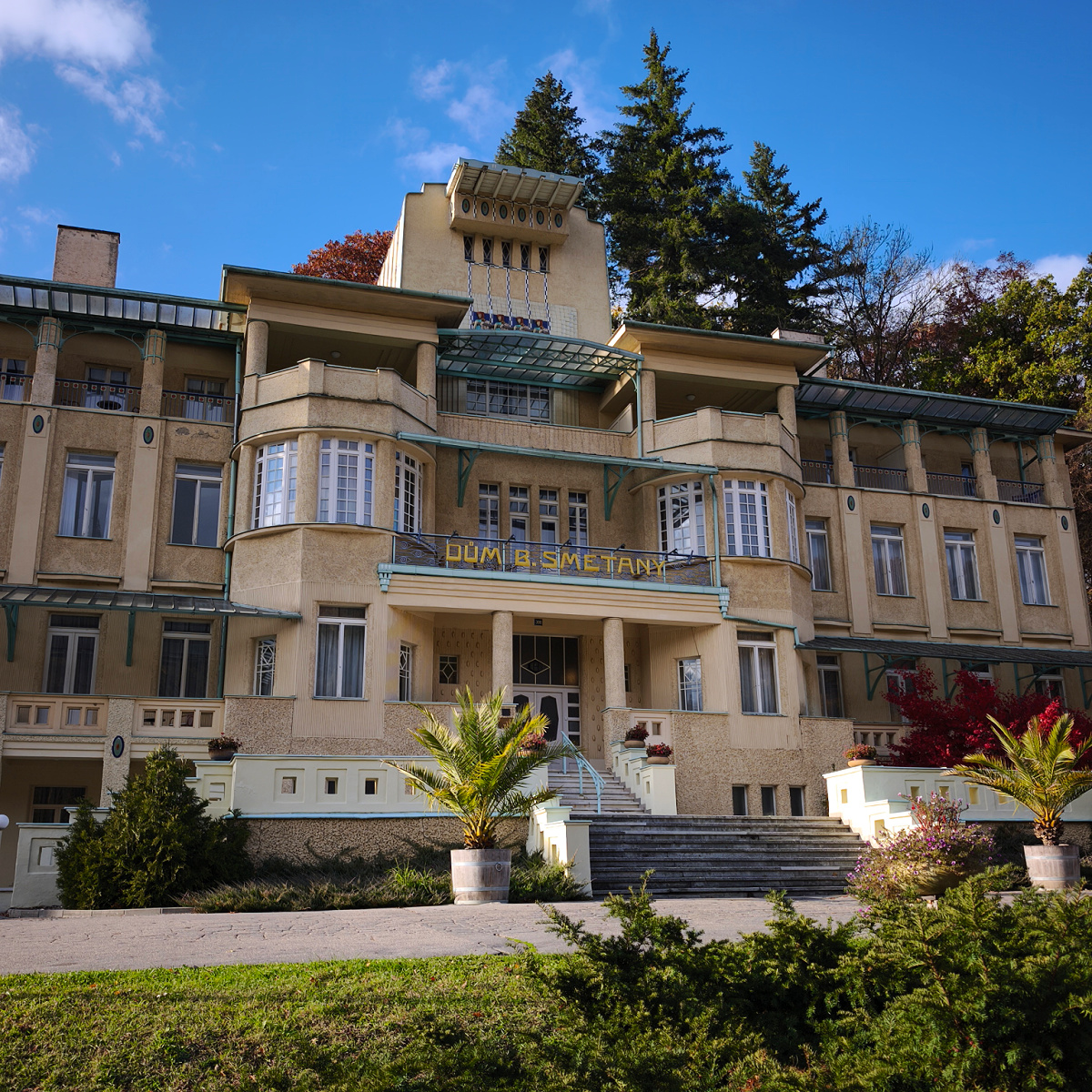
Luhačovice is in the Moravia and I think it’s worth visiting just for the unusual architecture and the surrounding countryside. You’ll find stunning folk-art-influenced buildings designed by the architect Dušan Jurkovič in the early 20th century here. Think wooden balconies with intricate carved decorations, fairy-tale towers and houses painted with folk motives.
The springs were discovered back in the 17th century, but it really developed as a spa in the early 20th century, when the railway arrived.
Luhačovice specialises in respiratory and digestive treatments and the mineral waters here have quite high carbon dioxide content, which makes them naturally fizzy. Honestly, drinking carbonated mineral water straight from the ground is a pretty cool experience!
I really enjoyed walking around admiring Jurkovič’s buildings – the Jurkovič House, the Sun Baths colonnade with wooden roof and the various spa hotels that look like from a folk fairy tale. There are lovely walking trails heading up into the woods, where you’ll find wooden sculptures and more natural spring.
There are 17 main springs around Luhacovice, but the most famous ones are Vincentka, Ottovka and Aloiska. You can even buy Vincentka in some shops around the Czech Republic and it’s actually quite nice to drink.
The main colonnade is rather modern as are a lot of the houses in the town, but the walk from the train station through the valley following the local Luhacovice stream is very pleasant. If you have the time, you can easily carry on walking until you reach the Luhacovice water reservoir on the top of the valley.
I’d also recommend that you try the local spa wafers, especially the ones made locally by Kare. They are sold in many shops around the town and are made in a small factory right in the town. They have quite a few different flavour, so there is plenty to choose from.
My local tip: This is perfect for architecture lovers and people who want something a bit more off the beaten path. This is the furthest of the major spa towns from Prague, so plan for a super long day trip or overnight stay. There are plenty of walking paths to make it worthwhile to stop for a couple of days.
How to get there from Prague:
- Direct fast train (Slovacky Expres) from Praha Hlavni Nadrazi to Luhačovice (4 hrs 20 minutes – no change needed), no direct bus (several options are available with 3 change overs and longer journey time)

9. Jeseník
Jesenik is quite a journey from Prague, but the town’s location in Jeseníky Mountains in northern Moravia is definitely worth the visit. I visited Jesenik as part of a hiking trip in local mountains, so I think it’s perfect if you want dramatic mountain scenery with your spa experience.
Jeseník is famous as the birthplace of hydrotherapy – a farmer’s son named Vincenz Priessnitz developed the “water cure” here in the 1820s and people came from all over Europe to try his cold-water treatments.
The fact that he had no medical training whatsoever and was considered a bit of a quack by the medical board makes the story even better. Turns out he was onto something, though!
The Priessnitz Spa still uses his original methods combined with modern treatments, this includes lots of cold wraps, mountain spring water baths and outdoor therapeutic exercises.
There are grand spa buildings (particularly the Priessnitz Spa complex, which is quite impressive) and the town also has a lovely central square with Gothic and Renaissance buildings, shops selling local cheese and traditional crafts, and hiking trails heading off in every direction. In winter, it’s a skiing destination, which gives it year-round life that some spa towns don’t have.
I also visited the building where Priessnitz originally treated patients, it used to be also his house and now it’s a museum about his life and methods. I vividly remember, that he advised ladies to go on a fast hike in the steep mountains as a part of their treatment and when it was raining, he brought them a wood planks to saw in their rooms as vigorous exercise instead!
My local tip: Perfect for active people who want to combine spa treatments with serious hiking or skiing. The spa treatments here are more about invigoration than pampering – if you want luxurious indulgence, go elsewhere.
How to get there from Prague:
- Trains from Praha hlavní nádraží to Jeseník (with change in Zabreh na Morave) take 4 hrs and then 10 minutes on a local bus from Jesenik train station (and town) up to the Jesenik spa. It’s only about 2 km, but quite steep hike, so there is also a local bus running every 30 minutes from the train station.
10. Lázně Bělohrad
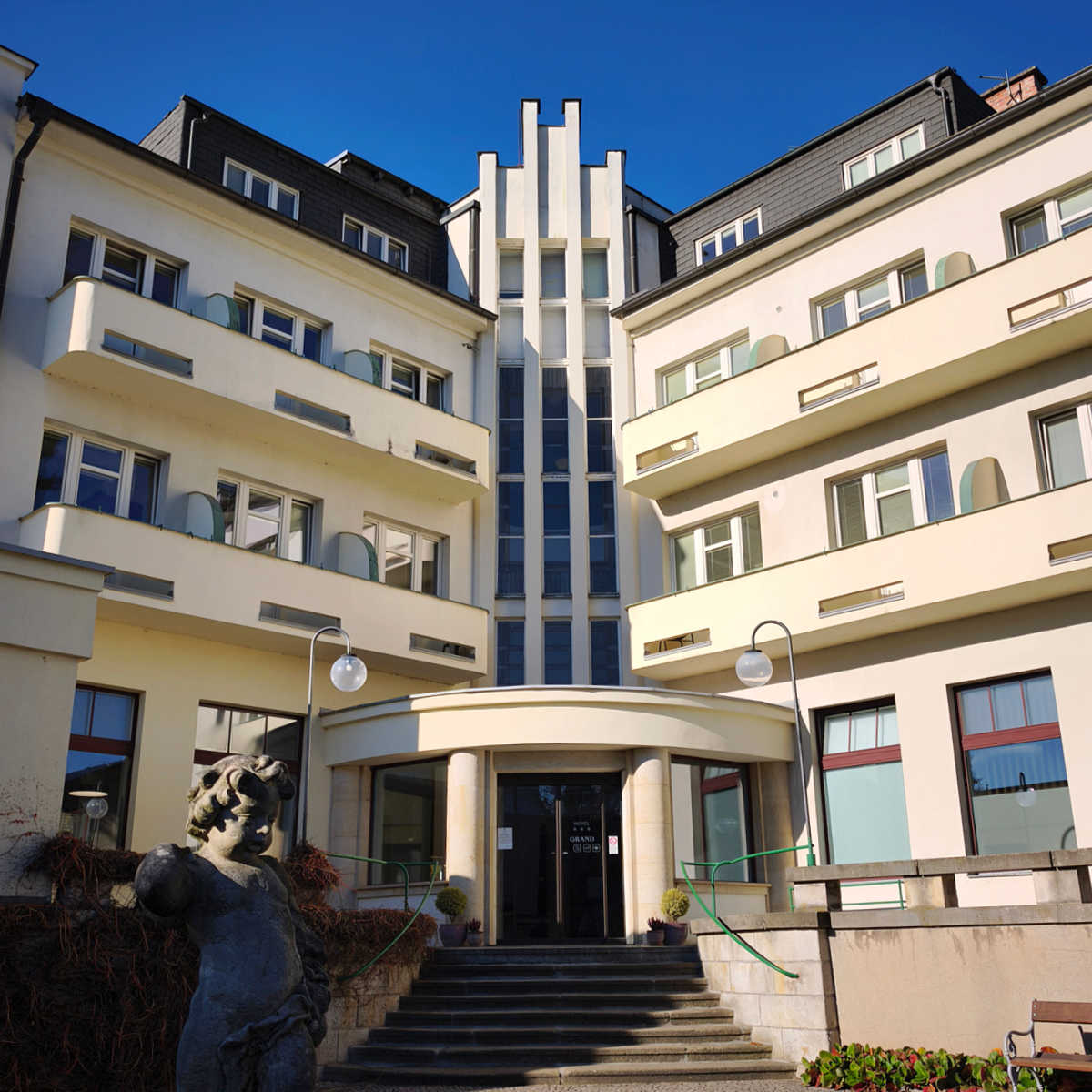
This is another small, unpretentious spa town that most foreign visitors have never heard of, which keeps it pleasantly quiet and authentically Czech.
Lázně Bělohrad is very close to the Bohemian Paradise region (Český ráj), which is one of my favourite parts of the country – all sandstone rock formations, pine forests and medieval castles perched on dramatic rocks. The historic town of Jičín is also just a short bus ride away and has a beautiful arcaded square.
The spa town itself developed in the mid-19th century around peat bogs and mineral springs, specialising in treating musculoskeletal and gynaecological conditions.
The town itself is modest, with pleasant park areas and functional spa buildings rather than architectural grandeur, but it has a friendly, welcoming atmosphere.
My local tip: Perfect for people who want to combine spa treatments with outdoor activities and exploring one of Czechia’s most beautiful regions.
How to get there from Prague:
- Fast train from Praha Hlavni Nadrazi (Krakonos or Hradecan) with one change in Chlumec nad Cidlinou
- Journey time 2 hours
11. Jáchymov
This is absolutely one of the most fascinating spa town in the entire country and I’m not exaggerating! Jáchymov’s history started as a 16th-century silver mining town. It was so wealthy it produced the first international currency, the Joachimsthaler, which is where the word “dollar” comes from.
But in 1906, the town become the world’s first radon spa and later had a rather dark period as a uranium mining centre with prison labour camps during the Communist era.
Jachymov spa specialises in radon water therapy, which sounds a bit dangerous, doesn’t it? But in very small, controlled doses, radon water baths are successfully used to treat joint and spine problems and the treatments is thought to be safe.
The radon comes naturally from the uranium-rich rocks in the surrounding Krušné Mountains (Ore Mountains) and Jáchymov’s discovery of these healing properties pioneered this type of treatment worldwide.
The spa buildings are scattered along the valley, connected by walking paths through the forest. It’s not as architecturally grand as Karlovy Vary or Mariánské Lázně, but there’s something rather special about its mountain setting.
You’ll want to visit the Royal Mint museum ( in a Renaissance building where those famous dollar coins were made), walk the educational trail about the mining history and if you’re feeling brave, you can actually visit a former mine shaft called ‘Shaft no. 1’ or ‘Astoria’
The modern spa facilities are primarily medical rather than tourist-oriented, but the Radium Palace and Běhounek spa hotels have beautiful historical interiors. The views from the hiking trails above the town are magnificent, you can see right across to Germany on clear days.
My local tip: This spa town is brilliant for hikers – the Krušné Mountains have excellent trails. The town of Boží Dar, the highest town in Central Europe, is nearby and worth a visit. You can also walk to Ostrov town following the dismantled railway track, which has been turned into a cycling and walking path.
How to get there from Prague:
- Buses from Prague Florenc to Karlovy Vary, then change to a local bus to Jáchymov
- Total journey time: approximately 2 hrs 20 min – 3 hrs max
12. Lázně Libverda
Lázně Libverda is hidden deep in the Jizera Mountains in northern Bohemia and it’s remained wonderfully unspoilt precisely because it’s a bit off the beaten path. The village is tiny, just a cluster of 19th-century spa buildings in a narrow valley surrounded by forest.
The spa was founded in 1906 by the same noble family that built the beautiful Clam- Gallas Palace in Prague and specialises in treating cardiovascular and nervous system conditions using the local iron-rich mineral springs.
But honestly, the real therapy here is just the setting itself, the clean mountain air and the green forest all around you. The main spa building, also called the Clam-Gallas Palace is this rather grand yellow neo-classical structure that looks almost comically oversized for such a tiny village, which just adds to the charm.
The surrounding Jizera Mountains have brilliant hiking and cycling trails and you’re very close to the historic Liberec town.
There’s not a huge amount to “do” here in terms of sightseeing, but the nearby town of Hejnice has a beautiful baroque monastery that’s worth visiting if you want a bit of culture.
My local tip: This is absolutely perfect for people who want complete escape and tranquillity. If you’re looking for nightlife or shopping, you’ll be disappointed. If you want to read books, take gentle walks, and reset your nervous system, it’s ideal.
How to get there from Prague:
- Bus journey involves two changes – first from Prague to Liberec (from Florenc or Černý Most stations), then to Raspenava and finally to Lazne Libverda (total time just under 3 hrs)
This blog post was originally written on 11 November 2026 and last updated on 11 November 2026